
Insights · Naples and Collier County
Is Bonita Springs, Estero or Fort Myers tap water different for a new pool finish than Collier's?
North of the Collier County line, the water that fills a pool comes from a different plant, and in Fort Myers from a different aquifer. Bonita Springs, Estero and Fort Myers each sit on their own utility, and each utility publishes a different amount about what comes out of the tap. This post sets what those utilities print beside what Collier County and the City of Naples print, says plainly where a number does not exist, and ends where every address ends: with a test kit rather than a report.
 Clayton Waggoner, Owner and Managing Member, Florida license CPC1461352 · Published November 1, 2026 · 16 min read
Fill water is the water that goes into a pool after a new interior finish is installed, usually from a hose on the house supply. For a cement-based finish it matters because the National Plasterers Council recommends fill water above 200 ppm calcium hardness (National Plasterers Council, 2025)10 and says not to use soft water or reverse osmosis water to fill a pool (National Plasterers Council, 2025)11. The utility decides what the hose carries.
The short version
Is Bonita Springs, Estero or Fort Myers tap water different for a new pool finish than Collier's?
This post was built from the utilities' own documents. Bonita Springs Utilities' 2025 report and its water quality FAQ were read in a browser (Bonita Springs Utilities, 2025)1. The City of Fort Myers' 2025 report was read page by page (City of Fort Myers, 2025)3. Lee County Utilities' 2025 report could not be read, so everything said about that system comes from the federal drinking water registry (U.S. EPA, 2026)6.
The record splits three ways. Bonita Springs Utilities prints no hardness row but answers the question in a FAQ, in one sentence quoted below (Bonita Springs Utilities, retrieved 2026)2. Fort Myers prints no hardness, pH, alkalinity or calcium (City of Fort Myers, 2025)3. This post does not rank the supplies by hardness, because a measured average and a stated ceiling are not the same kind of number.
Two of the three Lee-side utilities run reverse osmosis on some or all of their supply (Bonita Springs Utilities, 2025)1 (City of Fort Myers, 2025)3, and the National Plasterers Council says not to fill a pool with soft water or reverse osmosis water (National Plasterers Council, 2025)11. That is why the answer at every Lee County address is the one the Collier County tap water post arrives at: test the hose before the fill starts.
South of Naples the same question has its own answer. Marco Island tap water and a new pool finish covers the island's blended supply.
Which utility fills your pool, by address?
Estero is the address most likely to be guessed wrong. The Village's own utilities page states that Lee County Utilities provides water to properties north of Williams Road and Bonita Springs Utilities provides water to properties south of Williams Road (Village of Estero, 2026)5. Two houses with the same street name can be filling from two different plants. The water bill settles it in a minute.
Bonita Springs Utilities' 2025 report says it has grown along with the City of Bonita Springs and the Village of Estero and now serves a population of approximately 75,000 (Bonita Springs Utilities, 2025)1. The City of Fort Myers runs its own plant, with 16 wells in the Floridan Aquifer approximately 800 feet deep (City of Fort Myers, 2026)4. A Fort Myers address can be on the city's system or on Lee County Utilities, and the bill says which.
EPA records Lee County Utilities as a single consolidated community system with a Fort Myers address, serving about 282,000 people through 95,339 service connections (U.S. EPA, 2026)6. If the pool is in Collier, the pool resurfacing page covers how a resurfacing runs from drain to start-up. The same sequence applies north of the line, with the fill tested for the utility at that address.
| Address area | Utility | Report read for this post |
|---|---|---|
| City of Bonita Springs | Bonita Springs Utilities, Inc. | Annual Drinking Water Quality Report for 2025, read in a browser (Bonita Springs Utilities, 2025)1; water quality FAQ (Bonita Springs Utilities, retrieved 2026)2 |
| Estero south of Williams Road | Bonita Springs Utilities, Inc. (Village of Estero, 2026)5 | Same report and FAQ (Bonita Springs Utilities, 2025)1 |
| Estero north of Williams Road | Lee County Utilities (Village of Estero, 2026)5 | Report not readable; EPA registry only (U.S. EPA, 2026)6 |
| City of Fort Myers | City of Fort Myers Utilities | Annual Water Quality Reports for 2025 and 2024, read page by page (City of Fort Myers, 2025)3 (City of Fort Myers, 2024)15 |
| Unincorporated Lee County | Lee County Utilities or another supplier; the water bill names it | Report not readable; EPA registry only (U.S. EPA, 2026)6 |
What does each utility say its water is?
The Bonita Springs report is specific about the blend. It says the drinking water is a blend of two treatment processes, that the lime-softening process includes hydrogen sulfide removal, hardness reduction, filtration and chlorination, that the reverse-osmosis process includes membrane treatment, degasification and chlorination, and that each process includes a corrosion inhibitor (Bonita Springs Utilities, 2025)1. The blend ratio delivered to any one street is not printed.
Fort Myers describes one process: groundwater from the Lower Hawthorn Floridan Aquifer, reverse osmosis to purify brackish water, chlorine bleach, and phosphate for corrosion control (City of Fort Myers, 2025)3. The plant page adds 2,688 low pressure membrane elements and degasifiers that remove mainly hydrogen sulfide (City of Fort Myers, 2026)4.
Lee County Utilities is the gap. EPA's facility list names eight treatment plants, two with R.O. in the name and one with Lime in the name, plus a surface water intake at Olga and 167 active groundwater wells (U.S. EPA, 2026)14. Which plant serves Estero is not in any source this post could read.
Collier's two reporting utilities sit in the table for scale (Collier County Water-Sewer District, 2024)7 (City of Naples Utilities Division, 2024)8. On the UF/IFAS household scale, where moderately hard is 50 to 120 ppm or 3 to 7 grains per gallon, both 67 mg/L averages fall in that band (UF/IFAS Extension, 2025)9.
| Utility | Source water | Treatment | Disinfectant and level | Sodium | Hardness as printed |
|---|---|---|---|---|---|
| Collier County Water-Sewer District | Hawthorn and Golden Gate Tamiami wellfields (Collier County Water-Sewer District, 2024)7 | North Plant nanofiltration and reverse osmosis; South Plant lime softening and reverse osmosis7 | Chloramines, 3.4 ppm average, 1.6 to 4.1 (Collier County Water-Sewer District, 2024)7 | 57.8 ppm (Collier County Water-Sewer District, 2024)7 | 67 mg/L average, 42 to 94 mg/L (Collier County Water-Sewer District, 2024)7 |
| City of Naples Utilities Division | Lower Tamiami Aquifer, 51 wells (City of Naples Utilities Division, 2024)8 | Lime softening and filtration8 | Chloramines, 2.97 ppm average, 0.40 to 4.70 (City of Naples Utilities Division, 2024)8 | 32.9 ppm (City of Naples Utilities Division, 2024)8 | 67 mg/L average, 58 to 102 mg/L (City of Naples Utilities Division, 2024)8 |
| Bonita Springs Utilities, Inc. | Lower Tamiami Aquifer, nineteen wells about 100 feet deep, and Upper Floridan Aquifer, thirty wells 800 to 1,000 feet deep (Bonita Springs Utilities, 2025)1 | Blend of lime softening and reverse osmosis, corrosion inhibitor1 | Monochloramine (Bonita Springs Utilities, retrieved 2026)2; chlorine and chloramines 3.44 ppm average, 0.6 to 4.9 (Bonita Springs Utilities, 2025)1 | 83.1 ppm (Bonita Springs Utilities, 2025)1 | No row in the report1; FAQ: "The average hardness is less than 100 mg/L." (Bonita Springs Utilities, retrieved 2026)2 |
| City of Fort Myers Utilities | Lower Hawthorn Floridan Aquifer, 16 wells about 800 feet deep (City of Fort Myers, 2026)4 | Reverse osmosis, degasifiers, stabilization, phosphate3 | Chlorine (chlorine bleach), 1.99 ppm level, 0.41 to 3.1 (City of Fort Myers, 2025)3 | 114 ppm (City of Fort Myers, 2025)3 | Not published3 |
| Lee County Utilities | Surface water intake at Olga plus 167 active groundwater wells across a consolidated system (U.S. EPA, 2026)14 | Eight plants, two named R.O. and one named Lime; blend by area not published14 | Not published in any source read | Not published in any source read | Not published in any source read |
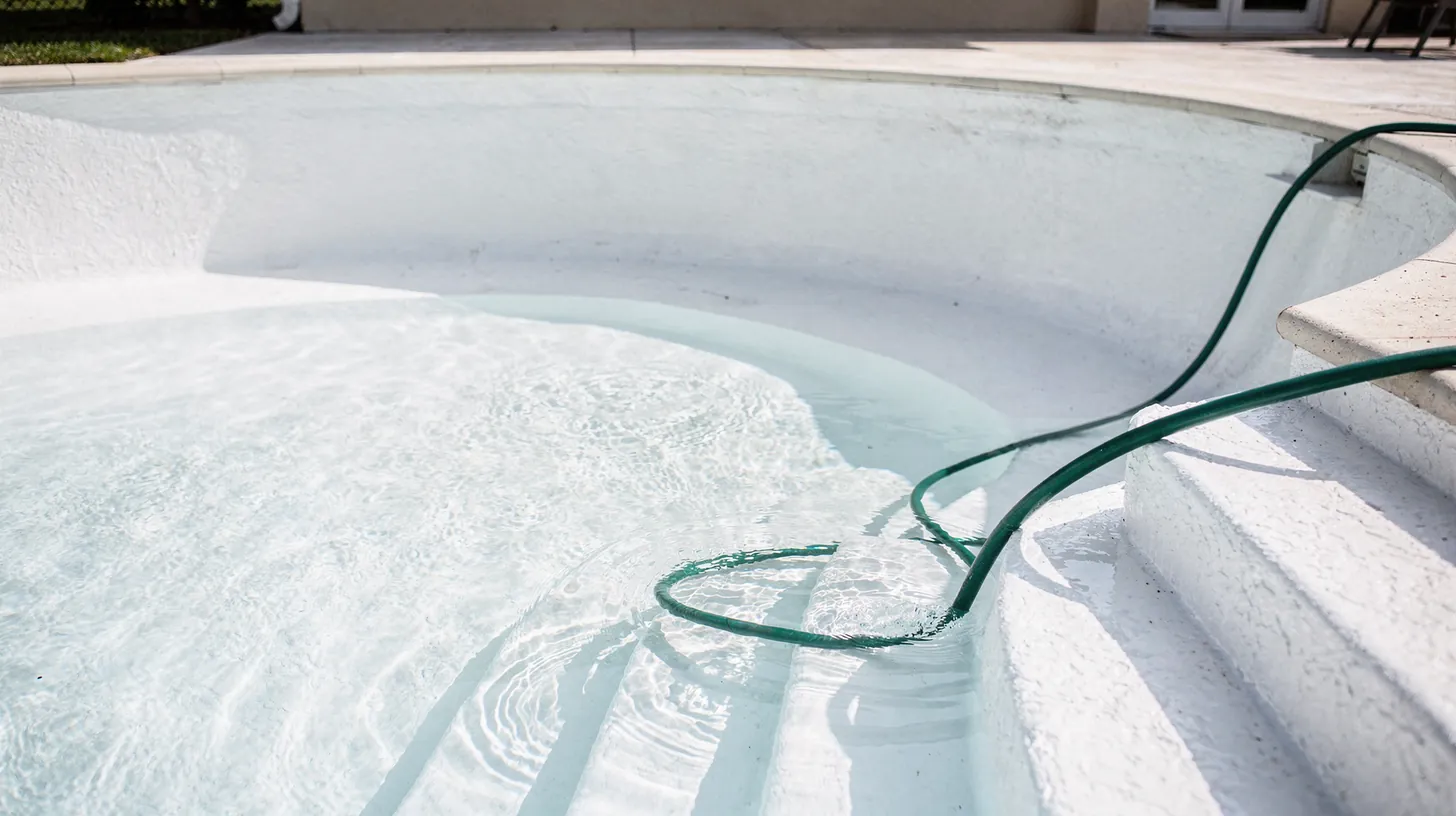
What does reverse osmosis water do to a new pool finish?
Reverse osmosis is membrane treatment, the step both utilities name for turning brackish aquifer water into drinking water (Bonita Springs Utilities, 2025)1 (City of Fort Myers, 2025)3. For filling a pool, the Council puts reverse osmosis water in the same sentence as soft water and says to use neither (National Plasterers Council, 2025)11.
The Council's white paper explains the mechanism. A new cement finish holds an excess of calcium hydroxide that migrates into the water as it cures, and that release is normal and not deleterious to the finish (National Plasterers Council, 2025)10. If soft water or water with low calcium hardness is in contact with the finish early on, it can leach calcium hydroxide from the upper surface beyond that excess, which can damage or weaken the cement binder at the surface (National Plasterers Council, 2025)10.
Bonita Springs Utilities' FAQ says "The average hardness is less than 100 mg/L." (Bonita Springs Utilities, retrieved 2026)2, a ceiling that sits below the 200 ppm fill-water floor the Council recommends (National Plasterers Council, 2025)10. Fort Myers prints no hardness at all (City of Fort Myers, 2025)3. The day-by-day calcium steps are in the first 30 days after a pool is resurfaced, and the same mechanism on Collier water is in why Collier County tap water is hard on a new plaster finish.
Does chloramine or free chlorine in the fill water matter?
Bonita Springs Utilities explains its choice in its FAQ: monochloramine uses both chlorine and ammonia, and it prevents chlorine from reacting with certain organic material that occurs naturally in almost all ground water (Bonita Springs Utilities, retrieved 2026)2. Collier County states its water is treated with chloramines, at a 3.4 ppm average in 2024 (Collier County Water-Sewer District, 2024)7, and the City of Naples reported chloramines at 2.97 ppm (City of Naples Utilities Division, 2024)8.
Fort Myers is the exception. Its report says the purified water is treated with chlorine bleach, and its table lists chlorine, not chloramines, at a 1.99 ppm level across 2025 (City of Fort Myers, 2025)3. A Fort Myers city fill arrives with free chlorine; a Bonita Springs, south Estero or Collier fill arrives with combined chlorine. Lee County Utilities' disinfectant is not published in any source this post could read.
The start-up card says what to do either way: DO NOT add chlorine for 48 hours, then on Day 3 add pre-diluted chlorine or liquid chlorine to a 1.5 ppm to 3.0 ppm level (National Plasterers Council, 2021)13. The utility's residual arrives on its own, so a total chlorine reading in the first two days is the utility's number, not sanitizer you put in. This post makes no claim that chloramine harms a finish, because none of the documents read for it says so.
What about sodium, color and metals?
Sodium first. Fort Myers lists sodium at 114 ppm in 2025, with the likely source given as saltwater intrusion and leaching from soil, against a 160 ppm maximum contaminant level (City of Fort Myers, 2025)3. Bonita Springs Utilities lists 83.1 ppm against the same 160 (Bonita Springs Utilities, 2025)1. Neither report says anything about pools, and this post draws no conclusion about a finish from a sodium figure.
Color is a question Bonita Springs Utilities answers directly. Its FAQ says most water from its source wells contains trace amounts of organic material that occurs naturally, that it tends to impart a yellow/green to green color when rainfall percolates through the ground into the water table, and that the color is most noticeable in large volumes with a light-colored background such as buckets, bathtubs or pools (Bonita Springs Utilities, retrieved 2026)2. A tint in a fresh fill over a white finish can be the source water, not the finish.
Metals are the third test. The Council's bulletin lists three ways fill water goes wrong: deterioration from low pH, low calcium hardness or low alkalinity; mineral salt scale from high pH, high calcium hardness or high alkalinity; and metal staining from elevated dissolved metals, most commonly copper, iron and sometimes manganese (National Plasterers Council, 2019)12. The well water post covers private wells, and the staining post covers what stains here usually are.
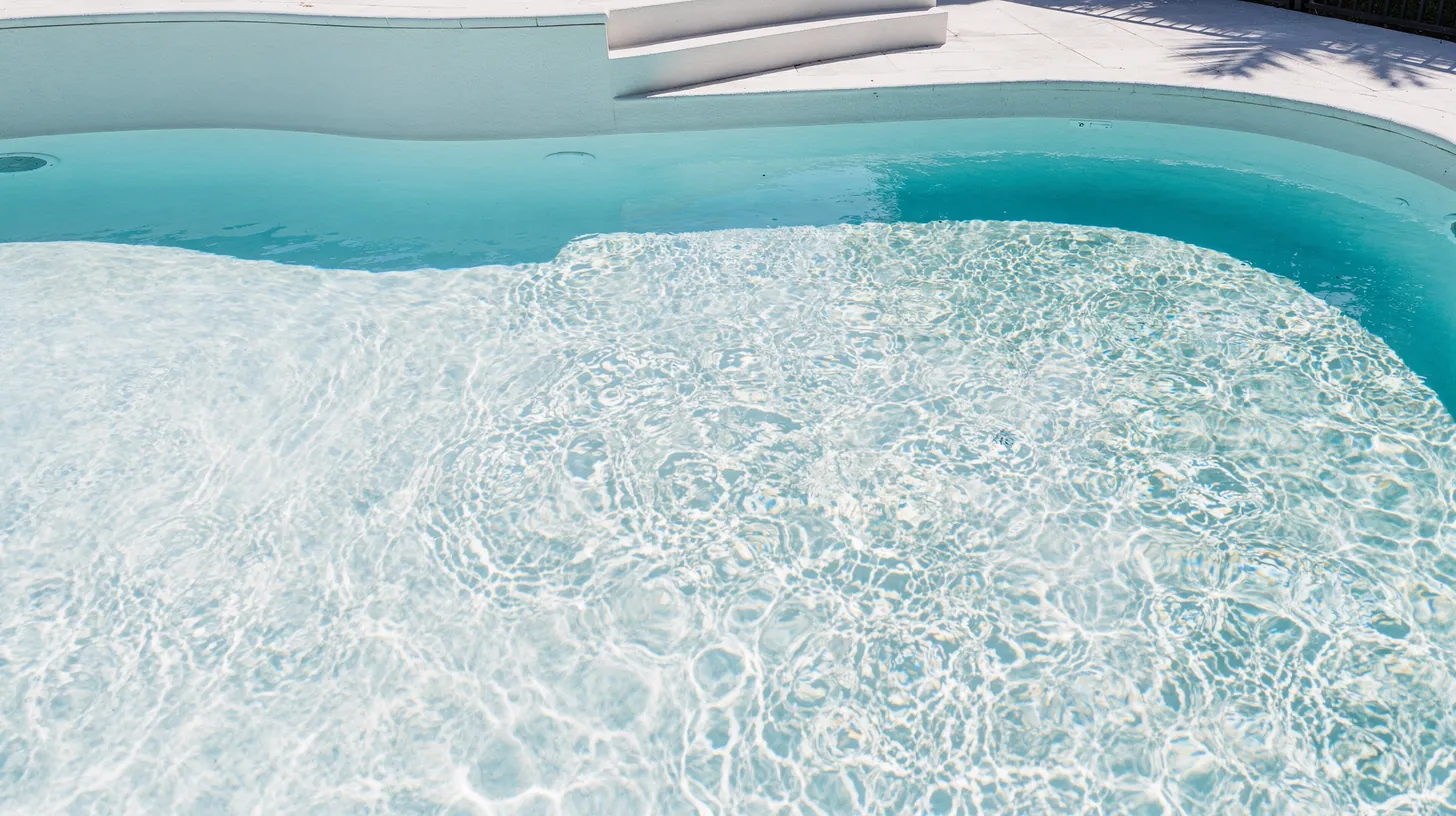
What should a Lee County fill look like, step by step?
Step one is a sample from the hose bib that will fill the pool, tested for pH, total alkalinity, calcium hardness and metals, with the results recorded (National Plasterers Council, 2021)13. At a Lee County address this is the step that stands in for the hardness row the utility does not print.
Step two is the fill. The card says to place a clean cloth on the end of the hose, position it in the deepest area of the pool, and fill to the middle of the skimmer without interruption as rapidly as possible with clean potable water, to help prevent a bowl ring and decrease shrinkage cracking (National Plasterers Council, 2021)13.
Step three is the Day 1 order: high alkalinity down to 80 ppm to 100 ppm or low alkalinity up to 80 ppm, then pH to 7.2 to 7.6, then low calcium hardness up to 80 ppm to 100 ppm in dissolved 10 pound increments separated by several hours, never together with alkalinity increaser (National Plasterers Council, 2021)13. Day 2 raises calcium hardness to 100 ppm to 150 ppm and Day 4 to a minimum of 200 ppm (National Plasterers Council, 2021)13.
Step four is deciding who does all of that before the hose goes in. The Council says the water is typically started by the plastering company and that the party performing the initial start-up should be determined in advance (National Plasterers Council, 2025)11. On a fill that may arrive under the Council's floor, that decision is not paperwork.
What should you ask a contractor working north of the county line?
The first question has a yes or no answer. The Council's bulletin says plasterers, builders, service companies and start-up persons should make pre-testing of the source water a mandatory requirement in their business practices (National Plasterers Council, 2019)12. A contractor who tests will have a number from the last fill. One who does not will have an opinion.
The second sounds trivial and is not. In Estero the utility changes at Williams Road (Village of Estero, 2026)5. In Bonita Springs the report has no hardness row (Bonita Springs Utilities, 2025)1. In Fort Myers the city's report prints no hardness (City of Fort Myers, 2025)3. The right answer names the utility and then says: we test.
The third and fourth are one conversation. If the sample comes back low, the start-up card's calcium steps are the plan, and the Council's floor of 200 ppm is the target (National Plasterers Council, 2025)10. Whoever owns that plan for the first 28 days, the window the card calls especially susceptible to staining, scaling and discoloration (National Plasterers Council, 2021)13, should be named before the pool is drained. The start-up post sets out that month in full.
Ask Clayton
Questions this article usually prompts
Tap a question. Clayton replies himself, here and on the phone.
Tap a question to ask
If this is the situation you are in
Pool resurfacing in Naples, including the part everyone skips →Pool remodeling in Naples, handled as one project →Pool repair in Naples, diagnosed before it is quoted →Spa remodels and new attached spas in Naples →References
- Bonita Springs Utilities, Inc., 2025 Annual Drinking Water Quality Report
- Bonita Springs Utilities, Inc., Common Water Quality Questions (hardness, monochloramine and color answers), retrieved 1 November 2026
- City of Fort Myers, Annual Water Quality Report, Reporting Year 2025, PWS ID 5360102
- City of Fort Myers, Water Treatment Plant page, content dated 1 April 2026
- Village of Estero, Utilities: Power, Water, Garbage, Telecom (Williams Road statement), retrieved 1 November 2026
- U.S. Environmental Protection Agency, Envirofacts SDWIS, water system record for Lee County Utilities (FL5364048), as served 1 November 2026
- Collier County Water-Sewer District, Annual Water Quality Report, 2024 data year, report dated 23 May 2025
- City of Naples Utilities Division, Consumer Confidence Report, 2024 data year
- University of Florida IFAS Extension, SL219/SS440 (Mylavarapu), Irrigation and Household Water Test and Interpretation, reviewed August 2025
- National Plasterers Council, White Paper 7: Avoiding Soft Water or Water with a Low Calcium Hardness (2025)
- National Plasterers Council, White Paper 6: Tips on Filling the Pool and Initial Start Up (2025)
- National Plasterers Council, Technical Bulletin #1: Testing Fill Water, revised January 2019
- National Plasterers Council, NPC Pool Start-up Card, REV 03-2021
- U.S. Environmental Protection Agency, Envirofacts SDWIS, water system facility records for Lee County Utilities (FL5364048), as served 1 November 2026
- City of Fort Myers, Annual Water Quality Report, Reporting Year 2024, PWS ID 5360102

The article is general.
Your pool is specific.
Tell us what the pool is doing, a sentence or two is enough. The person who wrote this is the person who calls back.