

The complete guide
Pool leak detection in Naples, with a finding before a shovel
A leak on a canal lot rarely shows itself. The ground takes the water, nothing goes soggy, and the first sign is the bill or the auto-fill running more than it used to.
Why this guide exists
What pool leak detection actually involves
Pool leak detection is the process of confirming a pool is losing water beyond evaporation and locating where. It uses pressure testing of the plumbing lines and dye testing of the shell and fittings to isolate the source before any excavation. Splash Pools LLC is a Naples, Florida pool contractor owned by Clayton Waggoner, serving Naples, Collier County, Marco Island, Bonita Springs and Estero.
Sound familiar?
How a Naples leak usually announces itself
The bill, not the waterline
The water bill jumped, the utility says nothing changed, and the deck and yard look completely dry. The pool is the only variable left.
A valve hissing at eleven at night
A healthy pool takes an occasional top-up. A pool with a problem is fed constantly, and owners usually notice it in the dark.
A patch of lawn that never dries
Greener grass over the pipe run than around it, or a soft spot near the equipment pad that stays wet when nothing else is.
A crack that came back
It was patched, it looked fixed, and it parted again on its own schedule. Near the water table that is pressure, not workmanship.
Part one
Is it actually a leak, or just Florida evaporation?
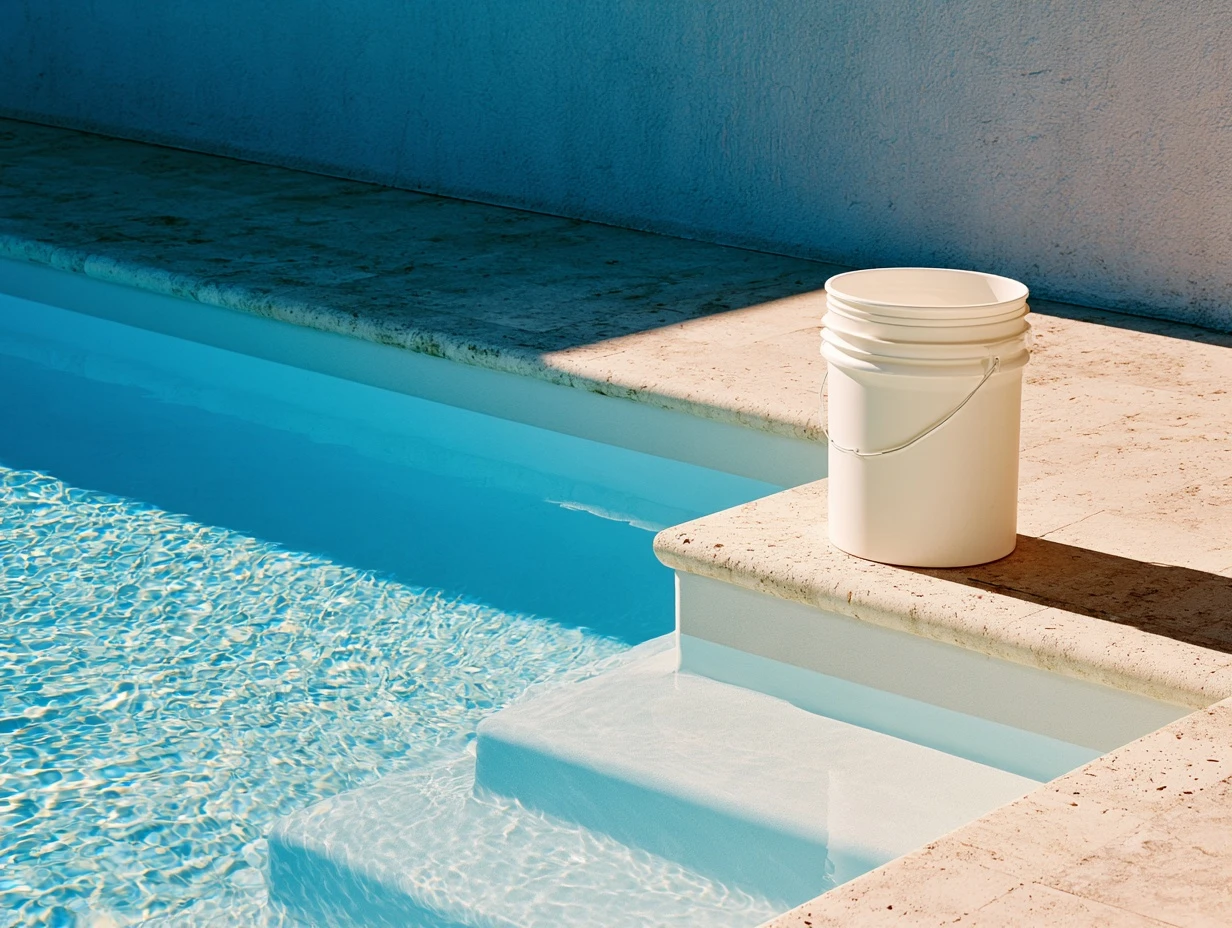
There is no one number, and any page that gives you one is repeating a rule nobody measured. What evaporation can honestly take runs about 0.095 inches a day in December to about 0.184 inches a day in May (SFWMD, 2010), and an unscreened pool in heat and wind sits at the top of that. The bucket test separates the two in 24 hours and costs nothing, and it turns a suspicion into a measurement.
Evaporation here is real and it is not small. Summer sun, the Gulf breeze and warm water working together will take a visible amount of water off an unscreened pool every day, and a heated spa spilling over into the pool loses more still. A screen cage knocks the rate down because it cuts the wind, which is why the same size pool can behave very differently two streets apart.
The reason the question matters is scale. A quarter inch a day off a typical Naples pool is somewhere around seventy gallons, and that is already more than any month's modeled average (SFWMD, 2010). Half an inch a day is roughly double that, and well past anything weather explains. This is how a leak most often announces itself: the water bill jumps, the utility says nothing changed on their end, and the deck and yard look completely dry. The pool is the only variable left, and the bill is doing the measuring that the waterline is hiding.
You do not have to guess which side of the threshold you are on, and you do not have to pay anyone to find out. The bucket test below settles it in a day.
Naples note: a screen cage cuts the wind, which is why the same size pool can behave very differently two streets apart.
Jump to the bucket test →Part two
Why your auto-fill can hide a leak for months
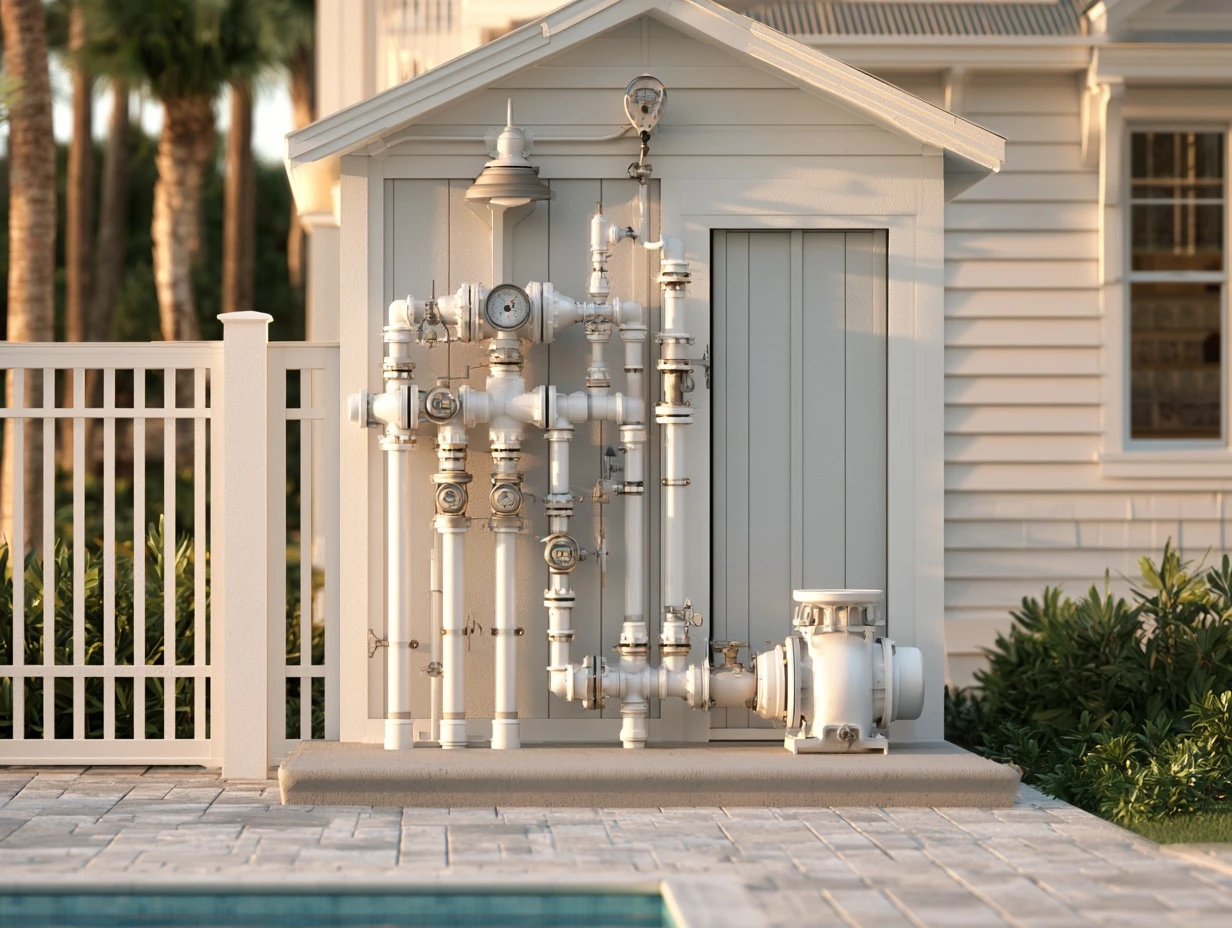
An auto-fill valve keeps the level looking perfect while the pool loses hundreds of gallons a week, so the first symptom is the water bill, not the waterline. Turning the auto-fill off for 24 to 48 hours and watching the level is the first test. A sticking fill valve can also mimic a leak all by itself.
Most pools in Collier County have an auto-fill, and it does its job too well. The float or paddle valve tops the pool up the moment the level drops, so a pool losing water around the clock still shows a perfect waterline every morning. The leak gets a free disguise for as long as the valve keeps up.
The tell is sound and frequency. A healthy pool takes an occasional top-up after a hot, windy day. A pool with a problem is fed constantly, and owners usually discover it at night: a fill valve hissing at eleven in the evening, weeks after it started, is very often the first symptom anyone actually notices.
The first test costs nothing. Find the fill valve, usually under a small round lid set into the deck near the pool or teed off the equipment pad, and shut it off for 24 to 48 hours. If the level holds, the pool is fine and the valve itself deserves a look. If the level drops, you now have something the bucket test can measure.
And sometimes the finding really is the valve. A sticking auto-fill runs water into a pool that does not need it, sends the excess out the overflow, and looks identical to a leak from the water bill. Saying so costs us the repair and is the reason people call again.
And sometimes the finding really is the valve. Saying so costs us the repair, and it is the reason people call again.
Interactive · check it yourself, free
The bucket test: check for a leak yourself before paying anyone
You do not need us to confirm a leak. Float a five gallon bucket on the top step, mark the level inside and the pool level outside, and wait 24 hours with the pump running as normal. Both drop by evaporation. If the pool dropped further than the bucket, the difference is your leak, measured in inches per day.
AT THE THRESHOLD, WORTH MEASURING PROPERLY
The modeled South Florida rate runs about 0.095 inches a day in December to about 0.184 in May (SFWMD, 2010), so the same reading means different things in different months. Run the bucket test for a full 24 hours, 48 in a windy week, before deciding either way.
Roughly 70 gallons a day on a typical Naples pool
The 24-hour test, step by step
- 01 Bring the pool to its normal level, then set a five gallon bucket on the top step. Put a few inches of pool water in it first so it sits weighted and stable, with the rim above the pool surface.
- 02 Fill the bucket until the water inside sits an inch or two below the rim. It does not need to match the pool level exactly. What matters is that both surfaces are exposed to the same air.
- 03 Turn the auto-fill off completely. This is the step people skip, and it invalidates everything, because the valve will quietly replace whatever the pool loses. Then mark the water level inside the bucket and the pool level on the outside of it, with a grease pencil or a strip of tape.
- 04 Leave it for 24 hours with the pump running on its normal schedule. No swimming, no backwashing, and if it rains, start over the next day, because rain tops up the bucket and the pool unevenly.
- 05 Compare the two marks. If the bucket and the pool dropped the same amount, you are watching evaporation, and in Naples summer that can be a genuinely surprising amount. If the pool dropped further than the bucket, the difference between the two drops is your leak, in inches per day.
- 06 Repeat the same 24 hours with the pump off. This comparison is the useful one. A pool that loses water with the pump running but holds when it is off is pointing at the pressure-side plumbing. A pool that loses water either way is pointing at the shell, a fitting or the suction side. Same bucket, different question.
This is the industry-standard 24-hour bucket test, and it works because the bucket and the pool share the same sun and the same wind. Whatever evaporation takes from one, it takes from the other. Anything extra the pool loses is the leak, isolated by simple subtraction.
Be honest with yourself about what the result proves. It proves whether you are losing water beyond evaporation, it puts a number on the loss, and the pump-on versus pump-off split gives a first rough sort between plumbing and structure. It does not tell you where the leak is, which is what pressure testing and dye testing are for. In a windy week, run it 48 hours instead of 24 before trusting a borderline result. And if the bucket says evaporation, believe it. It occasionally saves a call-out, which is fine by us.
Before you pay anyone
Your first seventy-two hours
Everything on this list is free, takes no tools you do not already own, and turns a suspicion into a measurement someone can act on.
Hour 0
Turn the auto-fill off
Find the valve, usually under a small round lid in the deck, or teed off the equipment pad, and shut it off. Skipping this invalidates everything that follows, because the valve quietly replaces whatever the pool loses.
Hours 0–24
Run the bucket test, pump on
Bucket on the top step, both levels marked, pump on its normal schedule. No swimming, no backwashing. If it rains, start again tomorrow.
Hours 24–48
Repeat it with the pump off
This is the comparison that matters. Losing water with the pump running but holding when it is off points at pressure-side plumbing. Losing it either way points at the shell, a fitting or the suction side.
Then
Call with numbers, not a suspicion
You now know whether you have a leak, roughly how much, and which half of the pool to look at. That is a far better starting point than "it seems low", and it is free.
Part four
How we find the leak without digging up the deck

We isolate before we excavate. The plumbing lines are pressure tested one at a time to find which circuit is losing, and the shell, skimmer throats, returns, lights and main drain are dye tested. That narrows a whole yard down to a section, which is the difference between opening a meter of deck and opening a deck.
Pressure testing tells you whether the loss is in the plumbing and, if so, which line. Dye testing tells you whether it is in the structure: a crack, a fitting, a light niche, or a skimmer that has separated. Those are different repairs and they are in different places, which is why finding out first is worth more than any amount of confident digging.
Dye testing is simpler than it sounds and harder than it looks. With the water dead still, a thread of dye released near a suspect spot drifts with the water, and water only moves toward a place it can leave. Dye pulled steadily into a skimmer throat, a return fitting or a hairline in the shell is the leak telling on itself. The skill is in the stillness, the sequence and knowing where older Naples pools tend to fail.
The spa version of this shows up constantly on pool and spa combos. The spa drains half down overnight while the pump is off, the pool barely moves, and by mid-morning the spa has quietly refilled itself because the pump came on and topped it back up. That pattern points at the spa circuit, and whether the culprit is a failed check valve letting the spa siphon down or a leak in the spa shell itself changes the repair entirely. Isolation testing is exactly the tool that separates the two: value the overnight drop, test the spa on its own, and the answer stops being a debate.
Interactive · read your symptom
What is your pool actually telling you?
Tap what you are seeing. Every symptom points somewhere specific, which is why isolation beats digging.
Points at
Pressure-side plumbing
Water is being pushed out of a return line every hour the pump runs. Pressure testing each circuit finds which one without opening the yard on a guess.
Points at
The shell, a fitting or the suction side
A loss that ignores the pump points at the structure or something passing through it. Dye testing the shell, skimmer throats, returns and light niches is what separates them.
Points at
A buried line
Water escaping underground has to surface somewhere. Mature landscaping in Pine Ridge Estates and Naples Park is the usual reason a root found the joint.
Points at
The suction side
On the suction side the symptom inverts: instead of water getting out, air gets in. Bubbles at the returns are the same fault seen from the other end.
Points at
The spa circuit
Either a failed check valve letting the spa siphon down, or a leak in the spa shell. Different repairs entirely. Isolation testing is what settles it.
Points at
A separated skimmer throat
The pool has just told you where the hole is. Original skimmers in Old Naples and Naples Park are among the most common hidden sources in the county.
Points at
Hydrostatic pressure
Near Naples Bay and the Gordon River the water table pushes on the shell from below. A patch treats the symptom; the pressure never left.
Part five
Wet spot in the lawn? What underground plumbing leaks look like
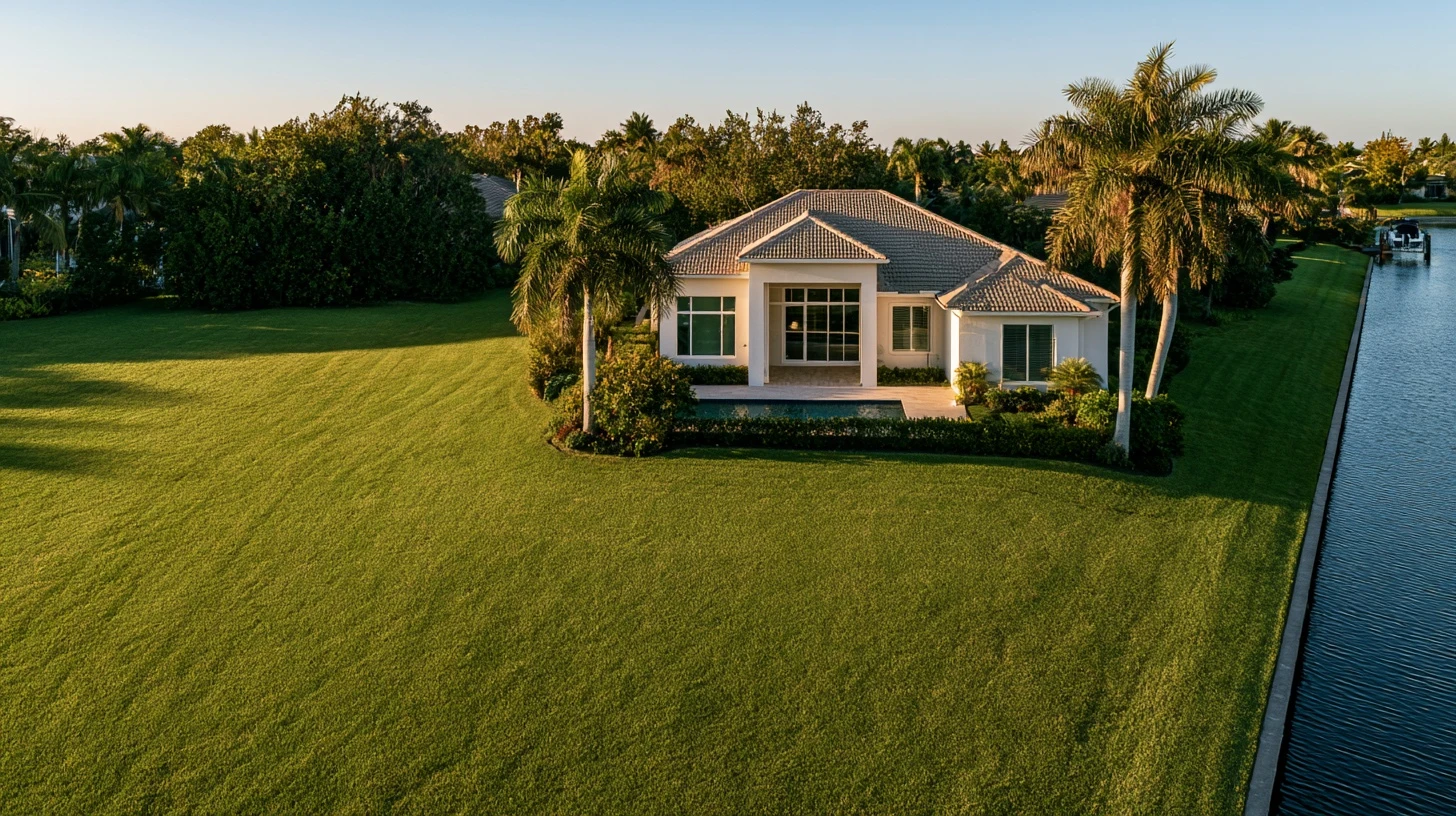
A soggy patch near the equipment pad or along the pipe run that never dries, grass greener over the line than around it, air in the pump basket, bubbles from the returns: those are underground plumbing symptoms. Pressure testing finds which line is losing without opening the yard on a guess.
Underground plumbing failures leave a different set of fingerprints from shell leaks. Water escaping a buried line has to go somewhere, and on lots where the ground can hold it, it surfaces as a patch of lawn near the equipment or along the run between pool and pad that stays wet when nothing else is, often with grass noticeably greener and faster growing right over the line. On the suction side the symptom inverts: instead of water getting out, air gets in, and you see it as air in the pump basket and bubbles spitting from the returns.
Pine Ridge Estates and Naples Park are where we see this most, for the same reason: mature landscaping. Ficus and oak roots have had decades to find a warm, wet PVC line and work on the joints, and a root does not announce which of the four or five buried lines it has opened.
That is what pressure testing is for. Each circuit is isolated and tested on its own, so the failing line identifies itself before anything is opened, and the excavation is a short trench over a known section rather than an exploration. The repair itself, from a single joint to a full underground plumbing repair and repipe, is work we do in-house.
Part six
Canal homes: the water table hides leaks, and pressure cracks shells

On canal lots in Royal Harbor and Aqualane Shores the water table takes leaked water away before it can surface, so a dry deck proves nothing. Near Naples Bay and the Gordon River the same groundwater pushes on the shell from below, which is why some cracks return through cosmetic patches and why you should never drain a pool here.
Everywhere else, a leak eventually shows itself: a wet patch, a soft spot, a stain. On pools on canal lots in Royal Harbor, in Aqualane Shores canal homes and on Isles of Capri, the water table sits close enough to the surface that leaked water simply joins it. The ground takes everything, nothing goes soggy, and the visual cue everyone waits for never arrives. This is why canal owners so often end up with two contradictory opinions: anyone reasoning from a dry deck is reasoning from evidence that means nothing here.
The same groundwater works a second, nastier trick. Near Naples Bay and the Gordon River the water table presses on the outside of the shell, and hydrostatic pressure becomes the actual cause of cracking rather than a contributing factor. A crack that pressure drove through the shell will come straight back through a cosmetic patch, because the patch treated the symptom and the pressure never left. Telling whether a pool crack is structural or cosmetic is its own discipline, and when it is structural, the fix is structural crack and shell repair, not another skim of patching compound.
It is also why "do not drain your pool" is safety advice here, not a scheduling preference. An empty shell sitting in a high water table can float out of the ground like a boat, and a floated pool is a rebuild, not a repair. A leak shows itself best with the pool full anyway, so nothing is gained by draining and a great deal can be lost.
Ground movement near a seawall accelerates all of it. The deck settles toward the water, coping separates, the bond beam picks up load it was never meant to carry, and fittings that pass through the shell get worked loose a fraction at a time. On a canal lot, leak detection is less a single test and more a structural reading of how the whole pool is coping with where it sits.
Part seven
What happens after the leak is found? Here, it gets fixed by the same contractor
Much of this market splits the job in two: one company finds the leak, hands you a report and a referral, and the repair becomes a second project with a second contractor. Splash Pools is a structural pool contractor, so the finding and the repair are one scope, carried out by the same people who tested your lines.
It is worth understanding how leak work is commonly sold, because the structure of the deal shapes the outcome. Detection specialists find leaks; most do not do structural work, so a shell crack or a failed skimmer body becomes a referral, and the homeowner who thought they were buying a solution discovers they bought a diagnosis and now has a second procurement to run. Some firms warranty their finding only if you also buy their repair, which tells you what the finding was for.
We are on the other side of that line. Splash Pools does pool repair in Naples as a structural pool contractor, so the finding and the fix are one scope: crack stitching in the shell, line repair or repipe underground, skimmer and main drain replacement at the throat. The person who pressure tested your lines is the person who opens the deck, and that person answers to Clayton, whose name is on the company. No handoff, no crew roulette, no warranty that dies if you get a second quote.
The written finding still comes before the quote, because a quote without a finding is a guess with a number on it. You get what was tested, what was ruled out and where the loss is, in writing, before any excavation is agreed. That order matters: it means you decide the scope rather than being told it after the deck is already open, and every meter of deck opened speculatively is a meter that has to be reinstated.
The finding is also yours to shop. Take it to another contractor for a second opinion if you want one; we would rather you did that than felt cornered. While you are comparing, verify licenses rather than trusting badges on websites. Florida pool contractors are regulated by the Department of Business and Professional Regulation, and the DBPR licensee search will confirm any Florida pool contractor’s license before they dig. When you are ready, book the isolation test and we will start with the lines, not the shovel.
Straight talk
Six things people believe about pool leaks
“The deck is dry, so there is no leak”
On canal lots in Royal Harbor, Aqualane Shores and Isles of Capri the water table sits close enough that leaked water simply joins it. The ground takes everything and the visual cue never arrives. Anyone reasoning from a dry deck here is reasoning from evidence that means nothing.
“Drain the pool so you can find it”
Never here. An empty shell sitting in a high water table can float out of the ground like a boat, and a floated pool is a rebuild rather than a repair. A leak also shows itself best with the pool full, so nothing is gained by draining.
“The level looks fine, so the pool is fine”
An auto-fill keeps the waterline perfect while the pool loses hundreds of gallons a week. The first symptom is the bill, not the water. Shut the valve for 24 to 48 hours and the pool will tell you the truth.
“Finding it means digging up the deck”
Only if nobody isolates first. Pressure testing narrows a whole yard to one circuit and dye testing narrows the structure to one fitting, which is the difference between opening a meter of deck and opening a deck.
“It just needs a better patch”
If a crack returns through a patch, something is driving it. Near the water table that something is hydrostatic pressure, and the repair has to carry the load rather than hide it.
“Leak detection and the repair are two different companies”
That is how much of this market is structured. One company finds it, hands you a report and a referral, and the fix becomes a second procurement. Here the person who pressure tested your lines is the person who opens the deck.
Part eight
What causes pool leaks in this part of Florida?
Four things, in roughly this order: separated skimmer throats on older pools, underground plumbing found by mature landscaping, structural cracks driven by hydrostatic pressure near the water table, and failed fittings at returns and light niches. Ground movement near a seawall accelerates all of them.
Original skimmers in Old Naples and Naples Park are one of the most common hidden sources in the county. The skimmer is a rigid plastic body cast into a concrete deck, two materials that move differently every day of their lives, and eventually the throat separates from the shell. Water leaves behind an otherwise sound wall, the deck above stays dry, and the level keeps dropping with nothing to see. Dye testing at the throat finds it, and skimmer and main drain repair closes it.
The rest of the list follows the ground. Buried plumbing gives way where roots and settlement have worked on it. Shells crack where hydrostatic pressure loads them from below. Returns and light niches fail at the interface where a fitting passes through the structure, the same story as the skimmer at smaller scale. And within a lot or two of a seawall, everything on this list happens sooner, because the ground itself is participating.
Once the source is found, the repair is often modest: a stitched crack, a section of line, a replaced skimmer body. It is the finding that is the job.
Interactive self-check
Do you have a leak, or a suspicion?
Eight honest questions. Check what has been true in the last few months and get a straight read on whether this is worth testing. Nothing you check leaves this page.
This self-check is an educational tool, not a diagnosis. Whatever you check, a pool that is losing water deserves a real look: 239-450-5933.
Service area
Where leaks hide differently
Click any marker. On canal lots the water table takes the water away before it can surface; inland it is roots and settlement. The card says which.
Where we work
Naples and Collier County, plus Marco Island, Bonita Springs and Estero. What fails is different in each, and that is what decides the work.
- Port Royal waterfront, architectural review, deck must match the house
- Old Naples pools built in the seventies and eighties, due for everything at once; original skimmers
- Aqualane Shores canal homes, deck movement near the seawall separates coping
- Park Shore Gulf Shore Boulevard salt air hits the tile line first; seasonal vacancy
- The Moorings direct salt air exposure, waterline tile failure
- Coquina Sands seventies and eighties pools; decks poured over uncompacted fill
- Royal Harbor canal homes, high water table hides leaks; coping separation
- Grey Oaks gated architectural review on anything visible from the street; spa additions
- Quail West natural stone decking matched to the house; spa additions
- Pelican Bay empty April to November; automation and heat pumps for year-round swimmers
- Lely Resort natural gas supply; builder decks aging out; year-round pump runtime
- Fiddler's Creek natural gas heater sizing; builder-era paver decks losing their base
- The Vineyards year-round swimming, heat pumps and variable speed payback
- Naples Park mature landscaping into pool plumbing; original skimmers; storm-loaded filters
- Pine Ridge Estates mature landscaping finds underground pool plumbing
- Vanderbilt Beach equipment pads corrode fast; storm season loads filters
- Golden Gate Estates well water iron staining on marcite; propane rather than natural gas
- Isles of Capri canal water table hides leaks; heavy equipment-pad corrosion
- Marco Island barrier island salt air corrodes heaters from the inside out
- Bonita Springs pool decks and patios on Southwest Florida soil
- Estero deck and patio base engineered for local soil
- Ave Maria newer east-county builds, patios and walkways matched to existing hardscape
Straight answers
Questions Naples owners ask about leaks
 Clayton Waggoner Owner, Splash Pools LLC
 Clayton · Owner
Evaporation is real here and varies with heat, wind, screening and month. The modeled South Florida rate runs about 0.095 inches a day in December to about 0.184 inches a day in May (SFWMD, 2010), so a reading that looks normal in May can be a leak in December. That is why the bucket test, which sits in the same weather your pool does, beats any fixed number. It confirms it in 24 hours. Clayton · Owner
No, and please do not. A leak shows itself best while the pool is full, because the water is what reveals where it is going. A drained pool can also float on a high water table, which is a far more expensive problem than the leak. Clayton · Owner
Only after we know where to dig, and only the smallest area that reaches it. Pressure testing and dye testing narrow it down first, and you get the written finding before any excavation is agreed. Clayton · Owner
It genuinely could, and a sticking auto-fill valve looks very similar from the water bill. That is one of the things checked, and if that is what it is, that is what we will tell you. Clayton · Owner
It depends on three things: how many plumbing circuits have to be pressure tested, whether dye testing the shell and fittings is enough or the lines need isolating one by one, and whether the repair can happen in the same visit once the source is found. You get the quote before any testing starts, and the written finding before any repair is agreed. Call 239-450-5933. Clayton · Owner
Yes, and it is common here. We can test, send the written finding through, and deal with whoever is handling decisions. If the property sits empty for the season, this is also the right moment to consider automation so the pool can be watched remotely. Clayton · Owner
Half an inch a day is comfortably a leak. A dry deck on a canal lot means nothing, because the water table takes the water away. The reason you have two different opinions is probably that neither was based on an isolation test. Pressure test the lines circuit by circuit, dye test the shell and fittings, and get the finding in writing before anyone opens the deck.Talk to Clayton
Tell us what the water is doing.
A sentence or two is enough. You get a call back from the person who does the work, not a dispatcher.
Related services
Pool repair in Naples, diagnosed before it is quoted →Underground pool plumbing repair, with the smallest possible hole →Skimmer and main drain repair, the quiet leak →Structural crack repair, starting with what is causing it → Does a home inspection cover the swimming pool? →What happens to a Naples pool while you are away for the summer? →How Fast a Naples Pool Actually Loses Water to Evaporation, Month by Month →Where a drained pool can legally go in Florida, and the rule FDEP still cites wrong →How much should you lower your pool before a hurricane in Collier County? →Is a failing pool pump repairable, or does it have to be replaced? →Why is my pool losing water, and is it a leak or evaporation? →Is that pool crack structural, or is it cosmetic? → Ready when you are
Start with the lines, not the shovel.
Run the bucket test tonight, then call with the number. You get the finding in writing before anything is dug, from the contractor who also does the repair.