

NAPLES, FL · PLUMBING REPAIR
Underground pool plumbing repair, with the smallest possible hole
The cost of an underground plumbing repair is mostly the deck, not the pipe. Which is why the whole job is about finding the failed section before anything comes up, and why the crew that opens your deck should be the crew that can put it back.
In short
What this work actually involves
Underground pool plumbing repair locates and repairs failed suction and return lines buried under deck or yard, up to and including a full repipe, with the excavation targeted by pressure testing and the deck reinstated afterwards. Splash Pools LLC is a Naples, Florida pool contractor owned by Clayton Waggoner, serving Naples, Collier County, Marco Island, Bonita Springs and Estero.
Part one
How do you find a buried leak without opening the deck?
- 35psi held for 15 minutes, the Florida Building Code pressure test new pool piping must pass
- 12hours pump off, then 12 running, the mark test that separates plumbing loss from shell loss
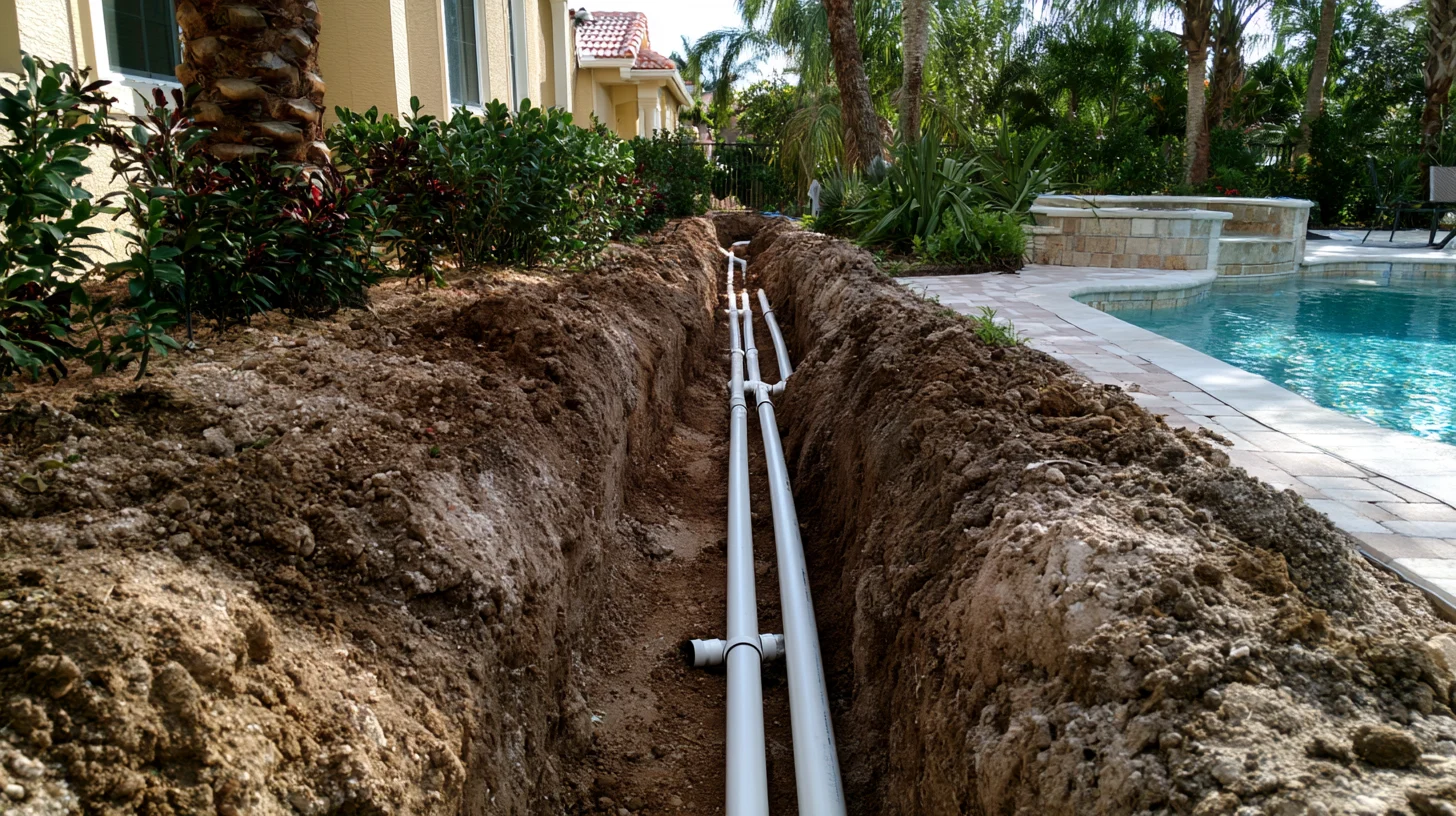
By isolating circuit by circuit. Each line is pressure tested separately so the loss is narrowed to one run rather than the whole system. That turns a speculative excavation into a targeted one, which is the difference between opening a meter of deck and opening a deck.
The method is line-by-line pressure testing. A pool has several separate circuits: the skimmer line, the main drain, the return runs, sometimes a dedicated cleaner or spa line. Each one is plugged off at both ends and put under pressure on its own. A line that holds is eliminated. A line that will not hold is the failure, and further testing along that run narrows the failed section before anyone talks about digging. Fittings that can be reached, at the skimmer, at the returns, get dye tested as well, because a surprising number of suspected pipe leaks turn out to be reachable without a trench.
This is not an exotic standard. The 2023 Florida Building Code, Residential, requires new pool piping to hold a pressure test of not less than 35 psi for 15 minutes before it is approved (R4501.6.2 and R4501.12.1 cover the circulation system and its testing). A repair should be held to the discipline new work is held to, which is why the same gauge comes back out at the end of the job.
Pine Ridge Estates and Naples Park are where this work comes up most, because both have the mature landscaping that eventually finds pool plumbing. Roots do not usually crush a line; they work at joints over years until one of them gives. Terry H. in Pine Ridge Estates described our crew as tidy and on time after his remodel, and that habit matters even more on a plumbing job, where the work happens in a hole in someone’s deck. There is more on how that neighborhood’s pools age on our Pine Ridge page.
If you are still at the stage of suspecting a leak rather than knowing where it is, start with pool leak detection. That is where the loss is confirmed and separated from evaporation before any of this begins. And if your fear is specifically a pool pipe leak under a concrete deck, the isolation work is what stands between you and exploratory digging. Nothing opens until the testing says where.
Part two
Suction side or return side: what your symptoms already tell you
Air in the pump basket, a pump that loses prime overnight and air blown into the pool at start-up point at the suction side, which pulls air in rather than letting water out, so the deck often stays dry. A wet or constantly green patch, and loss that worsens with the pump running, point at the pressure side. That split halves the search before any test is run.
The suction lines run from the pool to the pump, and the pump pulls water through them under vacuum. When a joint on that side fails, the line does not necessarily push water out; it pulls air in. That is why the classic suction-side symptoms are air symptoms: bubbles churning in the pump basket, a pump that loses prime when it shuts off overnight and struggles to catch again in the morning, a burst of air blown from the returns at start-up.
This is also why the picture that confuses people is not a contradiction. A pump full of air every morning, a water level that barely moves, and a deck that is completely dry can all be the same fault. The leak is letting air in while the pump runs and only seeping water when it stops, so the loss is small even though the fault is real. Air in the pump basket is a plumbing symptom, not a pump symptom, and replacing pump parts will not fix it.
The return side is the opposite mechanism. After the pump and filter, water travels back to the pool under pressure, and a failure there pushes water out into the ground every hour the system runs. The signs are wet ones: a soggy or constantly greener patch of lawn, a damp joint line in the deck, a water level that drops noticeably faster on days the pump runs longer.
You can read the split yourself with the equipment off. Mark the level, leave the pump off for 12 hours, and mark it again; then run the pump for 12 hours and compare. Faster loss with the pump running points at the pressure side. Loss that continues at the same rate either way points away from the plumbing and toward the shell or fittings. The split halves the search, and the isolation testing then confirms it, because an older pool can have more than one thing going on at once.
Part three
Repair the section or repipe the run?
Repair a single failed joint on otherwise sound pipe. Repipe when the line has multiple failures, when the material itself is at end of life, or when reaching a second failure later would mean opening the same deck again. The deciding factor is usually access cost rather than pipe cost.
That is the calculation people find counter-intuitive. Pipe is cheap and deck is not, so a repipe that avoids a second excavation can be the cheaper option overall even though it sounds larger. The question is never really what does the pipe cost. It is what does it cost to reach the pipe, and how many times are you prepared to pay that.
The clearest case is the older pool with a history. A pool built in the eighties that has had three pipe leaks in four years, each one fixed by a different company, is not unlucky. The run is telling you the material is done, and each patch has bought time on a line that keeps finding new places to fail. At that point a pool repipe of the affected run, done once, through one opening plan, is usually the honest recommendation, because the alternative is opening the same stretch of deck on somebody’s schedule every eighteen months.
The same arithmetic cuts the other way too. A single failed joint on pipe that tests sound either side of it does not justify a repipe, and we will say so. And where a deck is already coming up for other reasons, a remodel, a base rebuild, new drainage, that is the moment to deal with any plumbing that is marginal, because the access cost has already been paid.
Whichever way the decision goes, the line is pressure tested again before anything is closed up, to the same standard the isolation testing used at the start. Backfilling an untested repair is how a job gets done twice.
Part four
What happens to the deck afterwards?
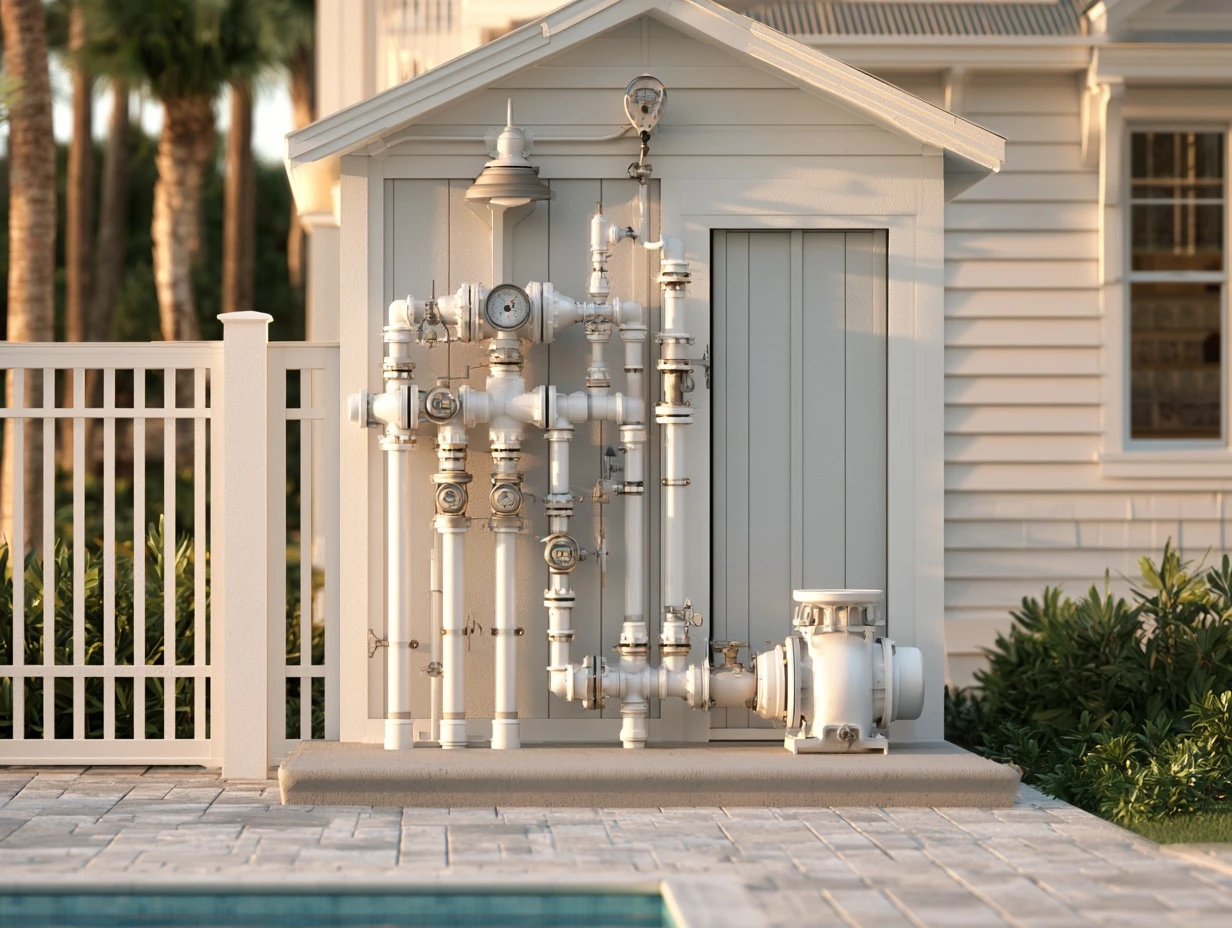
It gets reinstated by the same crew, on a properly re-compacted base. That matters because a repaired trench backfilled loosely will settle within a season or two, which turns a solved plumbing problem into a wavy deck and a trip hazard.
Base preparation on a reinstated trench follows the same specification as new work: material returned in compacted lifts rather than pushed back in loose. Loose backfill always looks fine on the day. The settlement comes later, after a wet season has worked through it, and it shows up as a dip that follows the line of the trench across an otherwise flat deck. Reinstatement done properly is invisible, which is exactly the point. See pool deck repair for what it takes to correct a deck where that was not done.
Where pavers came up, they go back. Pavers are the forgiving case, and it is one of the reasons they are the sensible deck material over plumbing: they are designed to be lifted and re-laid, and a repair under a paver deck can be genuinely seamless.
Travertine deserves its own mention because it is the deck people are most afraid for. Travertine can usually be lifted and re-laid rather than cut, provided the crew doing the lifting knows that from the start and plans the opening around whole stones. What ruins a travertine deck in this scenario is not the repair; it is exploratory digging by a crew with no plan for the stone. The opening plan and the reinstatement plan are made before the first stone comes up.
Where the deck is poured concrete, the opening is a cut, and that is a different reinstatement conversation: a patched cut never disappears the way re-laid pavers do, so the size and placement of the cut are worth discussing honestly before it is made.
Part five
One contractor for the pipe and the deck
An underground plumbing repair is two trades in one trench. A plumbing company will make a good repair and a hardscape crew will make a good deck, and the trench between them belongs to whoever is standing in it. Here the pressure test, the pipe, the compacted backfill and the paver reset are one scope and one call.
Look at how this market is actually built and the problem shows itself. The companies that find leaks are detection specialists: they test, they locate, and then the trench is handed to whoever will dig it. The companies that build decks are hardscape crews: they will not open pool plumbing, and most will not warranty pavers laid over someone else’s backfill. So the owner of a straightforward pipe leak ends up as the general contractor of their own trench, coordinating two firms who each consider the middle of the job to be the other one’s problem.
The arithmetic explains why that structure serves everyone except the owner. When the deck is most of the cost of the repair, the deck skill is most of the job, and a repair priced without the reinstatement is not really priced at all. Splash Pools does the decks and pavers work as its own trade, including travertine pool decks, which is precisely why we can take on the whole trench rather than half of it.
It also changes who answers for the result. Clayton runs both sides of that trench, so the isolation test, the pipe repair, the compacted backfill and the paver reset are one scope with one person accountable for it. If the deck settles over the repair a year later, there is no debate about whose work it was.
If that is the version of this job you want, book a consultation and we will start with the testing rather than the shovel.
Part six
Why pool plumbing fails in this part of Florida
Rarely a dramatic break. Joints worked loose by decades of root pressure and small ground movement, fittings at the skimmer and returns, and on canal lots the soil movement near a seawall that loads everything buried in it. Age plus landscaping is the usual verdict, which is why pools in mature neighborhoods lead this queue.
Buried PVC is rigid and the ground it sits in is not. Naples soil takes on and gives up a lot of water through the year, roots thicken against pipe runs a few centimeters at a time, and the pipe itself expands and contracts with temperature. None of that breaks a sound pipe outright. What it does is work at the glued joints, decade after decade, until one of them starts to weep. That is why the failure point is almost always a joint or a fitting rather than the middle of a straight run.
The most common fittings to fail are the ones that carry the most stress: the skimmer throat, where the pipe meets a concrete-encased skimmer body that moves differently from the ground around it, and the return and drain connections at the shell. Failures there are their own repair, often reachable without a long trench, and they are covered on our skimmer and main drain repair page.
Canal lots add one more force. Ground near a seawall moves more than ground inland, and everything buried in that soil, plumbing included, carries the load. It is part of why waterfront pools in areas like Royal Harbor see plumbing and structural work sooner than the pool’s age alone would predict; there is more on that pattern on our Royal Harbor page.
If you are not yet sure the plumbing is the problem at all, the wider picture of what fails on Naples pools and in what order lives on our pool repair in Naples hub. Plumbing is one suspect among several, and the testing is what convicts the right one.
Straight answers
Questions Naples owners actually ask
 Clayton Waggoner Owner, Splash Pools LLC
 Clayton · Owner
Each circuit is pressure tested separately: skimmer line, main drain, each return run. A line that holds pressure is eliminated, and the loss gets narrowed to a single run before anything is dug. Your symptoms usually shorten the search first, because air in the pump points one way and a wet patch points the other. That isolation is what keeps the excavation small. Clayton · Owner
The aim is the smallest opening that reaches the failure, and reinstatement on a properly compacted base by the same crew. A trench backfilled loosely will settle and show, which is why the reinstatement is part of the job rather than an afterthought. Clayton · Owner
Sometimes. If the failure is at a fitting or a skimmer throat that is reachable without a trench, no deck comes up at all, which is one reason the isolation work comes first. Where the failure is mid-run under a deck, it has to be reached, and the testing keeps that opening small. Clayton · Owner
Less than most people expect once the run has been isolated, because the opening is targeted rather than exploratory and the same crew closes it back up. We can talk through exactly what will be open, where, and for how long before anything starts, so there are no surprises for her. Clayton · Owner
Most often movement and roots working at glued joints over many years, which is why it turns up in neighborhoods with mature landscaping. The usual failure points are fittings under stress, the skimmer throat especially. On canal lots, ground movement near the seawall adds to it. Clayton · Owner
It depends on where the failure is, how much deck stands between us and it, and whether the sensible scope is one joint or the whole run. That is why the isolation testing comes first and the quote comes after it, with the deck reinstatement included rather than left to a second contractor. Call 239-450-5933 and we will start there. Clayton · Owner
Isolation testing first, so the opening is one section rather than a search. Travertine can usually be lifted and re-laid rather than cut, provided the crew doing it knows that from the start and plans the opening around whole stones. The thing that ruins a deck in this scenario is exploratory digging, not the repair.Talk to Clayton
Send the details, get a call back.
A sentence or two is enough. You get a call back from the person who does the work, not a dispatcher.
Service area
Where we work
Click any marker. What fails is genuinely different from one neighborhood to the next, and the card says which.
Where we work
Naples and Collier County, plus Marco Island, Bonita Springs and Estero. What fails is different in each, and that is what decides the work.
- Port Royal waterfront, architectural review, deck must match the house
- Old Naples pools built in the seventies and eighties, due for everything at once; original skimmers
- Aqualane Shores canal homes, deck movement near the seawall separates coping
- Park Shore Gulf Shore Boulevard salt air hits the tile line first; seasonal vacancy
- The Moorings direct salt air exposure, waterline tile failure
- Coquina Sands seventies and eighties pools; decks poured over uncompacted fill
- Royal Harbor canal homes, high water table hides leaks; coping separation
- Grey Oaks gated architectural review on anything visible from the street; spa additions
- Quail West natural stone decking matched to the house; spa additions
- Pelican Bay empty April to November; automation and heat pumps for year-round swimmers
- Lely Resort natural gas supply; builder decks aging out; year-round pump runtime
- Fiddler's Creek natural gas heater sizing; builder-era paver decks losing their base
- The Vineyards year-round swimming, heat pumps and variable speed payback
- Naples Park mature landscaping into pool plumbing; original skimmers; storm-loaded filters
- Pine Ridge Estates mature landscaping finds underground pool plumbing
- Vanderbilt Beach equipment pads corrode fast; storm season loads filters
- Golden Gate Estates well water iron staining on marcite; propane rather than natural gas
- Isles of Capri canal water table hides leaks; heavy equipment-pad corrosion
- Marco Island barrier island salt air corrodes heaters from the inside out
- Bonita Springs pool decks and patios on Southwest Florida soil
- Estero deck and patio base engineered for local soil
- Ave Maria newer east-county builds, patios and walkways matched to existing hardscape
Related services
Pool leak detection in Naples, with a finding before a shovel →Pool repair in Naples, diagnosed before it is quoted →Skimmer and main drain repair, the quiet leak →Pool deck repair in Naples, and whether resetting will actually hold →Pool deck pavers in Naples, built on a base that lasts →From the insights
How Fast a Naples Pool Actually Loses Water to Evaporation, Month by Month →Where a drained pool can legally go in Florida, and the rule FDEP still cites wrong →Why is my pool losing water, and is it a leak or evaporation? →Where this comes up most
Sources
Ready when you are
Tell us what the pool is doing.
A sentence or two is enough. You get a call back from the person who does the work, not a dispatcher.