
NAPLES, FL · PATIOS AND WALKWAYS
Paver patio and walkway installation in Naples, pitched the right way
Every patio sheds every storm onto something. The two things it must never shed onto are your house slab and your pool. Most patio and walkway problems in Naples start with where the water was sent.
In short
What this work actually involves
Paver patio and walkway installation covers patios, paths, lanai extensions, surrounds and connecting areas laid on a compacted aggregate base and pitched to a deliberate drainage target. Splash Pools LLC is a Naples, Florida contractor owned by Clayton Waggoner, serving Naples, Collier County, Marco Island, Bonita Springs and Estero.
Part one
Which way should a patio drain, and away from what?
- 1.5percent minimum surface slope (CMHA, PAV-TEC-002, 2022), so water leaves by design
- 4inches of compacted aggregate base, minimum, under pedestrian pavers
- 98percent standard Proctor compaction (CMHA, PAV-TEC-002, 2022) under the stones you actually see
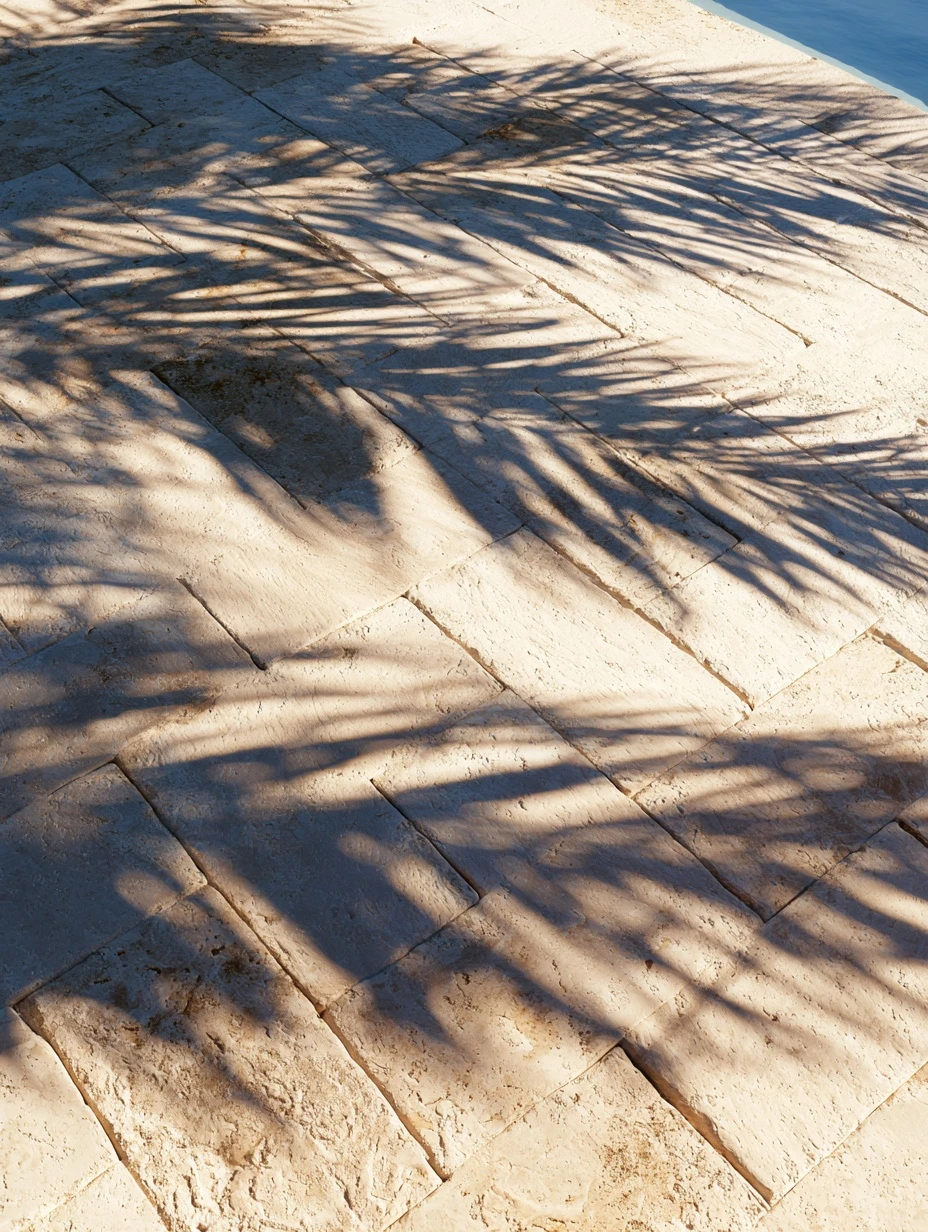
Away from the house slab and away from the pool, toward ground or a drainage detail that can take an afternoon storm. Pitch decides the target, and the target is chosen before the first paver goes down. Standing water at the lanai edge or a damp line on the slab means the pitch is sending water to the wrong place, and that is a grading fix, not a paver fix.
Start with the house. A patio pitched toward the home sends every afternoon storm against the slab edge, and the evidence arrives in a fixed order: water standing along the lanai edge after rain, then a damp line on the outside of the slab, then staining that keeps coming back after pressure washing. Left alone, that water works on the ground beside the stem wall season after season. None of it announces itself quickly, which is why the pitch matters more than the pavers do.
The pool is the other forbidden target. Water crossing the pavement toward the pool carries fine material out of the base as it goes and delivers its load to the ground behind the shell, which gets its own section further down this page. Everything else on the property is a candidate: lawn, planting beds, a swale, a drainage detail built for the purpose. The rule we work to is simple. Choose the target first, then set the pitch to reach it.
The published specification backs this up with a number. The Concrete Masonry and Hardscapes Association puts minimum surface slope for interlocking concrete pavement at 1.5% (CMHA, Tech Note PAV-TEC-002, 2022), which works out to roughly three sixteenths of an inch per foot. That number gets a patio shedding water instead of holding it. What it cannot do is say where the water goes. "Away from the patio" is not a plan, and a patio can meet the slope number perfectly and still aim its storm at the slab.
Sizing matters here because of how Naples rain arrives. A summer afternoon storm drops water faster than sandy ground can absorb it at the surface, so for those minutes the ground is effectively sealed and everything the patio sheds is moving. The fall has to deliver that water to ground that can take it once the storm passes, not just to the nearest edge. In the wet season much of the low ground in Collier County is already doing stormwater work, so the target has to be chosen honestly rather than optimistically.
Where a site has no good target, the honest answer is a drainage detail named as its own scope: a channel drain across the fall, a gravel margin along the problem edge, or a permeable section built to take the storm itself. Permeable interlocking pavement stores water in an open graded base beneath the pavers, and over soils that will not absorb it, perforated underdrains carry the water out to an outlet (CMHA, Tech Note PAV-TEC-018, 2022). That is extra work and we say so up front, because a patio that quietly floods the yard next door is not a finished job either.
The good news is that pitch is fixable without redoing everything. If water stands in one low spot and nothing else has changed, the base has usually settled there, and that area alone can be lifted, re-based and reset, the same repair we make on decks and describe on the pool deck repair page. If water runs the wrong way along a whole edge, the fix is regrading that run. Older patios in Naples Park tend to need the first; patios regraded for a later feature tend to need the second. What a localized reset cannot fix is a patio that was pitched at the house from the start, and we will say which situation yours is after seeing it, rather than resetting pavers that will send water at the slab again.
Part two
Can a lanai be extended with pavers?
Yes, and it is the most common patio project in newer east Naples communities, where the builder lanai is the minimum. The extension is a new floor that has to meet the lanai at exactly the existing elevation, carry its own base and its own pitch, and handle the enclosure drip line, which concentrates every storm onto one strip. Continue the old floor without those three answers and the extension fails.
The pattern across the Vineyards, Ave Maria and the newer east Naples communities is the same: a sound, plain, builder minimum lanai, and owners who want roughly double the outdoor floor beyond the screen line. Pavers are the right tool for that. The extension can meet the lanai cleanly, wrap the enclosure, and carry one surface out to a seating area or fire pit without the cold joints a poured slab would add.
The elevation match is the discipline. The new floor has to arrive at the join at exactly the height of the existing lanai floor, which means the base depth, bedding layer and paver thickness are all worked backwards from a line that already exists. Get it right and the join disappears underfoot. Get it wrong by half an inch and you have built a permanent trip step at the one threshold everyone crosses barefoot.
The extension also carries its own base and its own pitch. It is new pavement on new ground, not a continuation of the old floor, and its water has to go somewhere the lanai was never asked to send water: away from the house on one side and away from the pool on the other, exactly as the section above describes. An extension that simply continues the lanai level ends up flat, and flat pavement in a Naples summer is a puddle with edges.
The drip line is the detail nobody budgets. A screen enclosure or roof edge concentrates the whole storm onto one strip of pavement a few inches wide, and that strip takes more water in one August than the rest of the patio sees all year. It scours joint sand out faster than anywhere else, which is where paver sealing and re-sanding earn their keep on older floors. On a new extension, that strip gets detailed for drainage deliberately rather than hopefully.
Where the extension meets an existing builder paver area rather than the lanai slab, the base under the new work is built to match the standard of the original, because two areas on different bases age at different rates and the join is where it shows first. Soil matters too. Ground in Ave Maria and Golden Gate Estates is not the coastal strip, and base preparation follows what the site is actually made of rather than a template.
Matching the builder's paver itself is sometimes possible and often not, since runs change and lines get discontinued. Where an honest match is not available, a deliberate contrast reads as designed: a defined border at the screen line, or a change of pattern between lanai and extension. There is more on matching in the section below.
Part three
What if patio water runs toward the pool?
Storm water crossing the deck toward the pool carries fines out of the deck base and loads the ground behind the shell, so it is a pool problem as much as a patio problem. It usually starts when a later feature changes levels. Because we answer for the pool side as well as the pavement, the fix and the responsibility sit in one place, under one contract.
The usual story is a regrade. The patio and deck were built pitched away from the water. Then a fire pit, an outdoor kitchen or a spa went in years later, levels were adjusted to suit the new feature, and the water quietly changed direction. Nobody decided to aim the storm at the pool. Somebody just stopped checking where it went.
It matters because moving water carries material with it. Storm water crossing the deck picks up fines from the joints and the bedding layer as it goes, and delivers a patio's worth of every storm to the ground behind the pool shell, ground that was never asked to take it. The pavement problem and the pool problem are the same problem wearing two hats.
Which is why the two-contractor version of this argument goes nowhere. The hardscape company says the grading serves the feature it was asked to build. The pool company says it never touched the patio. Both are right, and the water is still moving. We take these jobs on because both sides of the line are ours, pool deck pavers and the deck-to-pool seam on one side and the patio pitch on the other, under one contract, one schedule and one accountable contractor.
Part four
Why do patios, paths and decks end up mismatched?
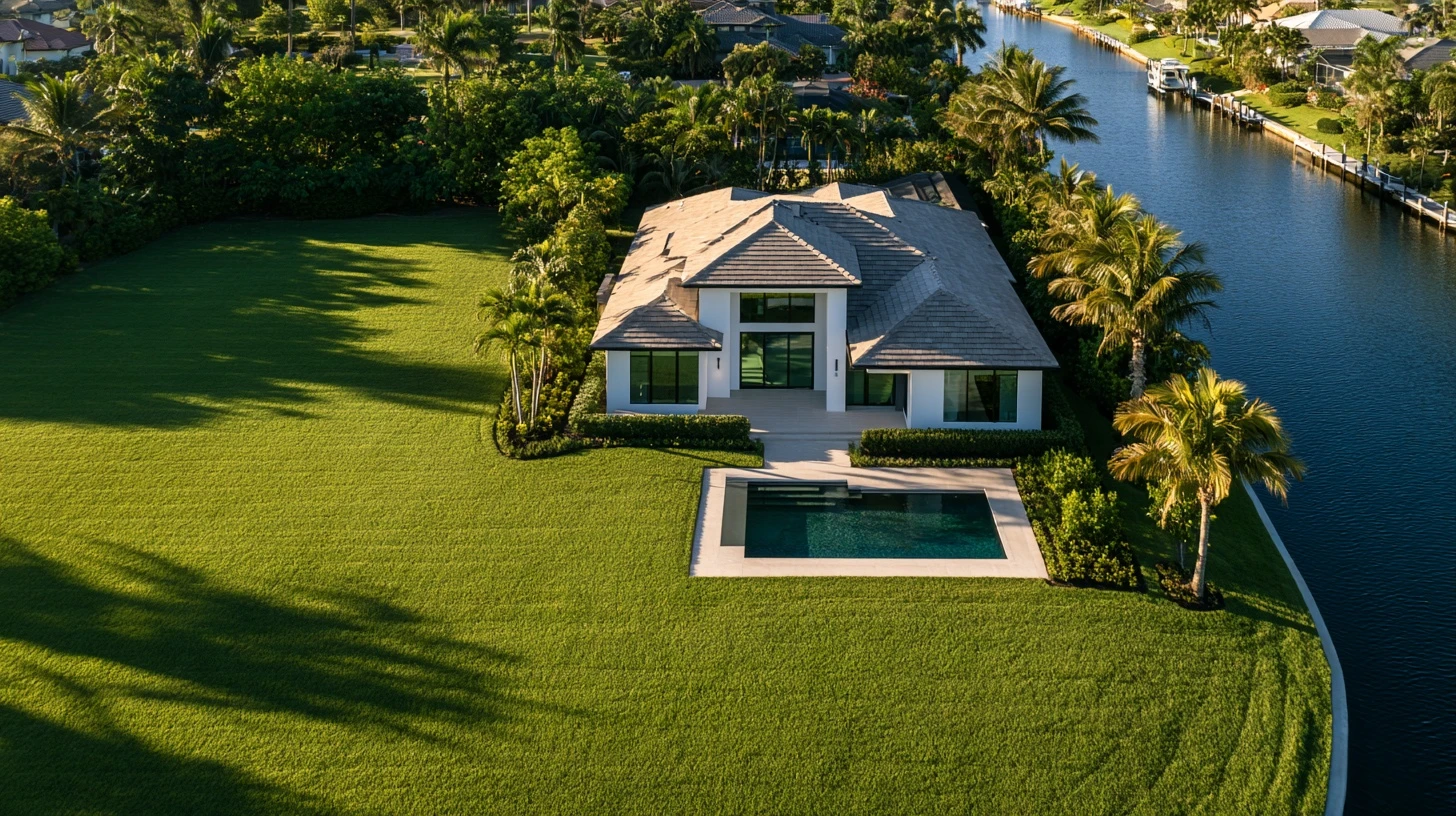
Because they get done one at a time as budget allows, by whoever was available. Different stone runs, different joint widths and different base standards produce a property that reads as several projects rather than one, and matching afterwards is harder than matching at the outset.
The giveaway on most properties is not the quality of any one area. It is that the deck, the patio and the path were laid by three people in three different years. Stone availability is the practical reason matching later is difficult: runs change, batches vary, and a discontinued line cannot be bought at any price.
Base standard is the invisible reason. Areas laid to different specifications age at different rates, so one settles while another holds its line, and the joins between them show it first. A property can be built out of good work three separate times and still read as three separate projects.
Where new work has to sit beside old, a deliberate contrast beats a poor match: a border, a band, a pattern change, or a step up in material, which is where travertine and natural stone decks enter the conversation. A near miss in the same format reads as a repair. A confident change reads as designed.
That is also why doing the deck, patio and walkway together is usually cheaper per square foot as well as better looking: one base standard, one stone order from one run, one schedule. The deck side of that combined scope is covered under paver pool decks.
Part five
How much base does a patio or walkway need?
Less than a driveway, not less than the job deserves. The published specification calls for a minimum of 4 inches of compacted aggregate base under patios, walkways and pedestrian areas over well drained soils, compacted to at least 98% standard Proctor density (CMHA, Tech Note PAV-TEC-002, 2022). Much of Collier County is not well drained, so 4 inches is a floor here, not a target.
Pedestrian areas carry less load than a driveway, so the specification is lighter. It is still a specification. Under building a walkway is the most common corner cut in residential hardscape precisely because nobody ever sees the base, and a path given two inches of base instead of four does not fail on day one. It works loose a paver at a time, starting at the edges, over the first few wet seasons.
Wet or weak ground needs more base, not less, which is why the well drained qualifier in the specification is doing real work in this county. The right depth comes from the ground on the day it is opened, not from a brochure, and paths deserve particular attention because they often run across the fall of a site rather than with it, which puts the drainage rules from the top of this page in play on a strip only three feet wide.
Where a walkway meets a surface that takes vehicle load, the transition takes the higher specification, because a wheel does not know where the walkway officially begins.
Choose the surface
Which deck surface fits how you live outside?
Four surfaces do most of the work in Collier County. They differ less in looks than in how they behave in August, wet, and ten years in.
- Barefoot in August
- Among the coolest choices. The stone breathes, so it sheds heat instead of banking it.
- Wet grip
- Naturally textured surface; tumbled finishes grip well around spillovers and steps.
- Salt air
- Happy near salt, but it is porous, so sealing decides how it ages.
- Upkeep
- Periodic resealing. Skip it and the pores start holding stains instead of shrugging them off.
The default for a reason: barefoot comfort and a look that matches the Naples build era.
- Barefoot in August
- Cool underfoot, close to travertine. Light colors matter more than the stone.
- Wet grip
- Depends entirely on the finish. Polished marble near water is a mistake; sand-blasted or tumbled is not.
- Salt air
- Dense and durable, but acids etch it. Chlorine splash and the wrong cleaner both leave marks.
- Upkeep
- The most particular of the four. It rewards owners who keep to a sealing schedule.
The formal choice. Crisp veining and a brighter deck, for owners who will maintain it.
- Barefoot in August
- Runs warmer than stone in dark colors; pale tones stay reasonable.
- Wet grip
- Manufactured with a rated slip texture. The most predictable wet surface of the four.
- Salt air
- Effectively immune. Nothing for salt or chlorine to get into.
- Upkeep
- The lowest of the four. No sealing; rinse it.
The modern, low-maintenance pick. Clean lines and color that does not shift over the years.
- Barefoot in August
- The warmest of the four, especially in the popular darker blends.
- Wet grip
- Good texture out of the box; smooths gradually where the traffic is.
- Salt air
- Fine structurally, but color is a surface layer. Coastal sun and salt fade it first.
- Upkeep
- Sealing keeps the color; joint sand wants topping up every few seasons.
The workhorse. The widest range of shapes and patterns, and the easiest to repair one paver at a time.
Straight answers
Questions Naples owners actually ask
 Clayton Waggoner Owner, Splash Pools LLC
 Clayton · Owner
Sometimes. Runs change, batches vary and lines get discontinued, so an honest match is not always available. Where it is not, a deliberate border or a change of pattern usually looks better than a near miss, because contrast reads as designed where a close miss reads as a repair. If you have spare pavers from the original job, keep them; they settle the question quickly. Clayton · Owner
The industry specification, published by the Concrete Masonry and Hardscapes Association, calls for a minimum of 4 inches of compacted aggregate base for patios, walkways and other pedestrian areas over well drained soils, compacted to at least 98% standard Proctor density (CMHA, Tech Note PAV-TEC-002, 2022). Much of Collier County does not qualify as well drained, so treat 4 inches as a floor. Building less is the most common shortcut in residential hardscape. Clayton · Owner
If both are due, yes. Same base preparation, same materials, one schedule, and the areas actually match rather than reading as separate projects laid years apart. Buying the stone for every area from one run is the single decision that removes the matching problem, and it is only available when the work is planned together. Clayton · Owner
Usually, yes, depending on the fall across the site. Where there is a level change, it can often be handled as a gentle gradient rather than a step, which is worth designing deliberately at the start rather than discovering at the end. Tell us steps are the concern when you call and we will design the route around that from the first visit. Clayton · Owner
Because the pitch is sending water somewhere that cannot take it, or a low spot has developed where the base settled. Standing water against the house or crossing toward the pool is worth correcting promptly, since both targets cost far more than the regrade does. Which fix applies depends on whether the base under the low area is sound. Clayton · Owner
We quote after seeing it, because the number follows what the ground needs more than the area: base preparation, whether the pitch has to be corrected so water stops running at the house or the pool, whether a drainage detail is needed, and the material class. A lanai extension adds the elevation match at the join. Call 239-450-5933 and we will come look. Clayton · Owner
Patios, walkways, lanai extensions, pool decks and the pool structure they meet are handled under one contract by one Naples contractor, owner Clayton Waggoner, serving Naples, Marco Island, Bonita Springs and Estero. Useful to have ready: your neighborhood, photos of the lanai edge and of where water goes in a storm, the existing paver if matching matters, and whether an architectural review board is involved. Phone 239-450-5933.Talk to Clayton
Send the details, get a call back.
A sentence or two is enough. You get a call back from the person who does the work, not a dispatcher.
Service area
Where we work
Click any marker. What fails is genuinely different from one neighborhood to the next, and the card says which.
Where we work
Naples and Collier County, plus Marco Island, Bonita Springs and Estero. What fails is different in each, and that is what decides the work.
- Port Royal waterfront, architectural review, deck must match the house
- Old Naples pools built in the seventies and eighties, due for everything at once; original skimmers
- Aqualane Shores canal homes, deck movement near the seawall separates coping
- Park Shore Gulf Shore Boulevard salt air hits the tile line first; seasonal vacancy
- The Moorings direct salt air exposure, waterline tile failure
- Coquina Sands seventies and eighties pools; decks poured over uncompacted fill
- Royal Harbor canal homes, high water table hides leaks; coping separation
- Grey Oaks gated architectural review on anything visible from the street; spa additions
- Quail West natural stone decking matched to the house; spa additions
- Pelican Bay empty April to November; automation and heat pumps for year-round swimmers
- Lely Resort natural gas supply; builder decks aging out; year-round pump runtime
- Fiddler's Creek natural gas heater sizing; builder-era paver decks losing their base
- The Vineyards year-round swimming, heat pumps and variable speed payback
- Naples Park mature landscaping into pool plumbing; original skimmers; storm-loaded filters
- Pine Ridge Estates mature landscaping finds underground pool plumbing
- Vanderbilt Beach equipment pads corrode fast; storm season loads filters
- Golden Gate Estates well water iron staining on marcite; propane rather than natural gas
- Isles of Capri canal water table hides leaks; heavy equipment-pad corrosion
- Marco Island barrier island salt air corrodes heaters from the inside out
- Bonita Springs pool decks and patios on Southwest Florida soil
- Estero deck and patio base engineered for local soil
- Ave Maria newer east-county builds, patios and walkways matched to existing hardscape
Related services
Pool deck pavers in Naples, built on a base that lasts →Travertine and natural stone pool decks in Naples →Pool deck repair in Naples, and whether resetting will actually hold →Paver sealing in Naples, and when to keep your money →From the insights
Are paver pool decks impervious area in Collier County? →Travertine, marble or porcelain: which pool deck actually stays coolest? →Where this comes up most
Sources
Ready when you are
Tell us what the pool is doing.
A sentence or two is enough. You get a call back from the person who does the work, not a dispatcher.