Insights · Decks and pavers
Travertine, marble or porcelain: which pool deck actually stays coolest?
This is asked as a contest between three materials, and answered with a ranking. The measurements point somewhere else. When a national laboratory fabricated and tested a batch of concrete surfaces, reflectance varied more within that single material than the gap people argue about between material categories. The name on the invoice is a weak predictor of how the deck feels in August.
 Clayton Waggoner, Owner and Managing Member · Published August 8, 2026 · 12 min read
How hot a paved surface gets in sun is governed mainly by its solar reflectance, the fraction of sunlight it bounces back rather than absorbs. Reflectance is a property of color and surface condition. Material category correlates with it loosely, because some materials are usually supplied pale and some usually are not, but the correlation is not the mechanism.
The short version
Which of these three materials actually stays coolest?
- 152degrees Fahrenheit conventional paving has been measured at in full sun
- 99degrees the Naples air has never officially exceeded since 1942
- 95percent of incident sunlight the darkest pavements absorb (LBNL Heat Island Group, 2026)
Researchers at Lawrence Berkeley National Laboratory fabricated and exposed 32 mixes of portland cement concrete. Twenty-four gave rough surfaces, and the albedos of the remaining eight smooth mixes ranged from 0.41 to 0.77, with a mean of 0.59 (Levinson and Akbari, LBNL-48334, 2001)3.
Hold that range in mind. Within one material, made of the same basic ingredients, the most reflective surface bounced back nearly twice the fraction of sunlight the least reflective one did.
The study also found what drove it. Concrete albedo generally correlated with cement albedo and sand albedo, and cement albedo had a disproportionately strong influence on the reflectance of concrete (LBNL-48334, 2001)3.
In other words, what the surface is made of and how pale those constituents are decides the outcome, not the label applied to the finished product.
That is why a shortlist written as travertine against marble against porcelain is answering a question about supply conventions rather than physics. Travertine tends to be specified pale here, which is a real and useful tendency, and it is a tendency rather than a property.
The practical version for an owner is short. Compare the actual slabs, in the actual colors, outdoors, rather than comparing the three words. Two travertines can differ more than a travertine and a porcelain.
What actually decides how hot a deck gets?
The definition is straightforward. Solar reflectance is the ratio of reflected to incident sunlight, measured on a scale of 0 to 1, where higher numbers indicate greater reflectance (Lawrence Berkeley National Laboratory, Heat Island Group)1.
The consequence is equally direct. Dark pavements get hot in the sun because they absorb 80 to 95 percent of sunlight (LBNL Heat Island Group, 2026)1.
The size of the effect is what surprises people. A thermal image of adjacent light and dark pavement segments showed the light segment about 17 degrees Celsius, roughly 30 degrees Fahrenheit, cooler than the dark one (LBNL Heat Island Group)1.
Thirty degrees is not a marginal preference. It is the difference between a surface you can stand on and one that sends children hopping to the grass.
Field measurement agrees. A pilot study in Arizona found that conventional paving materials such as asphalt can reach surface temperatures up to 152 degrees Fahrenheit at midday, while the surface temperature of cool pavements remained 10 to 16 degrees cooler (US Environmental Protection Agency)2.
Those are asphalt comparisons rather than pool decks, and the mechanism is the one that carries across. Reflect more, absorb less, run cooler.
Set that against the local air. The National Weather Service record for Naples spans 1942 to 2025 and gives an all-time maximum of 99 degrees, with June, July and August peaking at 98 (NOAA National Weather Service, Naples climatological records)4.
So the hottest air ever recorded here is roughly 50 degrees below what conventional paving has been measured at. The deck is not warm because the air is warm. It is warm because it is absorbing sunlight and handing it back to whatever touches it.
That distinction matters for what you can do about it. Air temperature is not negotiable. Reflectance and shade are both chosen, and both are chosen once, at the point the deck is specified.
Does a deck stay as cool as it was on the day it was laid?
The study exposed its concrete samples to simulated weathering, soiling and abrasion. Each reduced average concrete albedo, with mean decreases of 0.06, 0.05 and 0.19 respectively (Levinson and Akbari, LBNL-48334, 2001)3.
Abrasion is the big one, and abrasion is what a pool deck gets. Feet, furniture, brushes, pressure washing and grit tracked in from a driveway all work the surface.
On a stone deck the cleaner does more damage than the pressure, because these materials are acid sensitive. What is safe on each surface is set out in cleaning a pool deck.
Consider what that means against the choice being made. If a buyer is weighing two materials whose reflectance differs by 0.1, and ordinary wear can move reflectance by 0.19, the wear is the larger term.
Some of it runs the other way, which is worth stating rather than hiding. Some samples became slightly more reflective through weathering or soiling, and concrete albedo grew as cement hydration progressed, by a mean of 0.08, stabilizing within six weeks of casting (LBNL-48334, 2001)3.
If the existing deck is sound and only the surface is tired, a coating may be the cheaper route, which is weighed in can a cracked pool deck be resurfaced.
The same materials and the same base rules carry across to a patio or walkway away from the pool. On the stone side of that comparison, travertine and natural stone decks are where most of these numbers land in practice. The useful conclusion is not that the choice is pointless. It is that maintenance is part of the temperature, and a deck kept clean and intact holds more of what it started with. Whether sealing is part of that upkeep depends on the material, and on some of these it is money better kept.
It also means comparing a brand new sample against your neighbor's five year old deck is not a fair test of the material, which is how most people form their impressions.
Why does a wet deck feel cooler when water makes it darker?
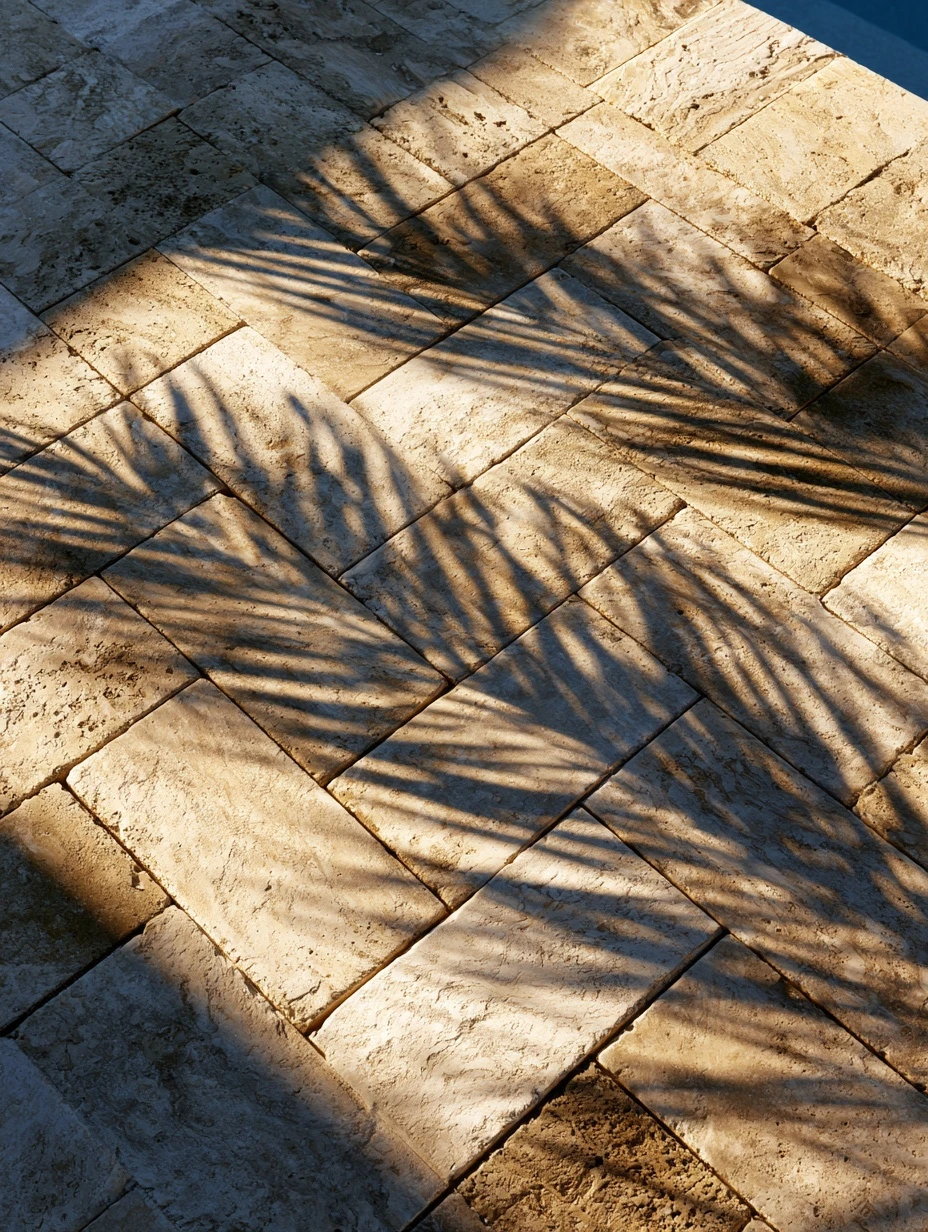
The reflectance side is measured. Simulated rain strongly depressed the albedos of the concretes, with a mean decrease of 0.23, until their surfaces were dried (Levinson and Akbari, LBNL-48334, 2001)3.
That is a bigger swing than abrasion, and bigger than most differences between candidate materials. A wet deck is, in reflectance terms, a substantially darker deck.
It is also a cooler deck to stand on, because evaporating water carries energy away from the surface. Cool pavements are defined partly by this route: materials that reflect more solar energy, enhance water evaporation, or are otherwise modified to remain cooler (US EPA)2.
Both things are true at once, and which one you notice depends on timing. While the surface is wet, evaporation is removing heat. Once it dries, the absorption advantage is gone and the surface is back to behaving as its dry reflectance says it should.
This is why a splashed area near the coping feels benign at four in the afternoon and the same deck ten feet back does not. It is not a different material. It is the same material with a different amount of water on it.
It also explains a common misjudgment. A deck sampled during or shortly after a rinse will always feel better than that deck will feel on a dry afternoon in August.
Measured effect
Does travertine's porosity actually help, or is that a sales line?
Unfilled travertine has open voids at the surface. Those voids retain some water after a splash or a rinse, which extends the evaporative cooling described above beyond the moment the surface looks dry.
A textured surface also reduces the contact patch between a foot and the stone, so heat transfers a little more slowly than it would from a dense polished plane at the same temperature.
Both are genuine and both are secondary. Reflectance differences on the order of 0.2 to 0.3 move surface temperature by tens of degrees, and neither porosity nor texture is operating at that scale.
The reason travertine has its local reputation is mostly that it is supplied pale. A light ivory stone reflects a large fraction of the sun before texture or porosity is considered at all.
Which is a helpful thing to know when a supplier offers a dark travertine, or a walnut tone, and the reputation of the material is doing the persuading. That reputation belongs to the color, and the color is the thing being changed.
The same logic applies in reverse. A pale porcelain in a matte finish is not a compromise on temperature, whatever the material rankings suggest, and the specification detail that decides its longevity is covered in travertine and natural stone pool decks.
So how should the deck material actually be chosen?
Start by comparing samples in sun, not indoors, and compare the specific colors on offer rather than the material names. Pale beats dark by a margin no other variable in this decision can match.
Then consider what the surface will become. Abrasion is the largest single degrader of reflectance in the laboratory work, so a surface that holds up to traffic and cleaning keeps more of its advantage over time.
Then look at where the sun actually falls. A west-facing expanse with no shade is a different problem from a deck that is under screen for half the afternoon, and shade outperforms every material choice available.
Then treat wetting as an operational tool rather than a material property. A rinse before use genuinely works, for as long as the water is there.
And keep the whole thing in proportion to what is underneath, because a cool deck that has dished is not a good deck. Base construction decides whether the surface stays flat, which is the subject of why paver decks sink and rut.
The reason to insist on this order is that it is the order the evidence supports. Reflectance is measurable, its effect is large, and it is set by a choice made in a showroom in ten minutes and then lived with for twenty years.
Where the deck is being relaid as part of a wider project, the material choice sits inside a sequence rather than standing alone, and resurface or remodel sets out what that order has to be.
Interactive · Choosing a deck
Are you comparing the right things?
Four questions drawn from what has actually been measured. They are about the variables with the largest effect, which are not the variables most showroom conversations spend their time on.
Ask Clayton
Questions this article usually prompts
Tap a question. Clayton replies himself, here and on the phone.
Clayton Waggoner Owner and Managing Member · Splash Pools Online Tap a question to ask
If this is the situation you are in
Travertine and natural stone pool decks in Naples →Pool deck pavers in Naples, built on a base that lasts →Paver patio and walkway installation in Naples, pitched the right way →Pool deck repair in Naples, and whether resetting will actually hold →References
- Lawrence Berkeley National Laboratory, Heat Island Group: Cool Pavements
- U.S. Environmental Protection Agency, Using Cool Pavements to Reduce Heat Islands
- Ronnen Levinson and Hashem Akbari, Effects of Composition and Exposure on the Solar Reflectance of Portland Cement Concrete, LBNL-48334, Lawrence Berkeley National Laboratory (December 2001)
- NOAA National Weather Service, Miami-South Florida: Climatological Records for Naples, FL, Highlights 1942 to 2025

The article is general.
Your pool is specific.
Tell us what the pool is doing, a sentence or two is enough. The person who wrote this is the person who calls back.