
NAPLES, FL · DECK REPAIR
Pool deck repair and resurfacing in Naples, and which one your deck needs
Resetting pavers on a base that has failed is a repair with an expiry date. The question worth answering before anyone quotes is whether the base is sound.
In short
What this work actually involves
Pool deck repair covers lifting and resetting settled pavers, resurfacing cracked concrete, correcting trip hazards, and rebuilding failed base where resetting will not hold. Splash Pools LLC is a Naples, Florida contractor owned by Clayton Waggoner, serving Naples, Collier County, Marco Island, Bonita Springs and Estero.
Part one
What is the shape of the settlement telling you?
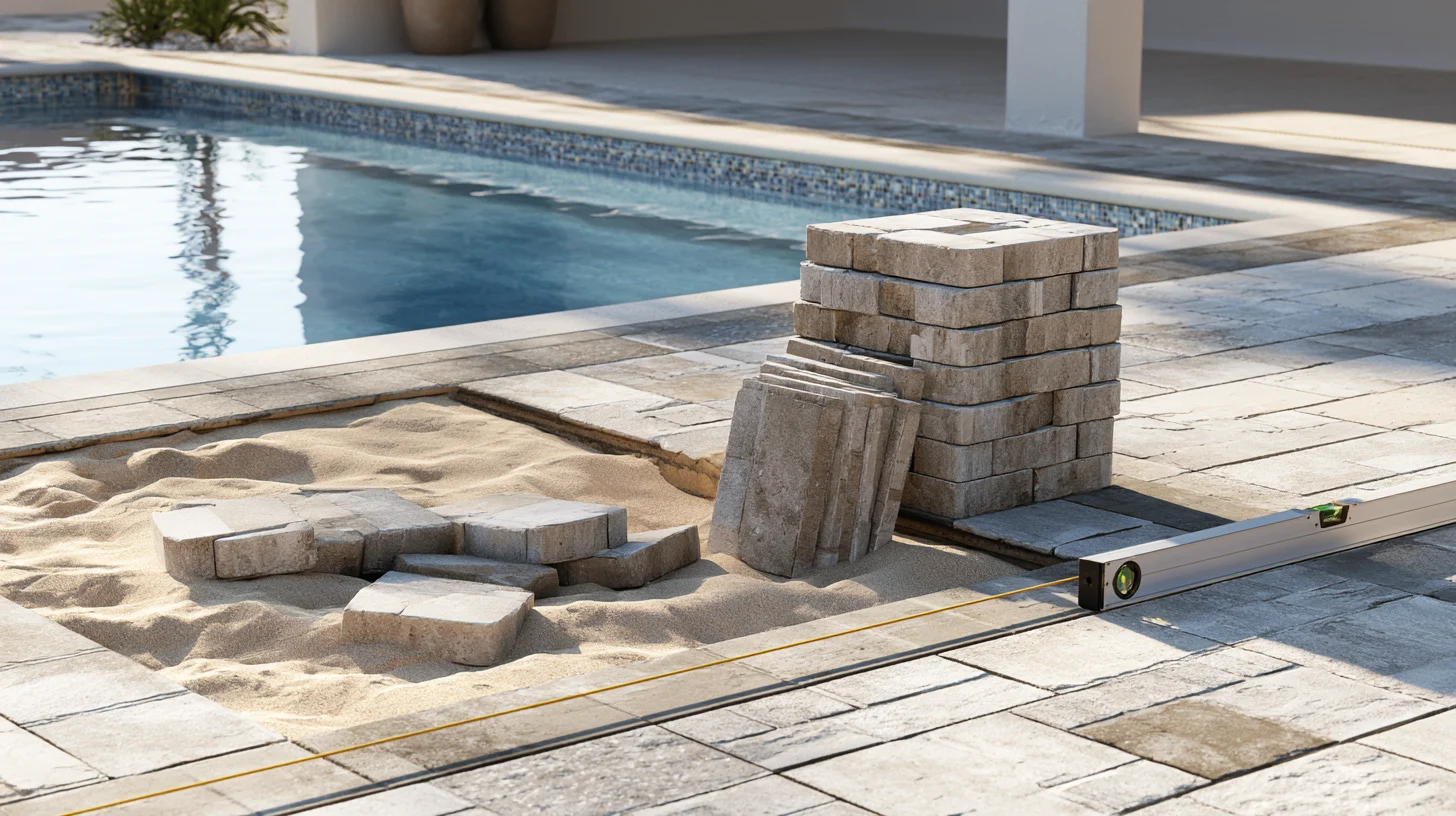
Settlement has a shape, and the shape is the first diagnostic. Dishing along walking paths points at base compaction under use. A drop along one edge of the pool points at the beam or at water underneath, so the pool side gets checked. A corner going down near a seawall or boundary points at the ground itself. Single rocking pavers are usually just empty joints. We read the shape before quoting anything.
Uniform dishing along the walking paths is the gentlest story a deck can tell. The route from the lanai door to the pool steps carries thousands of trips a year, the base under that line compacts a little further with each of them, and after a decade the path reads as a shallow trough. It shows up wherever feet funnel: at the steps, at the gate, in front of the grill. Nothing is broken. The fix is contained: lift that run, bring the base back to level, re-screed and reset the same stones.
A drop concentrated along one edge of the pool is the shape we take most seriously, because the deck there can only settle for a short list of reasons. Either the structure behind the coping is moving, or water underneath is carrying the base away. Settlement right at the coping usually points at the bond beam rather than the deck base; see pool coping replacement. If the pool also seems to be losing water, read the leak section below before you collect a single deck quote, because in that case the deck is the messenger and not the problem.
A corner going down near a seawall or a property boundary points past the deck entirely, at the ground along that edge. In Naples that shape has a history of its own, and it gets its own section below, because it is the one where resetting the pavers answers the wrong question.
Single pavers that rock underfoot, with no dip in the surface around them, are usually not settlement at all. The joint sand that locks each stone to its neighbors has washed out, the interlock is gone, and individual pavers have started to move on their own. Sun and afternoon storms in Naples Park and Vanderbilt Beach empty joints on a schedule. That is a maintenance fix, not a repair; see paver sealing and restoration.
Reading the shape first is not a party trick. Each shape has a different repair, a different cost logic, and in one case a different trade. The same inch of drop can be a morning of resetting in Naples Park or a moving-ground problem in Royal Harbor, and the shape is what tells you which quote you should even be asking for.
Part two
Why do decks in Royal Harbor and older bayfront Naples keep settling?
Those neighborhoods sit on mid-century dredge-and-fill ground, and fill consolidates for decades. A deck corner that settles, is reset, and settles again on the same line is reporting ground that is still moving. Resetting it a third time the same way buys the same result. The repair that lasts longer is a deeper, better drained base in the moving zone, quoted with honest expectations rather than promises.
Royal Harbor, Isles of Capri and the older bayfront streets around Coquina Sands were made the same way: canals were dredged and the spoil became the ground the houses stand on. That is ordinary local history, not a criticism of anyone. But fill placed in the middle of the last century keeps consolidating for a very long time, and a pool deck is a large, flat, unforgiving instrument for reporting it.
The pattern owners describe is remarkably consistent. The deck has been re-leveled twice in ten years, it is going again, and it is always the same corner. Each reset was honest work on its own terms, and each one ignored what the deck kept saying: the ground under that corner is still moving. A reset over moving ground is a repair with an expiry date, and by the third round the owner is effectively paying for the same repair on a subscription.
What actually helps on this ground is doing the moving zone differently rather than repeatedly. That means rebuilding the base in that area deeper and better drained than the original, so storm water moves through it instead of carrying the fines away, and setting the stones so the next adjustment, if the ground moves again, is a small lift and reset rather than another rebuild. Drainage is half of that sentence for a reason: on fill, the water that cannot get out is the water that takes the fines with it.
And it means saying the quiet part in the quote. On consolidating fill, never again is a promise nobody should make, and we will not make it. What we can honestly offer is movement that is smaller and slower, a deck detailed to be adjusted cheaply, and a straight answer about which of those two futures your corner is in. The mechanism itself is explained on our decks page under why decks sink near seawalls and canals; this page is about what to do once yours is doing it.
Part three
Is the deck failing, or is the pool leaking under it?
A pool or plumbing leak washes fines out of the deck base from underneath, and it leaves a signature: settlement concentrated along one side of the pool, sometimes soft or hollow underfoot, often with water loss beyond evaporation. The order matters: test the pool before rebuilding the deck, because a deck rebuilt over an active leak fails on schedule. We do both trades, so the diagnosis and the fix sit in one place.
Water attacks a deck from above and from below, and the two are not the same problem. From above, rain and splash empty the joints and the surface loosens. From below, water moving through the base carries the fine material with it, the base loses its structure, and the deck over it drops. When that water is coming from a pressurized plumbing run or from the pool itself, the arrow points one way: the settlement is not causing the leak. The leak came first, and the settling deck is how it announces itself.
The signature is specific enough to read. The drop concentrates along one side of the pool, following the buried line or the escaping water rather than the walking paths. The pavers there can feel soft or hollow underfoot, sometimes damp in dry weather. And the pool loses water faster than evaporation explains. Losing more than the month's modeled evaporation is more than Naples weather usually takes, and there is a free 24-hour bucket test that separates weather from leak; our pool leak detection page walks through it step by step. None of those signs is proof on its own. Together, along one edge, they are a strong hint that the water is doing the excavating.
The order of operations is where the money is saved or lost. Test the pool first. It costs a day and a bucket, and it decides everything that follows. A deck rebuilt over an active leak is the expensive order of operations: the new base washes out exactly the way the old one did, on schedule, and the second rebuild ends up paying for the leak detection anyway. Nobody should rebuild a deck along a pool edge without knowing the pool is tight.
The usual sources under a deck are the buried suction and return runs, and, less often, the shell itself; a crack low in the shell can feed the base quietly for months without ever showing a puddle, which is where crack and shell repair comes in. This is why a settled deck is sometimes a pool contractor’s job wearing a paver problem’s clothes. We do both trades, so the pool gets tested, the leak gets fixed, and the deck goes back down over it on one contract, one schedule, with nobody in the middle saying the other company caused it.
Part four
Lift and reset, re-lay, or resurface?
- 4inch minimum compacted base under a rebuilt pedestrian deck
- 6inch maximum lifts the aggregate goes down and gets compacted in
- 98percent standard Proctor density the construction spec calls for (CMHA, PAV-TEC-002, 2022)
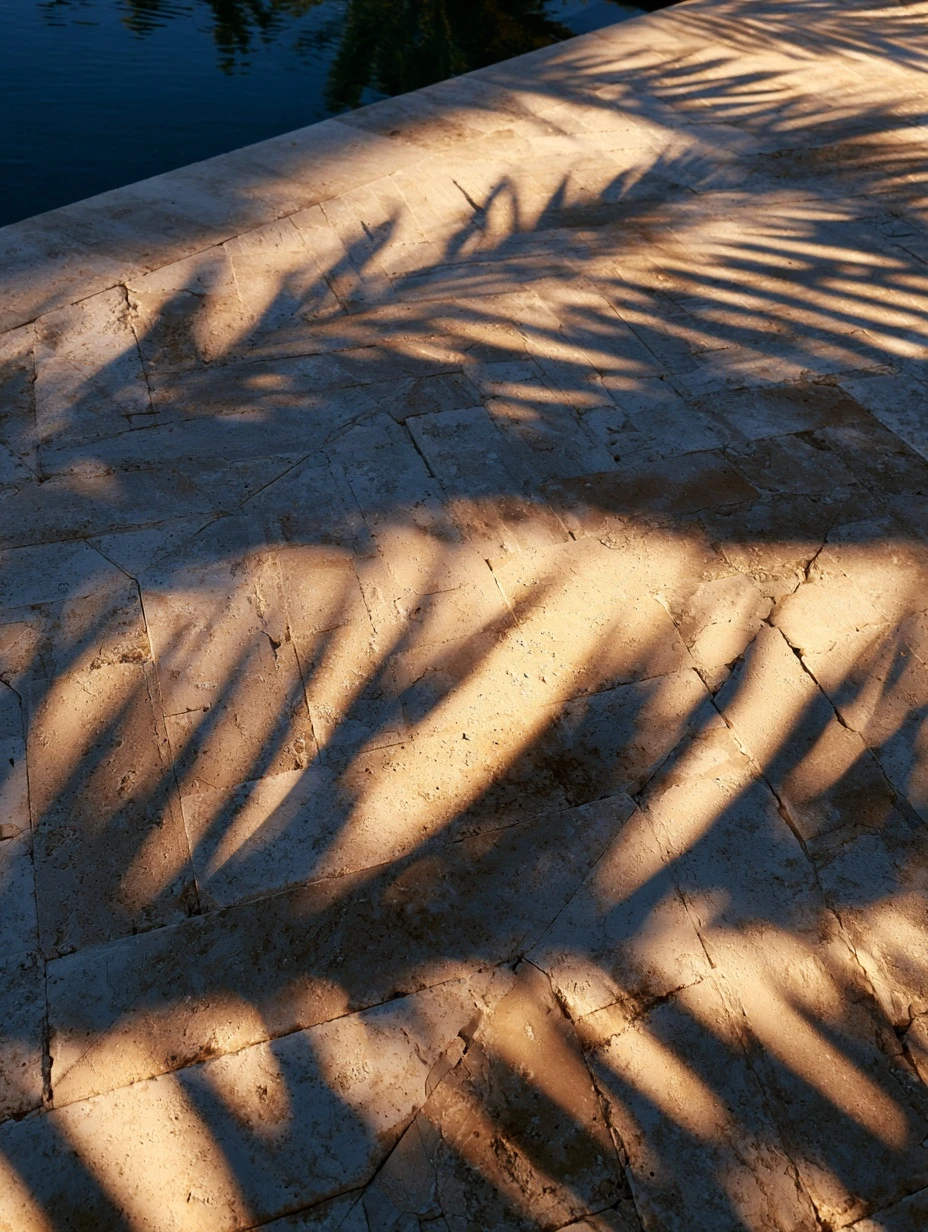
Localized settlement over a sound base: lift and reset that area, re-compacted and re-screeded, not just put back. Widespread settlement or a failed base: re-lay on a rebuilt base, reusing stone where it survives. Cracked poured concrete: resurface only if the movement has stopped, because a coating over a live crack is a cosmetic. Which one applies is a base question, and we answer it before quoting.
Lift and reset is the right call when the settlement is local and the base under it is sound. The industry maintenance guide describes exactly this repair: pavers over low severity depressions can be removed, the settlement corrected, and the same units reinstalled, with no wasted material and no patch that announces itself (CMHA, Tech Note PAV-TEC-006, 2022). That is the quiet advantage of a segmental deck: it unzips and zips back. Done properly it still involves re-compacting and re-screeding, not simply putting the stones back. Terry H. in Pine Ridge Estates described our work as neat, orderly and on time, which is what a reset should look like from a lanai chair.
Re-laying is the answer when the settlement is widespread or the base has failed, and on this the guide is blunt: the base gets repaired or replaced, fresh bedding goes down, and the pavers are reinstated over it (CMHA, Tech Note PAV-TEC-006, 2022). The stone is usually the survivor of a base failure, and reusing it is a real saving, especially on travertine and natural stone decks where the material is the cost. The rebuilt base is built to the construction specification rather than patched to match the old one: aggregate placed and compacted in lifts of 4 to 6 inches (CMHA, Tech Note PAV-TEC-006, 2022), a minimum of 4 inches of compacted base under pedestrian areas, compacted to at least 98% standard Proctor density, with the finished surface held within about three eighths of an inch over a ten foot straightedge (CMHA, Tech Note PAV-TEC-002, 2022).
Cracked poured concrete is the third branch, and it runs on one question: has the movement stopped? Resurfacing is honest work over a deck that cracked once, for a reason that has passed, and has been stable since. Over a crack that is still moving, a coating is a cosmetic, and the crack prints through it within a season or two. Cause first, cosmetics second.
The honest version of this answer costs us work sometimes, because rebuilding is the larger quote and resetting is the easier sale. Telling you a reset will hold when it will not is how a contractor gets paid twice.
Where a deck is coming up anyway, that is the moment to deal with any plumbing underneath it that is marginal. See underground plumbing repair.
None of this needs to be taken on trust, ours included. Ask everyone quoting which of the three methods they are pricing and what they found in the base that justifies it; the answer tells you whether anyone looked. Then ask for a license number and check it in about a minute at the Florida DBPR licensee search. Ask us for ours, then look it up. That advice applies to every quote you collect, including this one.
Part five
What are the ways to resurface a concrete pool deck?
Four, and they are different jobs. A thin coating changes the color and texture of a sound slab. A cementitious overlay builds a new wearing surface on it. Pavers or stone can be laid over the slab, with drainage and height conditions. Or the slab comes out and a new deck goes in. Which one fits depends on the slab underneath, not the brochure.
A coating is the lightest touch: a textured or acrylic finish bonded to the existing concrete. It suits a deck whose problem really is the surface, faded, stained or worn smooth, on a slab that is stable and drains. A coating keeps the slab's shape exactly, so a deck that holds water before it is coated holds water in the same places afterwards; pool deck drainage explains why and what fixes it.
An overlay is thicker, a cementitious or polymer-modified topping that rebuilds the wearing surface. It can cover crazing, staining and old patches, but it is bonded to the slab, so a crack that is still moving prints through it. The guide to resurfacing a cracked deck covers how to tell a crack that has stopped from one that has not, which is the question that decides whether an overlay lasts.
Pavers or stone laid over the slab change the surface entirely. The paver industry's application guide says existing concrete can be overlaid with pavers and lists pool decks among the uses, provided the water that soaks into the bedding layer has a way out and cracks and joints are treated first (CMHA, Tech Note PAV-TEC-010, 2022). The catch is height: the thin units made for overlays are 1 1/4 to 1 3/4 inches thick and sit on bedding sand screeded 1 to 1 1/2 inches deep (CMHA, Tech Note PAV-TEC-010, 2022), so the deck comes up at the doors, the coping and the screen. Pavers over an existing concrete deck walks through what to measure first.
Taking the slab out is the answer when the slab is the problem: sinking, broken up, pitched toward the pool or already too close to the door thresholds to gain any height. It is the larger quote, and it is the only route that fixes the base, the height and the fall at the same time. The pool decks and pavers page covers how a new deck is built, and choosing a deck resurfacing contractor explains which trade does which of these four jobs, so the quotes you collect are for the same thing.
Part six
What about trip hazards?
They get corrected promptly and separately from any larger plan. A lifted edge at a pool deck is the thing that gets found by a guest rather than an owner, and correcting it is quick work that does not need to wait for a decision about the whole deck.
This is worth separating out because owners often delay the whole project while deciding on scope, and the hazard sits there through the deciding.
The correction is usually localized: lift, re-compact, re-screed and reset that section so the edges sit flush.
It also buys time to make the bigger decision properly rather than under pressure.
Choose the surface
Which deck surface fits how you live outside?
Four surfaces do most of the work in Collier County. They differ less in looks than in how they behave in August, wet, and ten years in.
- Barefoot in August
- Among the coolest choices. The stone breathes, so it sheds heat instead of banking it.
- Wet grip
- Naturally textured surface; tumbled finishes grip well around spillovers and steps.
- Salt air
- Happy near salt, but it is porous, so sealing decides how it ages.
- Upkeep
- Periodic resealing. Skip it and the pores start holding stains instead of shrugging them off.
The default for a reason: barefoot comfort and a look that matches the Naples build era.
- Barefoot in August
- Cool underfoot, close to travertine. Light colors matter more than the stone.
- Wet grip
- Depends entirely on the finish. Polished marble near water is a mistake; sand-blasted or tumbled is not.
- Salt air
- Dense and durable, but acids etch it. Chlorine splash and the wrong cleaner both leave marks.
- Upkeep
- The most particular of the four. It rewards owners who keep to a sealing schedule.
The formal choice. Crisp veining and a brighter deck, for owners who will maintain it.
- Barefoot in August
- Runs warmer than stone in dark colors; pale tones stay reasonable.
- Wet grip
- Manufactured with a rated slip texture. The most predictable wet surface of the four.
- Salt air
- Effectively immune. Nothing for salt or chlorine to get into.
- Upkeep
- The lowest of the four. No sealing; rinse it.
The modern, low-maintenance pick. Clean lines and color that does not shift over the years.
- Barefoot in August
- The warmest of the four, especially in the popular darker blends.
- Wet grip
- Good texture out of the box; smooths gradually where the traffic is.
- Salt air
- Fine structurally, but color is a surface layer. Coastal sun and salt fade it first.
- Upkeep
- Sealing keeps the color; joint sand wants topping up every few seasons.
The workhorse. The widest range of shapes and patterns, and the easiest to repair one paver at a time.
Straight answers
Questions Naples owners actually ask
 Clayton Waggoner Owner, Splash Pools LLC · Florida license CPC1461352
Clayton · Owner
If the base under it is sound, yes, and that is a sensible localized repair. If the base has failed, resetting is a repair with a known expiry date and we will tell you that rather than take the easier quote. Clayton · Owner
Often yes, depending on the cause and extent of the cracking. Cracks driven by ongoing movement will come through a resurfacing, so the cause is what decides it. A deck that cracked once, for a reason that has passed, takes a resurfacing well. One that is still moving needs the movement addressed first. Clayton · Owner
Often, if the slab is sound and there is room for the extra height. The paver industry allows pavers over existing concrete as long as the bedding sand can drain and the slab's cracks and joints are treated first (CMHA, Tech Note PAV-TEC-010, 2022). The new surface sits higher by the thickness of the pavers plus their bedding layer, so check the doors, the coping and the screen door before choosing it. A slab that is sinking or slopes toward the pool is better replaced. Clayton · Owner
Usually not. Settlement at the coping generally points at the bond beam rather than the deck base, which is a different repair. Tapping the coping for hollow sections is the quickest first check, and if the pool is also losing water, that stretch deserves attention before any deck work is quoted. Clayton · Owner
A trip hazard is worth correcting quickly and it does not need to wait for a decision about the whole deck. It is a localized lift, re-compact and reset, the work area stays small, and it takes the pressure off making the larger decision properly. Clayton · Owner
Yes, and it is the case worth ruling out first. A leak washes the base out from underneath, and the signature is settlement along one side of the pool, sometimes with water loss beyond evaporation. Testing the pool before rebuilding the deck is the cheap step in the right order; rebuilding first and finding the leak after is the expensive one. Clayton · Owner
We quote after seeing it, because the drivers are condition, not area: whether the base under the settled section is sound, whether the settlement is local or widespread, whether the pool side is involved, and on waterfront fill, how the ground itself is behaving. Two decks with the same dip can be very different repairs. Call 239-450-5933 and we will come look. Clayton · Owner
We check the pool side as well as the deck: the coping and the bond beam behind it, whether the pool is losing water, and whether plumbing under the deck is implicated, alongside the base and the pavers themselves. One contract, with owner Clayton Waggoner, serving Naples, Marco Island, Bonita Springs and Estero. Useful to have ready: your neighborhood, photos of the settled areas, whether the same spot has been repaired before, and whether the pool loses water. Phone 239-450-5933.Talk to Clayton
Send the details, get a call back.
A sentence or two is enough. You get a call back from the person who does the work, not a dispatcher.
Service area
Where we work
Click any marker. What fails is genuinely different from one neighborhood to the next, and the card says which.
Where we work
Naples and Collier County, plus Marco Island, Bonita Springs, Estero and Fort Myers. What fails is different in each, and that is what decides the work.
- Port Royal waterfront, architectural review, deck must match the house
- Old Naples pools built in the seventies and eighties, due for everything at once; original skimmers
- Aqualane Shores canal homes, deck movement near the seawall separates coping
- Park Shore Gulf Shore Boulevard salt air hits the tile line first; seasonal vacancy
- The Moorings direct salt air exposure, waterline tile failure
- Coquina Sands seventies and eighties pools; decks poured over uncompacted fill
- Royal Harbor canal homes, high water table hides leaks; coping separation
- Grey Oaks gated architectural review on anything visible from the street; spa additions
- Quail West natural stone decking matched to the house; spa additions
- Pelican Bay empty April to November; automation and heat pumps for year-round swimmers
- Lely Resort natural gas supply; builder decks aging out; year-round pump runtime
- Fiddler's Creek natural gas heater sizing; builder-era paver decks losing their base
- North Naples pools from the 1990s build-out on a second or third finish; Ian surge on the coast
- The Vineyards year-round swimming, heat pumps and variable speed payback
- Naples Park mature landscaping into pool plumbing; original skimmers; storm-loaded filters
- Pine Ridge Estates mature landscaping finds underground pool plumbing
- Vanderbilt Beach equipment pads corrode fast; storm season loads filters
- Golden Gate Estates well water iron staining on marcite; propane rather than natural gas
- Isles of Capri canal water table hides leaks; heavy equipment-pad corrosion
- Marco Island barrier island salt air corrodes heaters from the inside out
- Bonita Springs Bonita Springs Utilities fill water and monochloramine; city permits; interior, tile and coping as one project
- Estero deck and patio base engineered for local soil
- Fort Myers very soft reverse osmosis city water; city versus county permits; Ian surge up the Caloosahatchee
- Ave Maria newer east-county builds, patios and walkways matched to existing hardscape
Related services
Pool deck pavers in Naples, built on a base that lasts →Pool leak detection in Naples, with a finding before a shovel →Paver sealing in Naples, and when to keep your money →Pool coping replacement, and the beam underneath it →Travertine and natural stone pool decks in Naples →From the insights
What does renovating a Naples pool deck involve, from the first crack to the last coat of sealer? →What are the steps of a pool deck renovation, and what decides how long each one takes? →Can pavers go over an existing concrete pool deck? →Why does water pool on my pool deck, and how is deck drainage fixed? →How do you choose a pool deck resurfacing contractor in Naples? →Why does pool coping come loose in Naples? →Does Florida require a fence around your pool? →Should you add a sun shelf to a Naples pool remodel? →Are paver pool decks impervious area in Collier County? →Remodeling or repairing a Naples pool: what to look at, layer by layer →Can a cracked pool deck be resurfaced, or does it have to come out? →Travertine, marble or porcelain: which pool deck actually stays coolest? →Why do paver decks sink and rut, and how is the base actually built? →Where this comes up most
Sources
Ready when you are
Tell us what the pool is doing.
A sentence or two is enough. You get a call back from the person who does the work, not a dispatcher.