
NAPLES, FL · NATURAL STONE DECKS
Travertine and natural stone pool decks in Naples
Natural stone is chosen here for two reasons that have nothing to do with looks: it stays cooler underfoot in August, and it handles salt air better than a stamped overlay.
In short
What this work actually involves
Travertine and natural stone pool decks are hardscape laid in stone rather than concrete pavers, typically French pattern travertine, shellstone or marble, set on a compacted aggregate base and bedding layer. Splash Pools LLC is a Naples, Florida contractor owned by Clayton Waggoner, serving Naples, Collier County, Marco Island, Bonita Springs and Estero.
Part one
Does travertine really stay cooler underfoot?
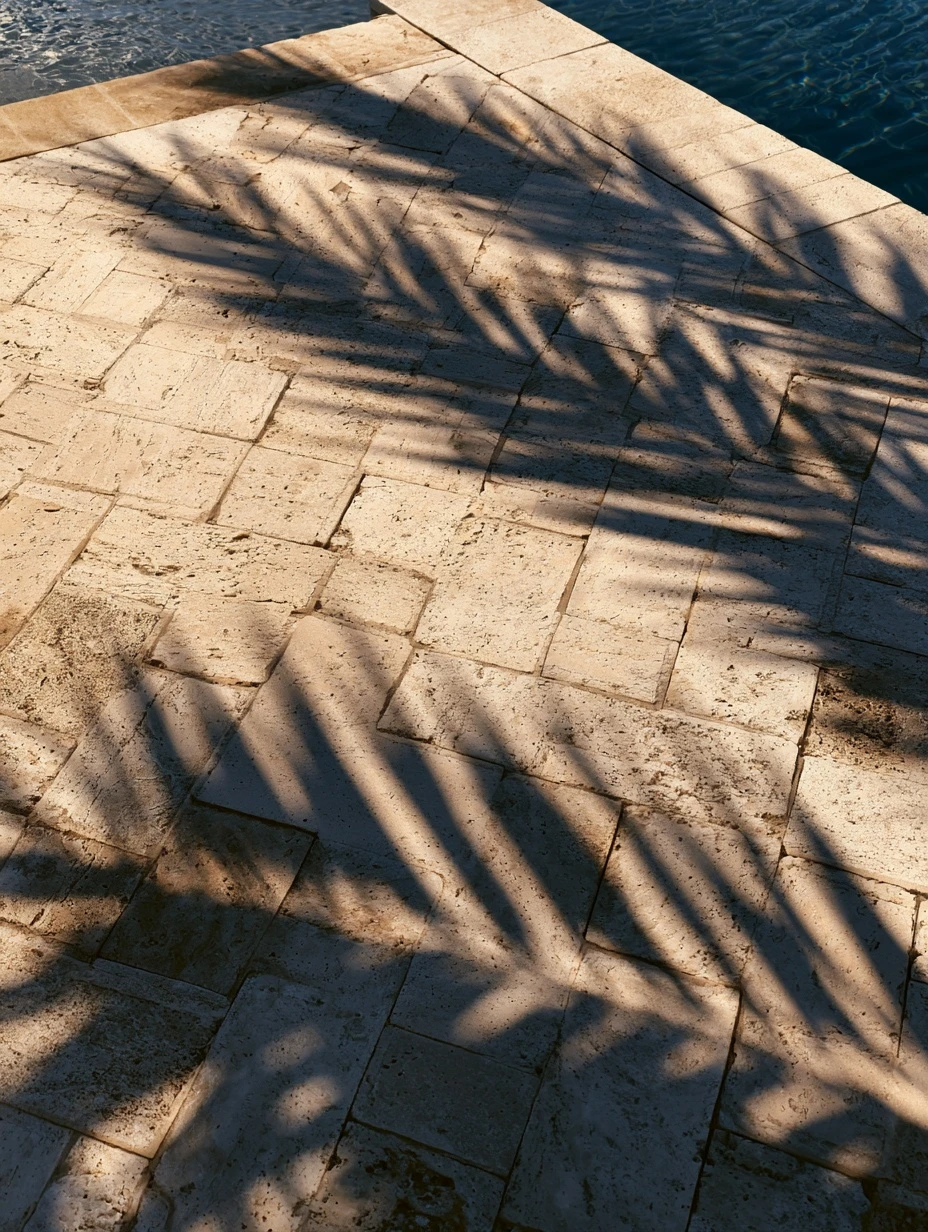
Cooler than concrete and dense stone, yes. Cool, no. Unfilled travertine sheds heat through its surface voids, but color and exposure decide as much as material: a dark stone in full sun runs hotter than a pale paver in shade. Any exposed deck is hot at two in the afternoon in August. The specification that matters is stone, shade and exposure together, chosen for crossable rather than cold.
The claim on every supplier site is that travertine stays cool. Half of that is physics and half is marketing, and they are worth separating. Unfilled travertine is full of small natural voids, which makes it less dense than concrete or marble. Less density means less thermal mass near the surface, so the stone stores less of the morning’s heat and sheds what it takes on faster. That part is real, and it is why a travertine deck is often crossable barefoot when the concrete beside it is not.
Color and exposure then decide as much as the material does. A dark walnut travertine in full sun runs hotter than a pale concrete paver in afternoon shade, which is why the honest specification is never just travertine. It is stone, shade of stone and exposure together. The barefoot test is the one owners care about and the one that gets left out of quotes: a deck that is unusable between noon and four in August has failed at its actual job, however good it looks in photographs.
So when a neighbor’s stone deck in Park Shore is untouchable by mid afternoon, the material class is rarely the culprit. Somebody chose a dark stone for a west-facing exposure, and no stone would have saved that choice. Every exposed deck in Naples is hot at two in the afternoon in August. The difference between a good specification and a bad one is whether you can walk it, and that difference is real, physical and worth planning for.
It is also why we talk about the deck’s orientation and shade before we talk about stone samples. A pergola, a mature tree or simply choosing the lighter end of a travertine range does more for August than any brochure claim about the material.
Part two
Which travertine finish is right at a pool?
Tumbled or brushed, almost always. Those finishes keep their texture wet, which is what bare feet need at a pool edge. Honed and filled travertine looks refined in a showroom and gets slick when wet, so it belongs on a covered lanai rather than an open deck. Finish decides slip behavior more than material does, and it is specified, not defaulted.
Travertine leaves the fabricator in several finishes and they behave differently the moment they are wet. Tumbled stone has been run until its edges and face soften into a weathered texture, and that texture is what bare feet grip. Brushed stone keeps a similar low relief surface. Honed stone is ground to a dull sheen, and filled and honed stone reads refined and even in a showroom, then turns slick with pool water on it. The showroom is dry. The deck never is.
Filling is a separate decision from finish. Travertine for horizontal work is usually supplied with its natural voids filled with a color-matched cementitious or epoxy fill. Left unfilled, the open voids drain splash water and add grip, but the Natural Stone Institute notes that in heavily trafficked paving, thin-walled cavities near the surface can open into holes under foot traffic, and filling holes that appear after installation is accepted practice (Natural Stone Institute, Dimension Stone Design Manual, Travertine chapter, 2022). Neither answer is wrong; they age differently, and you should choose knowing that.
Two questions sort deck-grade travertine pavers from tile-grade material quickly. First, ask whether the stone is specified to ASTM C1527, the standard specification for travertine dimension stone, which the Natural Stone Institute writes its own travertine specification around (ASTM C1527/C1527M-23). Second, ask to see your finish with water on it. A supplier who hesitates at either question has answered both.
Part three
Should a travertine deck be sealed?
It is a genuine choice, not a default. Sealing deepens color, adds sheen and resists staining, which matters with iron in well water out east. It also changes the look permanently, and the wrong product can trap moisture in porous stone. Unsealed travertine on a well drained deck is a legitimate answer. We would rather walk the deck and say which, than quote an interval unseen.
Sealing changes two things at once, protection and appearance, and it is permanent enough to deserve a real decision. A penetrating sealer slows staining from leaves, fertilizer and irrigation overspray, which matters most out in Golden Gate Estates, where iron in well water can print rust-colored marks on pale stone. Enhancing sealers go further and deepen the color while adding sheen. Some owners want exactly that. Others chose travertine for its dry, matte face and would quietly resent the change.
The wrong product is worse than none. Travertine absorbs between 0.10 and 2.5 percent of its weight in water (Natural Stone Institute, Dimension Stone Design Manual, Travertine chapter, 2022), and a film-forming sealer over that porosity can trap moisture inside the stone, where it shows up as clouding and, in bad cases, surface loss. Anything applied to travertine near a pool needs to breathe.
Unsealed travertine on a deck that drains well is a legitimate answer, not neglect. Suppliers publish sealing intervals as a rule, but an interval quoted without seeing the deck is a schedule, not advice. Sun exposure, tree cover, irrigation overspray and water chemistry set the real cycle, and they differ street by street. We would rather walk the deck and say seal it or leave it, with reasons attached.
Whichever way that decision goes, the maintenance signal to watch is the joints, not the stone. Washed-out joint sand is what lets individual pieces start moving, and once pieces move the deck stops reading as flat. The cleaning, re-sanding and sealing process itself lives on our paver and stone sealing page; this page’s job is the decision on stone.
Part four
Shellstone, travertine or marble near salt water?
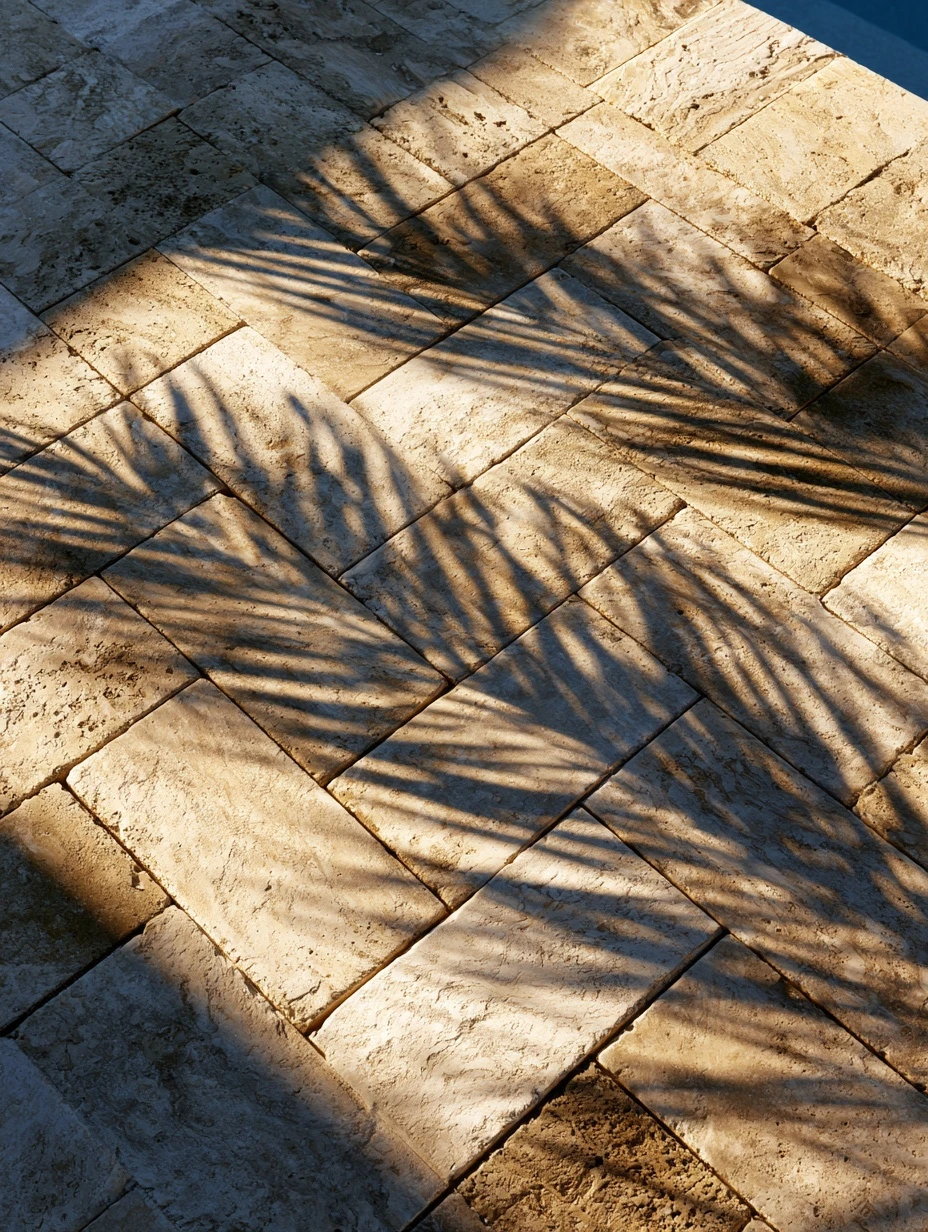
All three outlast a stamped overlay on the coast. Shellstone is softest and most porous, weathers fastest and wears its patina openly, which some owners want. Travertine holds its face longer in salt air. Marble is denser, runs warmer and must be tumbled or brushed near water. Two streets from the Gulf, the honest question is how you want the deck to age.
Two streets from the beach in Vanderbilt Beach, salt air is not a hypothetical, and it has usually already claimed one surface before we are asked about the next one. Shellstone is the softest and most porous of the three stones. It is a Florida limestone full of visible shell fragments, and it weathers openly: edges soften, the face gains texture, the color quiets into a patina. Owners who choose a shellstone pool deck for that character are rarely disappointed by how it ages, because aging is the point. Owners who expect it to hold a crisp factory face near the Gulf will be.
Travertine is denser and holds its face longer in salt spray, which is why it is the default on the coastal streets of Park Shore and The Moorings. It is still a calcium stone and salt still works on it slowly, but it stays close to its installed appearance for years without asking for much beyond a rinse and sound joints.
Marble is denser again, runs warmer at midday, and near water must be tumbled or brushed, never polished. The fuller marble and travertine comparison sits with the material overview on our pool deck pavers in Naples page. What all three share is the thing that matters near the Gulf: they are solid stone, the same material all the way through, so weathering exposes more stone. A stamped concrete overlay is a thin decorative skin over concrete, and coastal sun and salt find its edges and its color within a few years. That is usually the story behind a deck being paid for twice.
Part five
French pattern, coping and the pool-side seam
French pattern is a repeating module of four stone sizes. It hides natural variation and small cuts, and it asks for a tighter base tolerance than running bond. It ends at a border and at the coping, and the coping sits on the pool’s bond beam. We supply deck and coping from one batch and check the beam before setting stone, under one contract, on one schedule.
French pattern is a module of four stone sizes, from a small square up to a large rectangle, repeated in a fixed arrangement so no joint runs long in any direction. The mixed sizes hide the natural variation between stones and swallow small cuts, which is why the pattern and the material are so often sold together. The cost of that forgiveness is underneath: with four sizes meeting in short joints, the base has to be flatter than running bond requires, because every small hump or dip surfaces somewhere in the module as a rocking stone or a proud corner.
The pattern also has to end somewhere, and where it ends is where a deck is won or lost visually: a border course at the deck edge, cuts around planters and radius work, and the coping line at the pool. Coping is not deck. It is the shaped stone that caps the pool’s bond beam, and that beam is pool structure doing structural work.
That is why a deck quote sometimes excludes the coping and calls it pool work. It is pool work. But when deck and coping come from two contractors, the joint between them has two owners, which in practice means none, and stone from two batches, which the eye picks up immediately at the one line everyone looks at. If that joint opens or the coping loosens a year later, each contractor can point at the other with a straight face.
We set deck and coping from the same stone batch, check the bond beam before any coping goes down, and carry both under one contract, on one schedule, with one accountable contractor. Where coping is the only problem, that work stands on its own: see pool coping replacement.
Part six
Does natural stone need a different base?
- 4inches of compacted base, minimum, under a pedestrian deck per the industry spec
- 98percent standard Proctor density the base spec requires (CMHA, PAV-TEC-002, 2022)
- 2.5percent of its weight in water travertine can absorb (Natural Stone Institute, 2022), why the base must drain
No. The base specification is the same as for concrete pavers, and it is what decides how the deck lasts. The industry standard calls for a compacted aggregate base of at least 4 inches under pedestrian areas and 6 inches under residential driveways, compacted to 98 percent standard Proctor density, with the finished base surface within three eighths of an inch under a 10 foot straightedge (CMHA, PAV-TEC-002, 2022).
Those figures come from the Concrete Masonry and Hardscapes Association, the technical body that absorbed the Interlocking Concrete Pavement Institute, and they apply to the ground preparation regardless of what goes on top (CMHA, Construction of Interlocking Concrete Pavements, PAV-TEC-002, 2022). Beautiful stone on an under-compacted base moves exactly like cheap stone on an under-compacted base.
What is stone-specific is how loudly a base failure shows. Natural stone pieces vary more than pressed concrete pavers, the joints are tighter, and French pattern multiplies the corners that can sit proud, so movement appears sooner and reads worse. That is the whole of the stone-specific story. The full base build, from subgrade to bedding sand, is told once, on the hub page about how we build deck bases, and it applies here unchanged.
Where a stone deck has already moved, resetting is usually possible if the base underneath is still sound. If the base has gone, resetting is a repair with a known expiry date, and we will say so before you spend money on it. See pool deck repair.
Choose the surface
Which deck surface fits how you live outside?
Four surfaces do most of the work in Collier County. They differ less in looks than in how they behave in August, wet, and ten years in.
- Barefoot in August
- Among the coolest choices. The stone breathes, so it sheds heat instead of banking it.
- Wet grip
- Naturally textured surface; tumbled finishes grip well around spillovers and steps.
- Salt air
- Happy near salt, but it is porous, so sealing decides how it ages.
- Upkeep
- Periodic resealing. Skip it and the pores start holding stains instead of shrugging them off.
The default for a reason: barefoot comfort and a look that matches the Naples build era.
- Barefoot in August
- Cool underfoot, close to travertine. Light colors matter more than the stone.
- Wet grip
- Depends entirely on the finish. Polished marble near water is a mistake; sand-blasted or tumbled is not.
- Salt air
- Dense and durable, but acids etch it. Chlorine splash and the wrong cleaner both leave marks.
- Upkeep
- The most particular of the four. It rewards owners who keep to a sealing schedule.
The formal choice. Crisp veining and a brighter deck, for owners who will maintain it.
- Barefoot in August
- Runs warmer than stone in dark colors; pale tones stay reasonable.
- Wet grip
- Manufactured with a rated slip texture. The most predictable wet surface of the four.
- Salt air
- Effectively immune. Nothing for salt or chlorine to get into.
- Upkeep
- The lowest of the four. No sealing; rinse it.
The modern, low-maintenance pick. Clean lines and color that does not shift over the years.
- Barefoot in August
- The warmest of the four, especially in the popular darker blends.
- Wet grip
- Good texture out of the box; smooths gradually where the traffic is.
- Salt air
- Fine structurally, but color is a surface layer. Coastal sun and salt fade it first.
- Upkeep
- Sealing keeps the color; joint sand wants topping up every few seasons.
The workhorse. The widest range of shapes and patterns, and the easiest to repair one paver at a time.
Straight answers
Questions Naples owners actually ask
 Clayton Waggoner Owner, Splash Pools LLC
 Clayton · Owner
Natural stone generally runs cooler than concrete on an exposed deck, and shade of the stone matters as much as the material. A light travertine will be noticeably cooler underfoot at two in the afternoon than a dark paver of any type. Clayton · Owner
Finish decides that more than material. Travertine is available in finishes with very different surface textures, and a pool deck wants one specified for wet barefoot traffic rather than whatever looks best dry in a showroom. For an open pool deck that means tumbled or brushed; honed and filled surfaces get slick when wet and belong under a roof. Clayton · Owner
Natural stone is porous and it can take marks, which is why sealing is worth a real conversation rather than a default yes or no. Iron in well water is the one to plan around if you are out in Golden Gate Estates. Clayton · Owner
We quote after seeing it, because four things drive the number more than square footage: the stone and finish class, how much base preparation the ground needs, whether the coping and the beam under it are sound, and the pattern, since French pattern takes more cutting and tighter tolerance than running bond. Call 239-450-5933 and we will come look. Clayton · Owner
The work is outside, and the loud part comes first: demolition and base compaction in the opening days. After that it is quieter stone setting and cutting. We keep access to the lanai where the layout allows, and one contractor handling deck, coping and the pool side means one schedule and one person to call, not a sequence of trades to coordinate. Clayton · Owner
Deck, coping and the pool structure the coping sits on, under one contract. The owner is Clayton Waggoner, serving Naples, Marco Island, Bonita Springs and Estero. Useful to have ready: your neighborhood, whether an architectural review board is involved, photos of the existing deck and coping, and the finish you want, checked wet rather than dry. Call 239-450-5933.Talk to Clayton
Send the details, get a call back.
A sentence or two is enough. You get a call back from the person who does the work, not a dispatcher.
Service area
Where we work
Click any marker. What fails is genuinely different from one neighborhood to the next, and the card says which.
Where we work
Naples and Collier County, plus Marco Island, Bonita Springs and Estero. What fails is different in each, and that is what decides the work.
- Port Royal waterfront, architectural review, deck must match the house
- Old Naples pools built in the seventies and eighties, due for everything at once; original skimmers
- Aqualane Shores canal homes, deck movement near the seawall separates coping
- Park Shore Gulf Shore Boulevard salt air hits the tile line first; seasonal vacancy
- The Moorings direct salt air exposure, waterline tile failure
- Coquina Sands seventies and eighties pools; decks poured over uncompacted fill
- Royal Harbor canal homes, high water table hides leaks; coping separation
- Grey Oaks gated architectural review on anything visible from the street; spa additions
- Quail West natural stone decking matched to the house; spa additions
- Pelican Bay empty April to November; automation and heat pumps for year-round swimmers
- Lely Resort natural gas supply; builder decks aging out; year-round pump runtime
- Fiddler's Creek natural gas heater sizing; builder-era paver decks losing their base
- The Vineyards year-round swimming, heat pumps and variable speed payback
- Naples Park mature landscaping into pool plumbing; original skimmers; storm-loaded filters
- Pine Ridge Estates mature landscaping finds underground pool plumbing
- Vanderbilt Beach equipment pads corrode fast; storm season loads filters
- Golden Gate Estates well water iron staining on marcite; propane rather than natural gas
- Isles of Capri canal water table hides leaks; heavy equipment-pad corrosion
- Marco Island barrier island salt air corrodes heaters from the inside out
- Bonita Springs pool decks and patios on Southwest Florida soil
- Estero deck and patio base engineered for local soil
- Ave Maria newer east-county builds, patios and walkways matched to existing hardscape
Related services
Pool deck pavers in Naples, built on a base that lasts →Pool deck repair in Naples, and whether resetting will actually hold →Paver sealing in Naples, and when to keep your money →Pool coping replacement, and the beam underneath it →From the insights
Are paver pool decks impervious area in Collier County? →Can a cracked pool deck be resurfaced, or does it have to come out? →Travertine, marble or porcelain: which pool deck actually stays coolest? →Why do paver decks sink and rut, and how is the base actually built? →Where this comes up most
Sources
Ready when you are
Tell us what the pool is doing.
A sentence or two is enough. You get a call back from the person who does the work, not a dispatcher.