
Insights · Decks and pavers
What are the steps of a pool deck renovation, and what decides how long each one takes?
Most of a pool deck renovation happens before and after the days the new surface goes down. There is a paperwork stage, a wait before digging that Florida law sets, a base nobody sees again, a laying sequence with a rule for the end of every working day, and a sealing step that waits on the weather. This article walks the steps in order and names, for each one, what actually sets the clock.
 Clayton Waggoner, Owner and Managing Member, Florida license CPC1461352 · Published November 8, 2026 · 20 min read
A pool deck renovation is any job that replaces or rebuilds the walking surface around a pool: an overlay bonded to the existing slab, pavers or stone laid over the old concrete, or a full tear-out to the soil with a new base. The steps below follow the longest of those, a paver or stone deck built from the ground up, and say where the shorter routes skip a step.
The short version
What are the steps of a pool deck renovation, in order?
The table below is the whole job on one screen. The middle column is the honest answer to how long each step takes, which is what it depends on. The right column holds the only figures a primary source attaches to a step. Everything else turns on your lot, your materials, your approvals and the weather, and a week count printed for it would be invented.
Two of the published numbers are legal rather than technical. Florida's one-call law sets the wait before digging and the life of the notice (Florida Legislature, 2026)4. The rest come from the paver industry's construction and maintenance tech notes, which set a rule for the end of each working day and the drying windows around a sealer (Concrete Masonry and Hardscapes Association, 2022)12.
If the deck is part of a larger pool remodel, these steps slot into the pool's own sequence, and the deck work is usually planned around the coping and the new interior. How the county orders a pool job, including the survey that lands in the middle of it, is set out in how long a pool remodel takes in Collier County.
| Step | What decides how long it takes | Published figure |
|---|---|---|
| 1. Decide the scope | A look at the slab or base, the material chosen and whether it is available | None published |
| 2. Approvals | Association review, whether a permit is needed, the stormwater plan type | No review time published |
| 3. Utility locate | The notice period in the statute | Not less than 2 full business days before digging; notice valid 30 calendar days (Florida Legislature, 2026)4 |
| 4. Tear-out and subgrade | Deck size, what is found underneath, how wet the ground is | None published |
| 5. Base and edge restraints | Depth, number of lifts, density testing | None published |
| 6. Laying and cutting | Area, pattern, number of cuts at the coping and edges | None published |
| 7. Compaction and joint sand | The end-of-day rule, rain | Joints filled and compacted within 6 feet of the laying face at the end of each day (Concrete Masonry and Hardscapes Association, 2022)1 |
| 8. Cleaning and sealing | Efflorescence, a dry surface, calm wind, drying | At least 24 hours dry before most sealers; traffic off until dry, typically 24 hours; efflorescence may peak in as short as 60 days (Concrete Masonry and Hardscapes Association, 2022)2 |
What has to be decided before anyone digs or grinds?
Each route has a condition that rules it in or out, and each has its own article. An overlay only works over a slab whose cracks have stopped moving, which is the subject of whether a cracked pool deck can be resurfaced. Pavers over concrete raise the surface and follow the slab's slope, covered in pavers over a concrete pool deck. A rebuild is the answer when the base itself has failed.
The material is the second decision, and it changes the paperwork as well as the look. Collier County's stormwater guide counts cool deck, which it describes as spraycrete, and pavers with a limerock base as impervious area, and counts crushed stone and pavers without a limerock base as pervious (Collier County, 2025)7. So the base under the stone, not only the stone, decides how the county counts the deck. How color and finish change the temperature underfoot is in which pool deck material stays coolest.
Drainage belongs in this decision, not after it. A paver surface follows its base and an overlay follows its slab, so a deck that holds water today will keep holding it unless the fall is corrected as part of the job. Why water pools on a Naples pool deck covers what that correction involves.
What sets the clock at this step is the inspection and the material. A contractor cannot scope a rebuild until someone has looked at what is under the surface, and a particular stone or paver has its own availability. Neither has a published number, and both are worth asking about before anyone names a start date.
Which approvals come first, and what does the county ask about the deck?
The county's list is specific. Among the construction plans it wants for an in-ground pool is the line "Provide proposed deck material: wood, concrete, or sand set pavers" (Collier County, 2025)6. The same requirements say the site planning document may need to be certified if new impervious area is over 400 square feet, signed and sealed by a licensed surveyor and mapper, architect or engineer (Collier County, 2025)6.
The stormwater rule travels with the permit. The county's guide says stormwater plans must be included as part of an application for a building permit which adds or modifies the impervious area on the property (Collier County, 2025)7. Its worksheet names pool decks among the existing impervious area an applicant adds up (Collier County, 2025)7. Which plan type applies, and who may draw it, is laid out in whether paver pool decks count as impervious.
Whether a deck-only job needs a building permit at all is a question we could not settle from a county page. The county's exempt-work page and its pool requirements do not answer it for a deck on its own, so ask the permit office about your exact scope before the contract is signed. Inside the City of Naples or on Marco Island, the city's building department answers instead, as which office issues your pool permit explains.
The association step has rules of its own, and what a board may ask for and how it must say no is in HOA approval for a pool remodel. What sets the clock here is two queues nobody on site controls: the board's schedule and the permit review. Approvals are also the one step you can start before a crew is booked.
Why does the job wait two business days before any digging?
The definitions are broad. Excavation means any manmade cut, cavity, trench or depression in the earth's surface formed by removal of earth, intended to change the grade or level of land or to penetrate or disturb the surface of the earth (Florida Legislature, 2026)3. An excavator is any person performing excavation or demolition operations, and the system is a free-access notification system (Florida Legislature, 2026)3.
There is a homeowner exemption, and it is narrow. It covers excavation or demolition by the owner of a single-family residential property, only up to a depth of 10 inches, made entirely on that land, with due care and no encroachment on a utility's right-of-way or easement (Florida Legislature, 2026)5. The text extends it to work done for the owner by a member operator or an agent of one, and does not mention a hired contractor (Florida Legislature, 2026)5.
Depth matters because a rebuilt paver deck goes deeper than it looks. The paver industry's construction note calls for a minimum base thickness after compaction of 4 inches for patios and pedestrian areas over well-drained soils, under a nominal 1 inch bedding layer and the paver itself (Concrete Masonry and Hardscapes Association, 2022)1. Add the old deck coming out above that and the dig is rarely shallow.
What sets the clock is the calendar. On our reading of "full business days," a notice given on a Thursday clears no earlier than the Tuesday after, with Friday and Monday as the two days. And because the notice is valid for 30 calendar days (Florida Legislature, 2026)4, a start that slips past that window needs a new one.
What happens during tear-out and subgrade preparation?
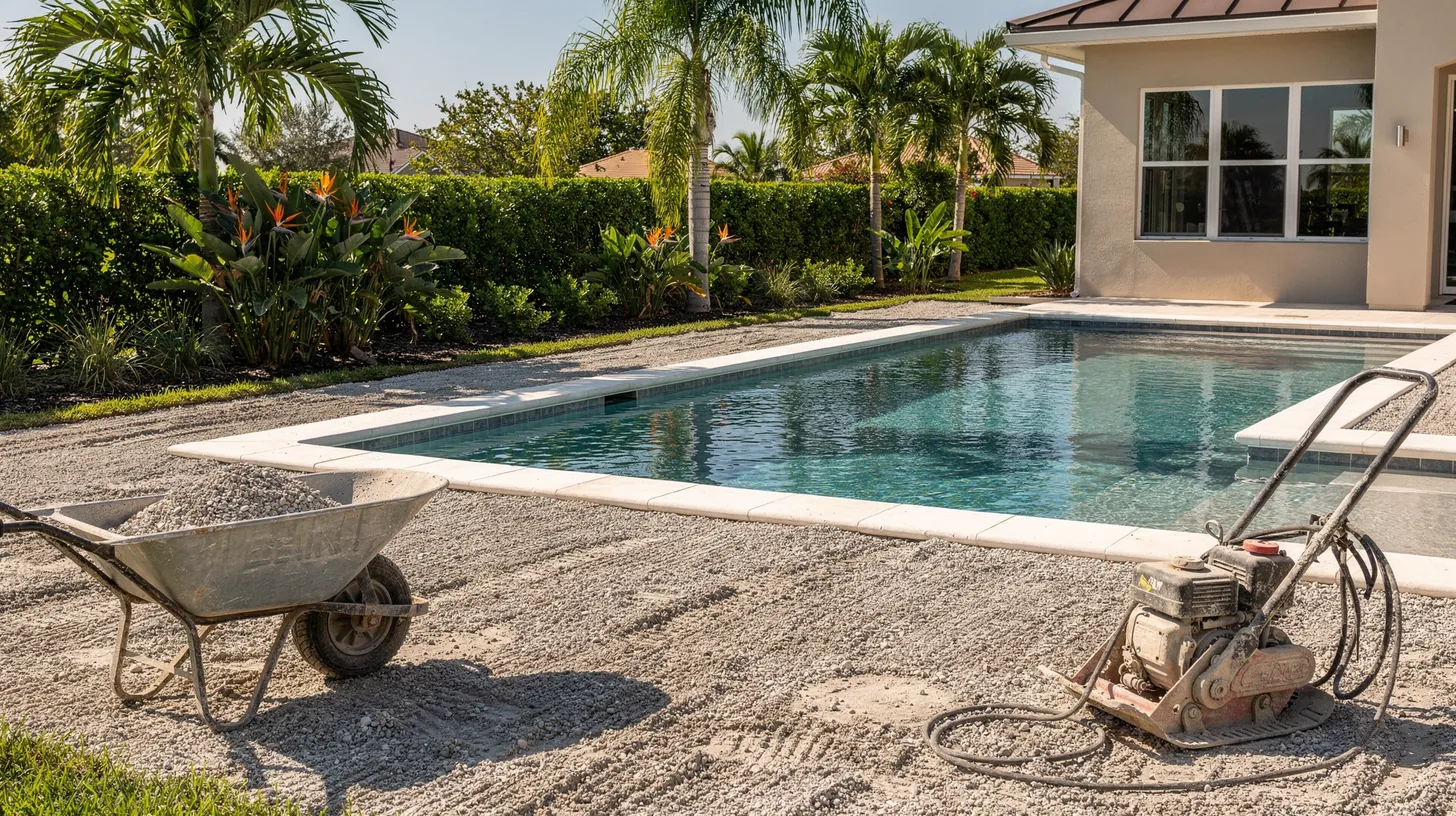
The note's installation steps begin with job planning, layout, and excavating and compacting the soil subgrade, followed by optional geotextile, the base, edge restraints, bedding sand and the pavers (Concrete Masonry and Hardscapes Association, 2022)1. The order is not a preference. Each layer is only as flat and firm as the one under it, and the subgrade is the first of them.
Geotextile is the step most likely to matter on a low Naples lot. The note says it may be used where soil remains saturated part of the year, laid with a downslope overlap of at least 12 inches, turned up along the sides of the excavation, and with no wrinkles on the bottom (Concrete Masonry and Hardscapes Association, 2022)1. Ask whether the quote includes it, and why or why not.
Tear-out is also when surprises appear. A leaking line under the slab, a soft patch where an old trench was never compacted, or a coping detail that ties into the deck shows up here and not before. What the shape of an old settlement says about its cause is on our pool deck repair page, and what a careful contractor checks before quoting is in how to choose a pool deck contractor.
A good contract says in advance what happens when the ground turns out worse than expected: work stops, you are shown it, and a priced change is agreed in writing before anyone carries on. What sets the clock at this step is deck size, what is found underneath and how wet the ground is, and none of the three has a published duration.
How is the new base built, and when can the pavers go on it?
The detail of base thickness, lift depth and density is the subject of why paver pool decks sink and rut, and it is not repeated here. For the schedule, two numbers matter. The base is spread and compacted in lifts of 4 to 6 inches, and the finished base surface should not vary more than 3/8 inch under a 10 foot straightedge (Concrete Masonry and Hardscapes Association, 2022)1.
Those two numbers are why the base cannot be hurried. More depth means more lifts and more passes of the compactor, and a base that fails the straightedge is corrected in the base. The note says bedding sand should not be used to make up for an uneven base (Concrete Masonry and Hardscapes Association, 2022)1.
The edges come next. The note says edge restraints are typically installed before the bedding sand and pavers are laid (Concrete Masonry and Hardscapes Association, 2022)1. On a pool deck the coping often forms the water-side edge, which is why coping work and deck work are planned as one sequence when both are being done, and why our pool decks and pavers page treats the coping as part of the deck.
What sets the clock: depth, the number of lifts and any testing. A rebuild over a deck that sank usually needs more base work than one over a deck that was sound, which is why the scope decision at the first step decides how long this one runs.
What happens on the days the pavers are laid and cut?
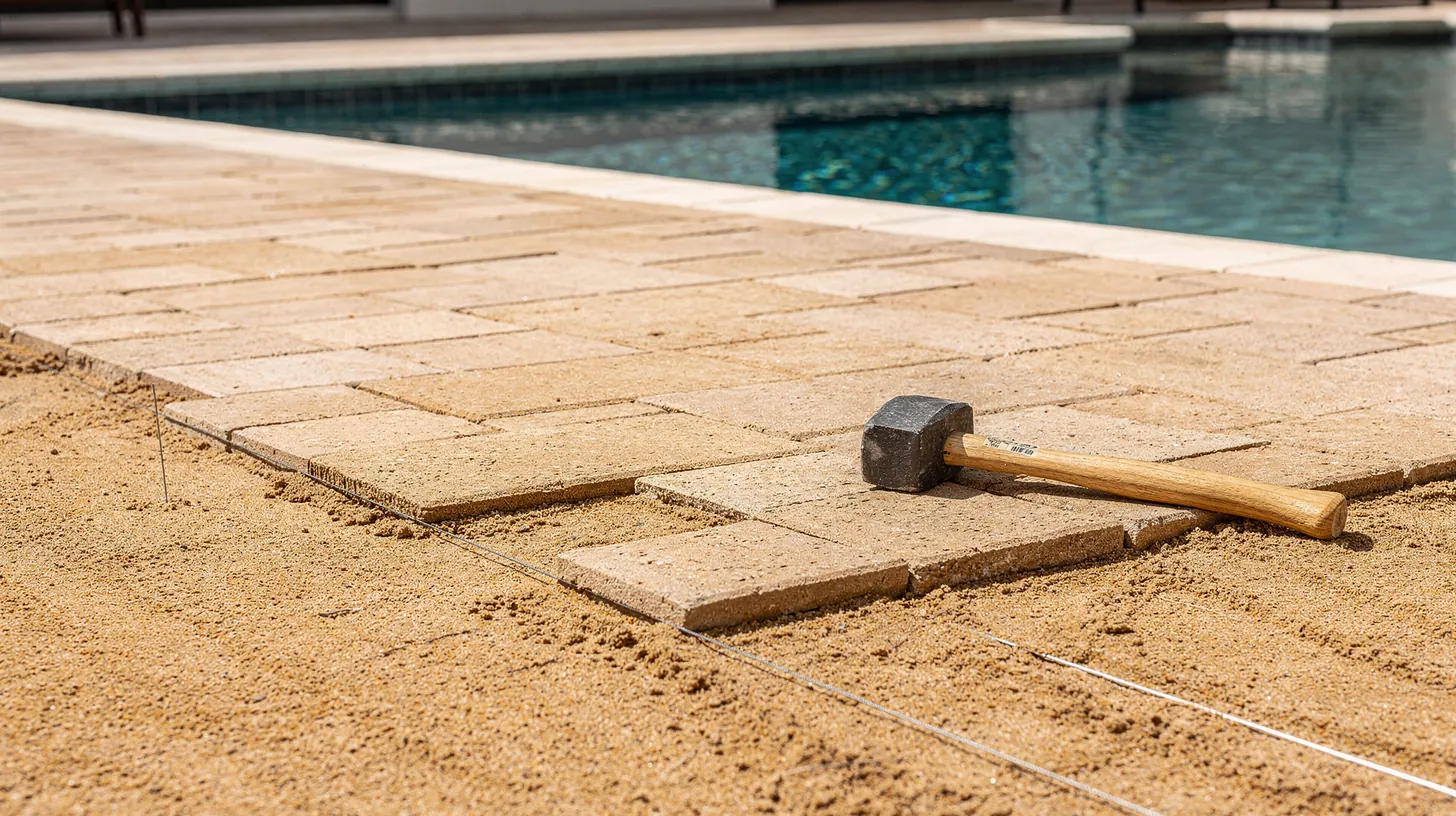
Drawing from several bundles is how an installer blends color across the deck instead of leaving one patch from one pallet. Chalk lines snapped on the bedding sand or strings pulled across the pavers keep the courses straight (Concrete Masonry and Hardscapes Association, 2022)1, and the straightness is something you can check later with a string of your own.
Cutting follows rules too. Gaps greater than 3/8 inch should be filled with cut pavers, and for street applications the note says not to cut pavers to less than one third of their original size, filling the void with two cut pavers instead (Concrete Masonry and Hardscapes Association, 2022)1. A pool deck is not a street, so treat that limit as a reference point and ask how the pieces at the coping will be cut.
The note says saws should carry equipment to reduce dust, because the dust contains respirable crystalline silica (Concrete Masonry and Hardscapes Association, 2022)1. Federal construction rules list handheld power saws, walk-behind saws and stationary masonry saws, and for each the control is a saw equipped with an integrated water delivery system that continuously feeds water to the blade (Occupational Safety and Health Administration, 2026)8. Those rules protect the crew. For an owner, the practical question is where the cutting station sits relative to the pool, the screen and the open doors.
The note recommends herringbone patterns at 45 or 90 degrees in all street applications (Concrete Masonry and Hardscapes Association, 2022)1. A pool deck carries feet rather than cars, so the pattern there is a design choice, and a pattern with more cuts at a curved pool edge takes longer to lay. What sets the clock: deck area, the cut count and rain.
What finishes each day of paving, and what does rain change?
The compactor the note describes exerts a minimum of 5,000 pounds of centrifugal force, makes at least two passes to seat the pavers in the bedding sand, then makes two or three more as dry joint sand is spread into the joints until they are full (Concrete Masonry and Hardscapes Association, 2022)1. Joint sand may be finer than the bedding sand, wet sand should be spread on a clean hard surface to dry first, and the excess is then removed (Concrete Masonry and Hardscapes Association, 2022)1.
The note's acceptance figures for the finished surface are a variation of no more than 3/8 inch under a 10 foot straightedge, and joint lines within 1/2 inch over 50 feet of a taut string line (Concrete Masonry and Hardscapes Association, 2022)1. Both can be measured on the day by an owner with a straightedge and a string.
Rain is the variable no contract can fix. At Naples Municipal Airport, NOAA's 1991 to 2020 normals count 71.6 days a year with a tenth of an inch of rain or more (National Oceanic and Atmospheric Administration, 2021)9. On our sum of the monthly normals, 47.1 of those days fall from June through September, against 12.6 from December through April (National Oceanic and Atmospheric Administration, 2021)9.
That split is the reason the daily rule exists: a laying face left unfilled and uncompacted overnight is exposed to whatever falls. Neither figure is a forecast for your job. Together they describe how many wet days a summer schedule has to work around compared with a winter one. What sets the clock at this step: area, the daily rule and the wet days in the window.
When can the new deck be sealed and walked on?
The tech note's other conditions are about the sealing day itself. For sprayed applications outdoors the wind should be calm so the coat goes on evenly, automatic sprinklers should be off during cleaning, sealing and drying, and a water-based sealer's curing time varies with temperature, wind and humidity (Concrete Masonry and Hardscapes Association, 2022)2.
Sealing is a choice rather than a step every deck needs. The same note says joint sand stabilization is generally optional and not required for many interlocking pavements, and that sealers normally need reapplying after a period of wear and weather (Concrete Masonry and Hardscapes Association, 2022)2. Which sealer suits this climate, and how to treat a haze that appears after sealing, are covered on our paver sealing page.
Cleaning before sealing has its own caution. The note says a large amount of water matters more to rinsing than high pressure, and that a low angle from a wide nozzle reduces the risk of dislodging joint sand (Concrete Masonry and Hardscapes Association, 2022)2. Joint sand blasted out at the first wash undoes the compaction step above.
Clayton's own rule about rain and an oil-based sealer is below. It is the reason a sealing day is picked from the forecast rather than from the calendar, and the reason this step has the least predictable start date of the eight.
So how long does a pool deck renovation take from start to finish?
Add up the published minimums and they are short: two full business days before digging (Florida Legislature, 2026)4, and a day of dry surface before a sealer plus a day of drying after it (Concrete Masonry and Hardscapes Association, 2022)2. Everything else, from the approval queue to the base to the laying, is set by the size and condition of the deck and by the weather.
Clayton's two answers on file describe his own work, not your schedule. One is his typical range for a full remodel that includes the deck. The other is a single deck job, a terrazzo paver replacement in Kings Lake, which took three weeks. One job is one job. It is not a norm, and the size, material and access on your deck will differ.
Approvals, where they apply, often run longer than any single step on site, and they are the part you can start first. The finish line belongs to the permit office if the job was permitted, and what the county checks at the end of a pool job is covered in how long a pool remodel takes. For the whole project, from the first crack to the last coat of sealer, see the pool deck renovation guide.
The useful question for any contractor is the one this article asks of each step: what decides how long this takes, and what happens to the schedule when it rains? A crew that answers both plainly has thought about the job you are actually buying.
Ask Clayton
Questions this article usually prompts
Tap a question. Clayton replies himself, here and on the phone.
Tap a question to ask
If this is the situation you are in
The whole project: What does renovating a Naples pool deck involve, from the first crack to the last coat of sealer? → Pool deck pavers in Naples, built on a base that lasts →Pool deck repair and resurfacing in Naples, and which one your deck needs →Paver sealing in Naples, and when to keep your money →Travertine and natural stone pool decks in Naples →References
- Concrete Masonry & Hardscapes Association, Tech Note PAV-TEC-002-22: Construction of Interlocking Concrete Pavements (revised 2022)
- Concrete Masonry and Hardscapes Association, Tech Note PAV-TEC-005-22: Cleaning, Sealing and Joint Sand Stabilization of Interlocking Concrete Pavement (2022)
- Florida Legislature, Florida Statutes 2026, s. 556.102 Definitions (Underground Facility Damage Prevention and Safety Act)
- Florida Legislature, Florida Statutes 2026, s. 556.105 Procedures
- Florida Legislature, Florida Statutes 2026, s. 556.108 Exemptions
- Collier County Growth Management Community Development, Swimming Pool permit application (PRSPL), form dated 27 January 2025
- Collier County Growth Management Community Development, Stormwater Plans and Impervious Area Worksheet, document dated 15 October 2025
- Occupational Safety and Health Administration, 29 CFR 1926.1153 Respirable crystalline silica, Table 1
- NOAA National Centers for Environmental Information, U.S. Climate Normals 1991-2020, Naples Municipal Airport (USW00012897)
- Laws of Florida, Chapter 2026-63 (CS/CS/HB 803), sections 11 and 12, approved May 6, 2026, effective July 1, 2026

The article is general.
Your pool is specific.
Tell us what the pool is doing, a sentence or two is enough. The person who wrote this is the person who calls back.