

NAPLES, FL · SPA
Spa remodels and new attached spas in Naples
A spa is a small pool with a much bigger heating problem. Get the sizing and the spillover right and it is warm when you walk out. Get them wrong and it is a feature nobody uses.
In short
What this work actually involves
Spa remodeling covers resurfacing, tile, and jet and blower repair on an existing spa, plus adding a new attached spa to an existing pool. It includes spillover and dam wall work, heater sizing to the spa volume, and automation. Splash Pools LLC is a Naples, Florida pool contractor owned by Clayton Waggoner, serving Naples, Collier County, Marco Island, Bonita Springs and Estero.
Part one
What decides whether a spa actually gets used?
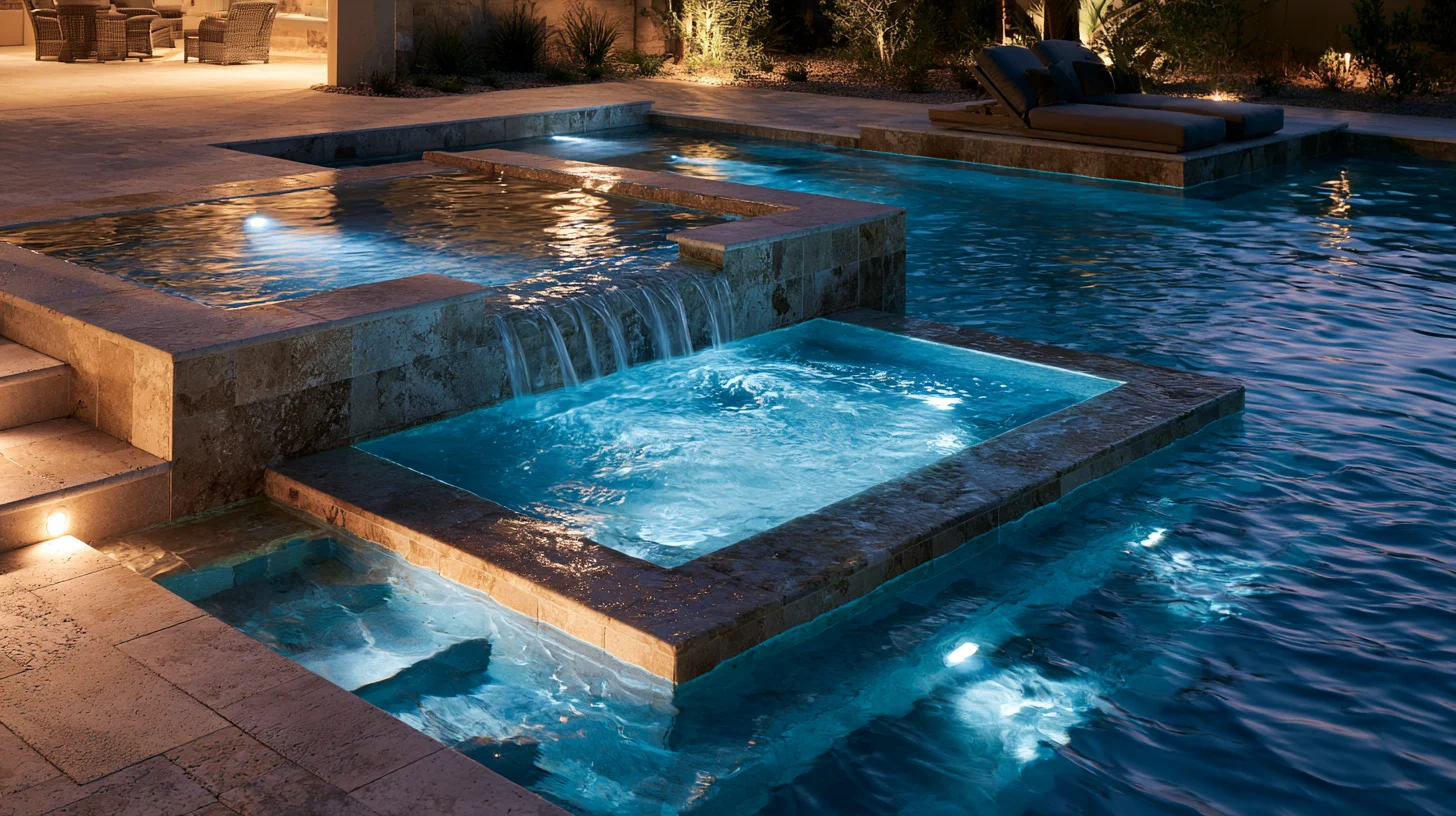
How long it takes to get hot. A spa that needs an hour of notice gets used on planned occasions; one that is ready in twenty minutes gets used on a Tuesday. That is a heater sizing and automation decision made at design time, and it is very expensive to change afterwards.
Spa volume is small relative to a pool but the target temperature is far higher, so recovery rate is what the heater is really being sized for. A pool asks a heater to hold a large volume a few degrees above ambient. A spa asks it to lift a few hundred gallons twenty degrees or more, on demand, while some of that heat spills straight back into the pool over the weir. A heater sized to the pool alone will do it, but slowly, and slowly is what kills the habit of using the spa at all.
The heater is only half of the heating question. A gas heater is rated in BTUs, and it only delivers its rating if the gas line feeding it can carry that load along with everything else on the meter. A large heater on a starved line runs like a small one, and no amount of waiting fixes it. This is why we look at the heater plate and the gas supply together before promising anything about warm water. See gas heater installation for how that sizing conversation works.
Automation is the other half. Being able to bring the spa up from a phone on the drive home is the difference between a spa that is used and an ornament with jets. The twenty minute spa is really a spa whose warm-up started before you got there. See pool automation.
The heater also has to be there when you want it, which in Naples means January, the exact stretch when heaters work hardest and fail most. Diana B. in Naples Park came to us with a failed pool heater and had it replaced on short notice, and that is the standard that matters for a spa, because a spa with a dead heater is not a spa. It is a cold bench with plumbing.
Part two
An attached spa is part of the pool, not an appliance
An attached spa shares the pool shell, its bond beam and much of its plumbing. The wall between them is structure, the spillover is a weir built into that wall, and the valves that hold the spa full overnight are part of the pool circulation. That is why spa problems are usually pool problems, and why the right trade for a spa is the one that owns the pool structure.
It helps to name the parts. The wall between the spa and the pool is the dam wall, a raised section of the same concrete structure the pool is made of, tied into the pool bond beam. The spillover is a weir built into the top of that wall, shaped so water sheets evenly over a lip and back into the pool. None of this is an accessory bolted on afterwards. It is the pool shell, continued.
The plumbing is shared too. In spa mode, valves turn so the pump pulls from the spa and returns heated water to the spa through its own jets. In pool mode the spa sits full while the pool circulates, and check valves are what keep it from quietly siphoning itself back down through the pipes. The blower pushes air into the jet lines for the boil most people picture when they picture a spa. Every one of those parts belongs to the pool system, not to a separate appliance.
This is why the trade matters. A hot tub is an appliance and an appliance technician is the right person for it. An attached spa is concrete, finish, tile, hydraulics and gas, which is pool contracting. When Clayton looks at a spa complaint, he is reading the whole structure and the whole equipment pad, because that is usually where the answer is.
It is also why the next section exists. When something goes wrong at the wall between the spa and the pool, it shows up in a handful of recognizable ways, and every one of them is a structural finding wearing a spa costume.
Part three
Spillway and dam wall problems: the spa leaks pools get
A spillover that has gone uneven or fallen to a trickle, a damp line on the spa wall that never quite dries, and a spa that quietly drains itself overnight are all one family of problem: water moving through or past the dam wall instead of over it. Which one you have changes the repair, so isolation testing comes before anything is opened.
The spillover complaint usually starts small. The even sheet of water becomes a trickle at one end, or the flow looks fine but a damp line appears on the pool side face of the spa wall and never quite dries. An uneven sheet can be as simple as scale or settlement putting the weir lip out of level, or a flow problem on the equipment side. The damp line is different. Water is supposed to travel over the top of that wall, and a face that stays wet says some of it is traveling through it instead.
The dam wall earns its problems honestly. It has hot, chemically aggressive spa water on one side, pool water on the other, and construction joints where the spa shell meets the pool shell. Its tile band takes the same punishment as any waterline, concentrated on a raised wall that never gets a break from the water. Where that band is failing, the fix is the same trade and often the same visit as waterline tile on the main pool.
The sneakiest version is the spa that drains itself down overnight while the system is off, then refills the moment the pump comes on, so for months nobody notices. The pool level holds; only the spa moves. That pattern points at the spa circuit, and the culprit is either a check valve letting the spa siphon down or a leak in the spa shell itself. The two repairs have nothing in common, which is why isolation testing settles the question before anything is opened. That page covers how the testing works; here it is enough to know the overnight drain is a finding, not a mystery.
The repairs run from simple to structural: relevel or reset the weir lip, regrout and reseal the tile band, swap a check valve, or open and rebuild a section of the wall face. Guessing at the top of that list when the problem lives at the bottom is how the same spillover gets redone twice. Diagnosis first is cheaper, and it is the discipline we bring to every pool repair.
One honesty note. A spillover redone cosmetically over a structural path will look right for a season and then fail the same way again. If the wall is passing water, the wall is the job, and we will say so even when the tile quote would have been easier to hear.
Part four
Can a spa be added to an existing pool?

Usually yes, as an attached spa sharing the pool structure and equipment. The work involves the shell, the plumbing, the heater capacity and the spillover detail. The constraint is more often the existing equipment pad and gas supply than the pool itself.
Structurally, a new attached spa is doweled and tied into the existing shell so the two behave as one structure rather than two neighbors. That connection detail, along with the new dam wall and its waterproofing, is the part of the job that decides how the spa ages. It is concrete work, done once, and worth doing by the trade that will stand behind the whole shell.
Spillover is the detail that makes an attached spa look designed rather than added. The height, the lip and the flow all decide whether it reads as one composition or as two pools next to each other. It is drawn and decided on paper, because it is nearly impossible to change gracefully after the concrete is in.
The equipment side is where the real feasibility question sits. A new spa adds heating demand, and usually a dedicated circuit, valves, a blower and controls. If the pad is already crowded or corroding, this is the natural moment to rebuild it rather than bolt more onto a failing base. See equipment pad rebuild.
So the honest feasibility check is not whether your pool can take a spa. It almost always can. It is whether the heater, the gas supply and the pad behind it can take one, and that is answered with a site visit rather than a hope.
Part five
Adding a spa in Grey Oaks, Quail West and the gated communities
In most gated communities, anything that changes the outdoor structure goes through architectural review, and that review often shapes the timeline more than the construction does. Starting the submittal early, with deck and coping drawings that match the existing hardscape, is what keeps a spa addition moving. We prepare for the review; we do not promise its outcome.
Here is the part competitors selling speed tend to skip: in Grey Oaks, Quail West and the surrounding gated communities, the architectural review board usually has to approve a spa addition before anyone touches concrete, and the review calendar answers to nobody. We cannot promise what a board will approve or when. What we can do is put a complete submittal in early, with drawings that answer the questions boards actually ask, because an incomplete packet is how a spa addition stalls for a season.
The question boards ask most is whether the finished work will look like it was always there. That is a drawing problem first and a crew problem second. Deck and coping that match the existing hardscape are straightforward when the same contractor is doing the shell and the stone, and much harder when the concrete and the paver work arrive on separate trucks with separate opinions. One contractor, one composition is the version review boards and neighbors both like. You can see our remodeling work in the neighborhood at pool remodeling in Grey Oaks.
Beyond the board sits the county, because an attached spa is a regulated structure, not landscaping. The Florida Building Code residential chapter on private swimming pools (2023 FBC Residential, Chapter 45) counts nonportable spas and hot tubs within its definition of a private pool, and it is the same chapter that governs barriers, electrical bonding and water heating equipment. A spa addition is permitted and inspected like the pool work it is.
Review boards and permit offices also expect a licensed contractor on the paperwork, and so should you. Any Florida pool contractor license can be checked in about a minute at the DBPR licensee search. Ask us for our number, then look it up, and ask every other quote for theirs too.
Part six
What goes wrong with older spas, and what a spa remodel includes
Hotter water drives chemistry harder, so a spa finish and tile line age ahead of the pool they share, and jets and blowers are mechanical parts that wear out on a long timescale. A spa remodel is the resurface, the tile and the mechanical rebuild done together while the shell is open, usually timed with the pool resurface it tends to precede.
Higher temperature drives chemistry harder. The same water that is stable in a pool is more aggressive in a spa, which is why spa interiors mottle and etch sooner, and why the tile band on the dam wall goes before the tile line on the main pool. A spa surface that looks worse than the pool it shares water with is normal aging, not evidence of a bad job.
Jets and air blowers are mechanical parts living in a wet, hot environment, and they are consumables on a long timescale. Jet internals seize, air lines clog, blowers weaken. Rebuilding them while the spa is drained and open is a fraction of the effort of reaching them afterwards, which is why they belong inside the remodel scope rather than on a someday list.
So here is what a spa remodel actually includes, in plain terms: drain and chip out the failed interior, repair the shell and the dam wall face where the chip-out exposes trouble, reset or replace the tile on the waterline and the spillway, rebuild the jets and fittings, check the blower and air lines while they are reachable, and bring the light and controls up to current parts. The finish work is what you see. The mechanical rebuild is what you feel a year later.
If the spa is being resurfaced, the pool interior is often close behind, because the spa is the early warning for the same finish aging in slower motion. Doing both together is one drain, one crew and one start-up rather than two. See pool resurfacing for how that start-up works and why it matters.
And where the spa is one item on a longer list, tile, coping, deck, equipment, it usually belongs inside a single planned project rather than a string of visits. That is what pool remodeling in Naples covers, and a consultation is the easy way to find out which version of the job your pool actually needs.
Plan the scope
What would your remodel actually touch?
Pick everything that bothers you about the pool. The tool shows which trades the fix involves and, more importantly, where they meet, because the seams are where split jobs fail.
Your scope so far
A new interior finish dies at the waterline. If the tile above it stays, the joint between old tile and new plaster is the first place the job shows its age.
Tile comes off with demolition that always disturbs the bond beam behind it, which is why tile-only quotes grow once the old mortar bed is open.
Coping sits on the same bond beam the tile hangs from, and the deck butts against its back edge. Three trades meet in a strip about a foot wide.
A settling deck is usually a base problem, not a paver problem. Relaying pavers over a failed base moves the same problem to next season.
The spillover is a plumbing calculation wearing a tile face. Retiling it without checking the flow behind it fixes how it looks, not how it runs.
A remodel is the cheapest moment to right-size the pump and filter. The plumbing is already open and the pool is already down.
More than one trade means sequencing decisions. What gets demolished first, what cures before what goes on top. One contract holds one company responsible for every seam above.
Straight answers
Questions Naples owners actually ask
 Clayton Waggoner Owner, Splash Pools LLC
 Clayton · Owner
That is a design decision rather than a fixed number. It depends on the spa volume, the heater size and the gas supply feeding it. We size to the recovery time you actually want, because that is what determines whether the spa gets used. Clayton · Owner
Often yes. The pool interior does not have to be redone to add an attached spa, though if the interior is close to end of life it is cheaper to resurface both while the pool is already drained and the crew is already there. Clayton · Owner
It depends on the heater size and the gas supply. A spa raises the recovery demand significantly, and a heater sized for the pool alone will heat it slowly. Both are checked against the spa volume before anything is committed. Clayton · Owner
Yes, with automation. Heat can be brought on remotely from a phone, so the spa is at temperature on arrival rather than starting from cold when they get there. It is one of the most common reasons Naples owners add automation in the first place. Clayton · Owner
Because the water is hotter and therefore more aggressive, so the finish and tile in the spa age faster than the same materials in the pool. A shared system will usually show wear in the spa first, which is normal rather than a sign the work was done badly. Clayton · Owner
It depends on whether the scope is the surface and tile alone, the jets and blowers as well, or a new attached spa with its heating and controls. The shell and the equipment pad decide more of it than the finishes do, which is why we look before we quote and put the scope in writing first. Call 239-450-5933. Clayton · Owner
Start with the heater and gas supply calculation, because the twenty minute target sets the sizing and the sizing sets what the supply has to carry. Then the architectural review, which usually governs the timeline more than the construction does. The deck matching is the straightforward part if the same crew is doing both.Talk to Clayton
Send the details, get a call back.
A sentence or two is enough. You get a call back from the person who does the work, not a dispatcher.
Service area
Where we work
Click any marker. What fails is genuinely different from one neighborhood to the next, and the card says which.
Where we work
Naples and Collier County, plus Marco Island, Bonita Springs and Estero. What fails is different in each, and that is what decides the work.
- Port Royal waterfront, architectural review, deck must match the house
- Old Naples pools built in the seventies and eighties, due for everything at once; original skimmers
- Aqualane Shores canal homes, deck movement near the seawall separates coping
- Park Shore Gulf Shore Boulevard salt air hits the tile line first; seasonal vacancy
- The Moorings direct salt air exposure, waterline tile failure
- Coquina Sands seventies and eighties pools; decks poured over uncompacted fill
- Royal Harbor canal homes, high water table hides leaks; coping separation
- Grey Oaks gated architectural review on anything visible from the street; spa additions
- Quail West natural stone decking matched to the house; spa additions
- Pelican Bay empty April to November; automation and heat pumps for year-round swimmers
- Lely Resort natural gas supply; builder decks aging out; year-round pump runtime
- Fiddler's Creek natural gas heater sizing; builder-era paver decks losing their base
- The Vineyards year-round swimming, heat pumps and variable speed payback
- Naples Park mature landscaping into pool plumbing; original skimmers; storm-loaded filters
- Pine Ridge Estates mature landscaping finds underground pool plumbing
- Vanderbilt Beach equipment pads corrode fast; storm season loads filters
- Golden Gate Estates well water iron staining on marcite; propane rather than natural gas
- Isles of Capri canal water table hides leaks; heavy equipment-pad corrosion
- Marco Island barrier island salt air corrodes heaters from the inside out
- Bonita Springs pool decks and patios on Southwest Florida soil
- Estero deck and patio base engineered for local soil
- Ave Maria newer east-county builds, patios and walkways matched to existing hardscape
Related services
Pool remodeling in Naples, handled as one project →Gas pool heater installation, sized to the whole run →Pool leak detection in Naples, with a finding before a shovel →Pool resurfacing in Naples, including the part everyone skips →From the insights
Does Resurfacing a Pool Need a Permit in Collier County? → Ready when you are
Tell us what the pool is doing.
A sentence or two is enough. You get a call back from the person who does the work, not a dispatcher.