
Insights · Naples and Collier County
Does Resurfacing a Pool Need a Permit in Collier County?
A resurfacing quote has landed on your kitchen table and it says nothing about a permit. Whether that is your contractor saving you trouble or creating it is a question the county already answered, in writing, on a form almost nobody opens.
 Clayton Waggoner, Owner and Managing Member · Published August 17, 2026 · 18 min read
If you are looking for a pool resurfacing permit Collier County answer, the county published one, on a form dated 27 January 2025. Collier County's own pool permit application lists Resurfacing Pool as a selectable work item, and the same form asks the applicant to categorize the work as an addition, an alteration or remodel, or new construction (Collier County Growth Management Community Development, 2025)1. That is the county treating resurfacing as permitted pool work. The widely repeated claim that resurfacing never needs a permit is not a Florida rule, and it is not Collier's position.
The short version
Does Collier County actually say resurfacing needs a permit, or is that an opinion?
The form is the one the county index calls Pools, and its application code is PRSPL. Its footer carries the date 1/27/2025 and the file itself was created on 27 January 2025. Near the top it asks the applicant to select one or more work items, and the list that follows includes Resurfacing Pool alongside Pool and Public Pool Commercial (Collier County Growth Management Community Development, 2025)1. No interpretation is needed to read that line. Resurfacing appears on the county list of things a pool permit is filed for.
The next question on the same page removes what ambiguity is left. The form asks the applicant to categorize the nature of the work being done, and offers Addition, Alteration/Remodel, New Construction (Collier County Growth Management Community Development, 2025)1. A resurface is not an addition and it is not new construction, which leaves alteration or remodel. The form is not asking whether the work is permitted work. It has already assumed that, and is asking what kind of permitted work it is.
Which code edition Collier is working under is worth knowing before anyone argues about it. The county's Building Official states that Collier County Ordinance 2023-64, and amended by Ordinance 2024-40, adopted and amended the 2023 8th Edition Florida Building Code (Collier County Building Official, 2025)2. That bulletin was itself amended on 4 November 2025, so the edition in force here is current rather than carried over from an older cycle.
The rest of the application shows how much detail the county wants on pool work generally. An inground submittal is asked for site specific TDH calculations, the make, model and horsepower of the proposed pump with a supporting manufacturer's pump curve, the lighting selection as standard or LED with or without niche, and the proposed deck material (Collier County Growth Management Community Development, 2025)1. Every pool permit also carries a Residential Swimming Pool Safety Act form and a proposed method of barrier protection1.
So the popular version, that resurfacing never needs a permit anywhere in Florida, is not a reading of a Florida rule. It is a generalization from somewhere else, repeated until it began to sound like law. Permitting in Florida is decided jurisdiction by jurisdiction, which is exactly why the forum answers contradict each other so confidently. Collier County has published its position, and the document is a browser tab away.
| What the form asks | What it tells you |
|---|---|
| Select one or more work items | Resurfacing Pool is on the list, next to Pool and Public Pool Commercial |
| Categorize the nature of the work | Addition, Alteration/Remodel or New Construction. A resurface lands in the middle one |
| Site specific TDH calculations | The county reviews hydraulics, not just the finish |
| Pump make, model, horsepower and pump curve | Equipment is part of the submittal, not an afterthought |
| Lighting selection, standard or LED, with or without niche | Lighting is named on the pool application itself |
| Barrier protection method and the Safety Act form | Every pool permit carries a barrier declaration |
What does the building code say about a resurface, a modification and a new facility?
There is a real nuance underneath this subject and it deserves publishing rather than hiding, because burying it is why the argument keeps restarting. The Florida Building Commission's staff analysis quotes the code directly: resurfacing the pool interior to original nontoxic, slip-resistant and smooth specifications or equivalent replacement of equipment are not considered modifications (Florida Building Commission, 2015)3. Read on its own, that sentence sounds like permission to skip the whole process.
The same code section says something close to the opposite about a larger job. Replacement of the pool or spa shell is considered to be construction of a new facility and shall be processed as such (Florida Building Commission, 2015)3. So the code is not silent on resurfacing at all. It is drawing a line inside the word, between work that stays in the finish and work that replaces the vessel holding the water.
Here is the part that nearly every page quoting those sentences leaves out. Both come from Chapter 4 Section 454 of the Florida Building Code, which governs public swimming pools rather than the pool behind a single family house. Quoting a public pool provision as though it were the residential rule is the most common error in this subject, and this article is not going to make it. The residential answer for Collier County rests on the county form above1.
What that section does establish, for the pools it governs, is that not being a modification is not the same thing as not being permitted work. A modification in Section 454 is a defined trigger for a particular review path. Whether a permit is required is a separate question, answered by the jurisdiction that issues permits. Collapsing those two ideas into one is most of what circulates online, and it is why two people can quote real code at each other and both feel correct.
None of this is academic for an owner deciding what to buy. The scope you sign decides which side of that line the job falls on, and the same scope decides how long a resurfacing job actually lasts here. The permitting question and the durability question turn out to be two readings of one document.
When does a resurface stop being a resurface and become something else?
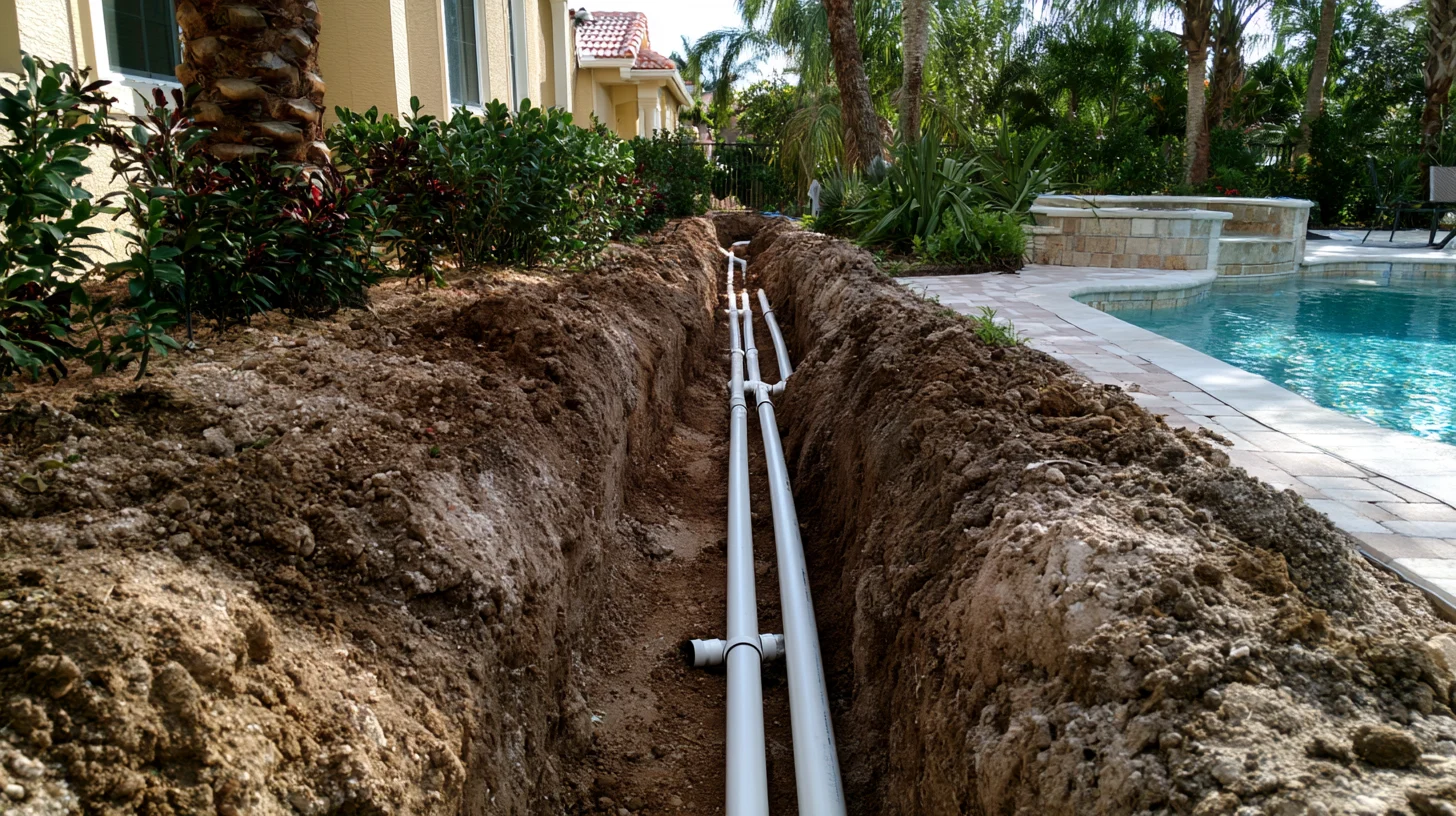
Main drain. Returns. Lights. Bonding. Those four words appear on real scope sheets, and any one of them moves a job out of the finish and into a trade the county permits separately. A job that chips out the old interior, patches the shell and applies a new finish is one thing. A job that also opens a suction line, resets return fittings, pulls a light niche or touches the bonding grid is a different job carrying the same word on the invoice.
The code is unusually direct about pipe. If any concealed trap, drain pipe, water, soil, waste or vent pipe becomes defective and it becomes necessary to remove and replace the same with new material, such work shall be considered as new work and a permit shall be obtained and inspection made as provided in this code (Florida Building Commission, 2015)3. A drained pool is precisely when concealed pipe stops being concealed, so a resurface is precisely when defective pipe gets found.
That is not a paperwork footnote, because a permitted job has gates built into it. The Florida Building Commission's own pool electrical safety fact sheet states that final electrical and barrier code inspection shall be completed prior to filling the pool with water, with an exemption noted for vinyl liner and fiberglass pools which are required to be filled on installation (Florida Building Commission, 2016)4. Filling the pool is the last thing that happens on a resurface. On a permitted job it is the thing that waits.
So the useful question to put to a contractor is not whether resurfacing needs a permit in general. It is which Collier County permit this specific job will be filed under, and who is pulling it. Confirming that the person pulling it holds the right class of license is a separate five minute job, set out in how to check a Florida pool contractor's license. Ask it in writing. A contractor who has run the process can answer in a sentence, and the answer is checkable against the application types the county publishes.
Read your own scope sheet for the four words before you sign anything. If the document says chip out and replaster and stops there, the job is narrow. If it says replace main drain cover, reset returns, new LED light, verify bonding, the scope has already crossed into trades that carry their own permits in this county, and an honest quote will say so rather than leaving you to find out at the inspection.
Can the $7,500 exemption cover a pool resurfacing job?
The first of those three sentences is the one everybody has heard. Collier County Growth Management Community Development publishes it on a page called Work Exempt from Permit, and it reads that certain qualifying work valued under $7500.00 will be exempt from building permits (Collier County Growth Management Community Development, retrieved 2026)5. The two sentences that follow it on the same page are the reason the exemption so seldom reaches a pool.
The county states that the work may not include any structural, mechanical, electrical, plumbing or gas (Collier County Growth Management Community Development, retrieved 2026)5. Set that against the previous section of this article. A resurface that opens a return is plumbing. A light is electrical. Bonding is electrical. Shell repair before the finish goes on is structural. Those named categories are not the outer edge of pool work, they are the middle of it.
The third condition is decided by the address rather than by the scope. The property where the work is located may not be in a flood hazard area (Collier County Growth Management Community Development, retrieved 2026)5. In coastal Collier County that single line removes a great many properties before anyone has read a scope sheet, and it is checkable for free at the county rather than guessed at here.
Above the county there is a state sentence that closes the remaining gap. Exemptions from permit requirements of this code shall not be deemed to grant authorization for any work to be done in any manner in violation of the provisions of this code (Florida Building Commission, 2015)3. An exemption removes a permit. It does not lower what the work has to meet, and it removes the inspection that would otherwise have recorded whether the work met it.
The full mechanics, who applies, what document the county issues at the end, and why dividing one project into two does not work, are worked through in the $7,500 permit exemption in Collier County. This article makes only the narrower point. On a resurfacing job the excluded trades usually decide the question long before the cap is reached, so the valuation is rarely where the answer lives.
Is an HOA, condominium or community pool resurface different?
A community, condominium or association pool is a public pool in the terms the code uses, and the process around it is heavier than the one behind a house. Collier County distributes a Florida Department of Health form titled Notice of Resurfacing of Public Swimming Pool, revised 1 May 2024, carrying excerpts of the Florida Building Code 2023 8th Edition (Florida Department of Health, 2024)6. The owner signs an undertaking on it rather than simply notifying anyone that work is starting.
The form then lists what complying actually means, and the items are specific rather than general. New cross-braced ladders shall be installed in place of non-cross-braced ladders in conformance with the code during a pool resurfacing (Florida Department of Health, 2024)6. Handrails and grabrails that do not meet the requirements of the relevant section shall be brought into compliance or removed if needed for compliance6. A resurface becomes the moment several other things get brought up to current code.
Two items on that form reach directly into other trades. It carries a note to ensure Florida Building Code equipotential bonding has been inspected and verified by jurisdictional building authority (Florida Department of Health, 2024)6, which is a building department inspection by definition rather than a contractor sign-off. It also requires that all elevated above-grade concrete pool walls and floors shall have waterproofing or damp-proofing installed prior to the final surface application6.
The form even specifies the finish itself in measured terms, which is worth reading before comparing bids. The finish coating shall have a dry lightness level, the CIE L value, of 80.0 or greater and a wet luminous reflectance value, the CIE Y value, of 50.0 or greater, determined by manufacturer test results using ASTM D4086, ASTM E1477 and ASTM E1347 (Florida Department of Health, 2024)6. Pool floors and walls shall be white or light pastel in color and shall reflect rather than absorb light6.
One more filing sits behind the work. If suction outlet drain covers, sumps or other anti-entrapment safety features are replaced, the form directs the owner to provide the Department of Health with a completed DH 4157 form under section 514.0315 of the Florida Statutes (Florida Department of Health, 2024)6. A homeowner does none of this. A board does all of it, and knowing that before bids arrive changes which bids look credible.
Collier County's own pool application points the same way for anything that is not a house. It lists additional submittal requirements for commercial and multi-family work, including a completed Health Department application, form DH4159 (Collier County Growth Management Community Development, 2025)1. Two agencies, two documents, one job. A bid that mentions neither has not costed the process it is bidding on.

Does any of this apply in the City of Naples or on Marco Island?
That distinction is doing more work than it appears to be doing. An article that quotes a Collier County form and then addresses every reader in the Naples area has quietly changed jurisdiction halfway through without telling anyone. A great deal of what is written about pool permits in this market does exactly that, and it is the most comfortable way to be confidently wrong about something a homeowner is going to act on.
If your address sits inside either city, the thing to ask for by name is that city's own pool permit application. Does resurfacing appear on it as a work item? Which application type does the city file a resurface under? Who pulls it, and what inspections does it carry? Those are the questions this article answers for unincorporated Collier County, and a city building department can answer them for its own jurisdiction in a single call.
The pool work itself does not change at the city line. The authority over it does. On the island, pool work on Marco Island is where the island specifics live, and inside the old city grid pool work in Old Naples covers that ground. Neither of those pages carries a permitting rule that was not read at the source, and neither will.
The permit answer follows the scope, so the useful first step is pinning the scope down in writing. Before you sign, ask which Collier County permit the job will be filed under and who is pulling it, then read your own scope sheet for main drain, returns, lights and bonding. That is the same conversation that opens any pool resurfacing in Naples project, and it happens before a number is discussed rather than after.
Everything above is unincorporated Collier County and the state code it has adopted. The City of Naples and the City of Marco Island are separate permitting jurisdictions with their own building departments, and their requirements were not verified for this post. If your pool is inside either city, confirm the permit question with that city's building department before work starts.
Ask Clayton
Questions this article usually prompts
Tap a question. Clayton replies himself, here and on the phone.
Clayton Waggoner Owner and Managing Member · Splash Pools Online Tap a question to ask
If this is the situation you are in
Pool resurfacing in Naples, including the part everyone skips →Pool remodeling in Naples, handled as one project →Spa remodels and new attached spas in Naples →Pool repair in Naples, diagnosed before it is quoted →References
- Collier County Growth Management Community Development, Swimming Pool permit application (PRSPL), form dated 27 January 2025
- Collier County Building Official, Bulletin 21: Survey and Elevation Certificate Requirements, amended 4 November 2025
- Florida Building Commission and Florida DBPR, Staff Analysis DS 2015-080, quoting the Florida Building Code (2015)
- Florida Building Commission, Swimming Pool Electrical Safety fact sheet, 30 June 2016
- Collier County Growth Management Community Development, Work Exempt from Permit (PRAD), retrieved 13 August 2026
- Florida Department of Health, Notice of Resurfacing of Public Swimming Pool, form revision 1 May 2024, distributed by Collier County
The article is general.
Your pool is specific.
Tell us what the pool is doing, a sentence or two is enough. The person who wrote this is the person who calls back.