
NAPLES, FL · FILTERS
Pool filter repair, when it is not a chemistry problem
Debris blowing back into the pool while the pressure climbs is not a water chemistry problem. It is a torn element, and no amount of balancing will fix it. This page is the triage: how to tell chemistry from circulation from media, and what Naples does to every interval printed on a filter box.
In short
What this work actually involves
Pool filter repair and replacement covers cartridge, diatomaceous earth and sand filters: element replacement, internal rebuilds, and full unit replacement. Splash Pools LLC is a Naples, Florida pool contractor owned by Clayton Waggoner, serving Naples, Collier County, Marco Island, Bonita Springs and Estero.
Part one
Cloudy water triage: chemistry, circulation, or media?
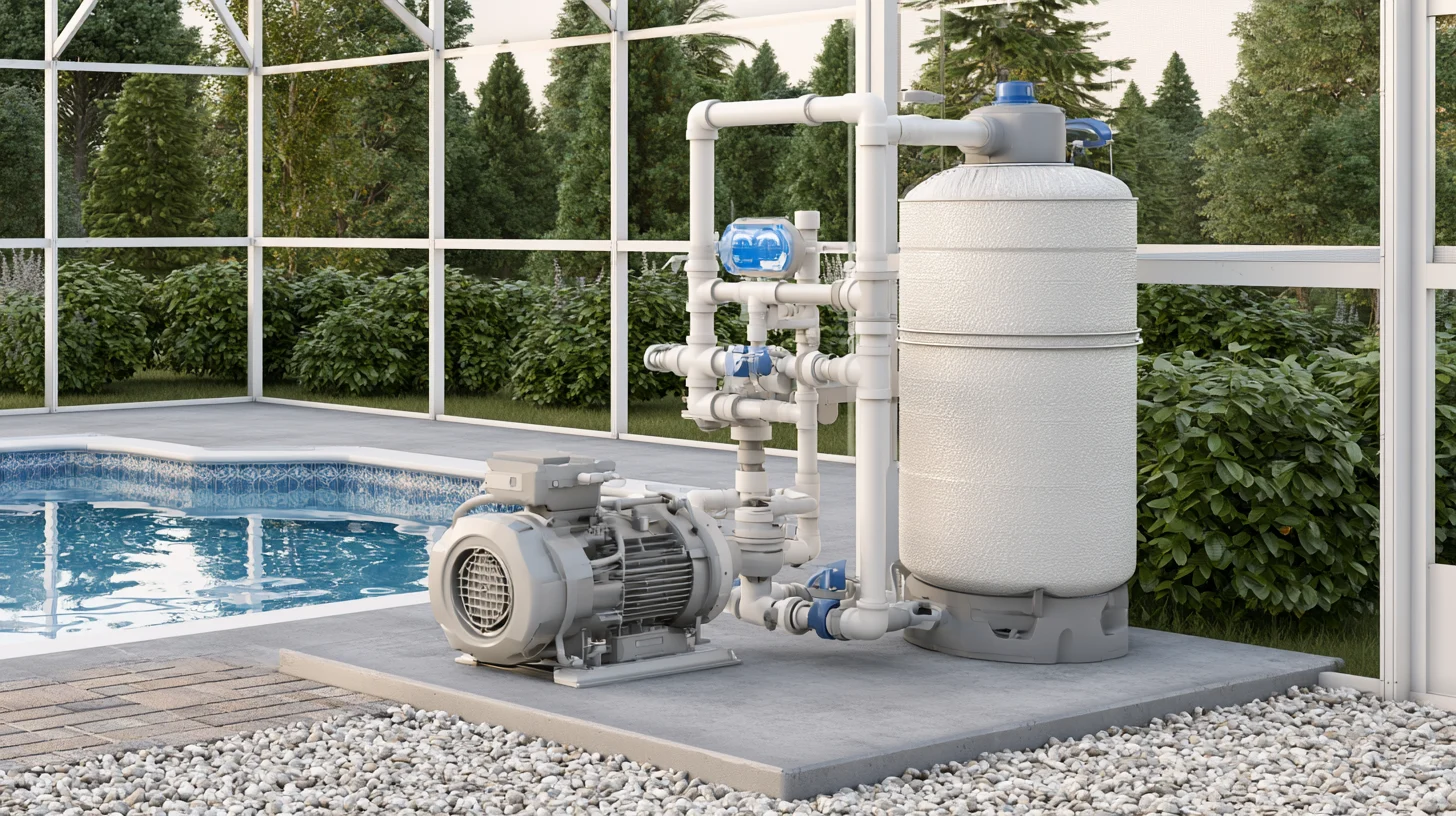
Cloudy water has three possible causes, and each leaves a different signature. A chemistry problem tests out of range. A circulation problem shows at the pump before it shows in the water. A filter problem shows as pressure and clarity moving together: pressure climbing while the water dirties means the media has failed and water is bypassing it. Balanced but cloudy points at the last two.
The search that brings most people to this page reads something like: pool cloudy but chemicals are balanced. The test strip says everything is in range, the pool store confirmed it, the water has been shocked twice, and it still looks like weak milk. At that point the advice that begins and ends with chemistry has run out, because chemistry was never the problem.
Cloudy water only has three causes. The chemistry is wrong, the water is not moving enough, or the water is moving but the filter is not catching what it carries. Each one leaves its own evidence. Chemistry problems show up on a test. Circulation problems show up at the equipment pad first: a pump losing prime, an impeller fouled with the same debris that is clouding the pool, run times cut short to save power. Media problems show up in the pair of readings this page keeps returning to, the pressure gauge and the water itself.
Read them together and the tank tells you what is happening inside it before anyone opens it. High pressure with clear water is a filter doing its job and due a clean. High pressure with cloudy water means the media is either packed solid or torn, and water is finding a way around it. Normal or low pressure with cloudy water and weak flow at the returns points upstream of the filter entirely, at the pump or a suction-side restriction, which is pool repair and troubleshooting territory rather than a filter job.
The summer version arrives with the storms. A pool that goes cloudy for a week after every storm, with a pressure spike that cleaning barely dents while the chemistry keeps testing fine, is describing a compromised element. Storm load is normal here; non-recovery is not. An element that has thinned passes fine particles straight back through the returns, so the pool is being filtered and re-seeded with the same debris at the same time.
And a fine haze that survives correct chemistry and a fresh cleaning is nearly always a particle-size problem: what is in the water is smaller than what the media can catch. Whether the answer is a deeper clean, a new element or a finer filter type gets settled by opening the tank, which is the one step no article can do for you.
Part two
Why does my filter pressure keep climbing?
- 10psi above clean starting pressure, the manufacturer point to clean cartridge elements
- 6psi above a new-element baseline after cleaning, the point to replace them
Rising pressure means restricted flow through the media. Normally that means the filter is doing its job and is due for cleaning. When pressure climbs and debris also returns to the pool, that combination means the media has failed and water is bypassing it rather than passing through it.
Storm season is what accelerates this here. Naples Park and Vanderbilt Beach filters take a heavy load of sand and fine debris quickly, and that finishes an element that was already thin.
The pattern worth writing down is the rebound. Hose the elements, restart, and note the gauge. Hayward’s own manual for its SwimClear cartridge filters says to clean the elements when pressure rises 7 to 10 psi above the starting pressure, and to replace them once the starting pressure after a clean sits more than 6 psi above where new elements started (Hayward, SwimClear owner’s manual). That second number is the one owners miss. An element that starts high after a thorough clean is holding fines deep in the pleats where no hose reaches, and each cycle after that will be shorter than the last.
Which is why the gauge is only useful with a record behind it. One reading tells you almost nothing. The starting pressure with new elements, the starting pressure after each clean, and how long each cycle lasts tell you everything. Cycles shortening from months to weeks are load or age. Cycles shortening to days are a failure.
The diagnostic pair is pressure plus clarity. High pressure with clean water is a cleaning job. High pressure with dirty water is an element job.
And if the pump is also losing prime or the heater is cutting out on flow, the cause may sit upstream of the filter entirely. That is the low-pressure branch of the triage above: poor flow with a quiet gauge is a suction-side story, not a media story.
Part three
Why Naples shortens every filter interval
Three loads shorten filter intervals here, and national advice prices in none of them. The swim season never ends, so the filter never rests. Spring oak and pine drop films the water yellow-green and packs media in weeks. And storm season can deliver a year of debris in an afternoon. Replacement intervals in Naples follow load, not the calendar printed on the box.
The maintenance schedule printed on a filter box was written for a national average: a pool that swims from May to September and sits winterized the rest of the year. Naples pools run twelve months. The filter here does a year of work in the time that schedule assumes half of one, before any local load is even counted.
Spring is the first local load. February to May is the peak pollinating season for Florida’s oaks, per the university extension service (UF/IFAS Gardening Solutions, Pollen and Allergies in Florida). Live oaks spend those weeks pushing off old foliage as new growth comes in and dropping their yellow-green catkins with it. On a pool that reads as a film on the water, skimmer baskets full of what looks like fuzzy string, and pollen fine enough to pack deep into pleats and DE grids. It is why spring cleaning intervals collapse from a couple of months to a couple of weeks.
If that is your spring, the filter is not broken. It is doing more work than its schedule assumed. The distinction that matters comes afterwards: cleaning every two weeks in March is load, but still cleaning every two weeks in July means the pollen packed the media with fines a garden hose cannot lift, and the element has been finished early.
Then storm season runs June to October and delivers debris in a different currency: not a steady film but a year of leaves, sand and roof grit in an afternoon. In Naples Park and the other established neighborhoods with mature trees, one good storm finishes an element the spring already thinned.
Two habits absorb most of this. Watch the gauge rather than the calendar, and clean ahead of a named storm rather than after it, so the filter meets the surge with its full capacity. For a pool that sits empty part of the year, pool automation can flag a pressure fault while you are away instead of letting it run for weeks.
Part four
Cartridge, DE or sand for a Naples pool?

Cartridge is the common choice: no backwashing, straightforward maintenance, good filtration. DE filters the finest but needs more handling. Sand is the simplest and the coarsest. In a market with heavy storm debris, ease of cleaning matters more than the last increment of filtration fineness.
Water conservation is a real consideration in favor of cartridge, since it does not backwash. That also matters for anyone on a well.
DE gives the clearest water and asks for the most involvement. It suits an owner who is engaged with the pool rather than one who wants it to look after itself.
The specification sheets put the difference in microns: sand catches the coarsest particles, cartridge runs considerably finer, and DE is the finest of the three. What that means at the waterline is simpler. If the pool holds a fine haze through correct chemistry and a clean filter, the particles are passing through the media, and the fix is a finer medium rather than more chlorine. That stubborn haze is DE territory, and it is the honest reason to accept DE’s extra handling.
The other question worth asking is who will actually maintain the thing. DE suits the owner who enjoys the equipment. It does not suit the owner who is starting to find backwashing physically difficult, or a family trying to manage a parent’s pool from another state. For those pools, cartridge is the handover-friendly choice: no backwash valve to sequence, nothing heavy to manage, and a routine any service company or family member can pick up mid-stream.
Whatever the type, replacing elements at the right time is cheaper than running a failed filter, because everything downstream works harder while it is bypassing.
Part five
Repair or replace the filter?
Replace elements as consumables. Replace the whole unit when the tank, the manifold or the internals have failed, or when the housing itself has degraded in a coastal pad environment. On the coast the housing frequently outlives the internals, and sometimes does not.
The frame that keeps this decision honest: elements are consumables and the tank is the appliance. Cartridges and DE grids wear out on a cycle, and replacing them is maintenance, not failure. The unit itself gets replaced when the tank, the manifold or the internal assembly has failed, when the housing has degraded, or when parts for an old model have aged out of the supply chain.
Equipment pads in Vanderbilt Beach and Isles of Capri corrode faster than almost anywhere. Where the pad is going generally, replacing one component means returning for the next. See equipment pad rebuild.
Sizing is worth revisiting at replacement rather than matching the old unit by default, particularly if the pump has been changed to variable speed since. See pump replacement.
Bigger is not the same as better sized. Oversizing past what the pump can push buys diminishing returns, and undersizing makes the whole system work harder while shortening every cleaning interval. A filter sized to the pool and the pump runs at lower pressure and asks less of the motor, which is the quiet efficiency gain nobody quotes.
And sometimes the honest finding is that nothing needs replacing at all. High pressure with clear water is a cleaning job, and we will say so. Telling an owner the filter has plenty of life left costs us a sale, and it is exactly why the next call comes to us.
Part six
What drives the cost of filter work in Naples?
Three things set the scope of filter work: whether the job is elements, internals or the whole unit; the filter type and size; and what the equipment pad around it needs. Two identical filters can price differently on the pad alone, which is why we quote after seeing it rather than over the phone. Call 239-450-5933.
Filter work spans three scopes, and the scope is most of the story. Replacing elements is the small job. Rebuilding internals, meaning a cracked manifold, broken laterals in a sand filter or a torn grid assembly in a DE unit, is the middle one. Replacing the whole filter, with the plumbing adapted to the new tank, is the large one.
Type and size do the rest of the parts side. Larger tanks carry more filter area and cost more to feed, and cartridge, DE and sand consumables are priced differently to begin with.
Then there is the pad. Two identical filters can need very different visits, because the unions, valves and fittings around a coastal pad corrode on their own schedule, and a fitting that turns freely inland is seized solid on a canal lot. That gets discovered by looking, not by phone.
So we look first and quote after, and the consultation is free. While you are comparing quotes, verify whoever you invite: any Florida pool contractor’s license can be checked at the DBPR licensee search. Ask us for the number, then look it up, and ask the other quotes for theirs. Call 239-450-5933 or book a consultation.
Straight answers
Questions Naples owners actually ask
 Clayton Waggoner Owner, Splash Pools LLC
 Clayton · Owner
It depends on load rather than the calendar, and Naples loads filters hard: a swim season that never ends, spring pollen, storm debris. The practical signal is the gauge. When pressure climbs sooner after every clean, and a freshly cleaned element starts well above where a new one did, the element is finished. Debris returning to the pool is the end stage of the same failure. Clayton · Owner
Water is bypassing the media rather than passing through it, which means a torn element, a failed manifold or a damaged internal part. It is not a chemistry problem, and balancing will not resolve it. The tank has to be opened to confirm which part failed, and that inspection is the first thing we do on a filter call. Clayton · Owner
DE filters the finest particles of the three types, which is why it clears a stubborn haze that cartridge can pass. Cartridge is easier to live with: no backwash cycle, less handling, no backwash water lost, which matters for anyone on a well. Better depends on how involved you want to be with your own equipment. Clayton · Owner
Cartridge, almost certainly. There is no backwash cycle to run, no valve sequence to remember and nothing heavy to lift. Maintenance is periodic rather than routine, and it is the easiest of the three types to hand over to a service company or a family member when the time comes. Clayton · Owner
It depends on whether the fix is elements, internals or the whole unit, on the filter type and size, and on what the pad around it needs, since corroded fittings and tired valves tend to surface on the same visit. We look first and quote after, and the consultation is free. Call 239-450-5933. Clayton · Owner
Four things: the property address and how we get access, a phone number for whoever makes decisions, the filter type if known, and the symptom. Cartridge, DE or sand is printed on the tank label, and a photo of it works. Useful symptoms to pass on: cloudy water, climbing pressure, debris returning, a leaking tank. We visit before quoting anything. Book online or call 239-450-5933. Clayton · Owner
Storm load is normal here but a week of cloudiness with a pressure spike that cleaning does not resolve is not. That pattern usually means the media is compromised, so the filter is passing fines straight back. Worth checking the elements before accepting it as a seasonal fact of life.Talk to Clayton
Send the details, get a call back.
A sentence or two is enough. You get a call back from the person who does the work, not a dispatcher.
Service area
Where we work
Click any marker. What fails is genuinely different from one neighborhood to the next, and the card says which.
Where we work
Naples and Collier County, plus Marco Island, Bonita Springs and Estero. What fails is different in each, and that is what decides the work.
- Port Royal waterfront, architectural review, deck must match the house
- Old Naples pools built in the seventies and eighties, due for everything at once; original skimmers
- Aqualane Shores canal homes, deck movement near the seawall separates coping
- Park Shore Gulf Shore Boulevard salt air hits the tile line first; seasonal vacancy
- The Moorings direct salt air exposure, waterline tile failure
- Coquina Sands seventies and eighties pools; decks poured over uncompacted fill
- Royal Harbor canal homes, high water table hides leaks; coping separation
- Grey Oaks gated architectural review on anything visible from the street; spa additions
- Quail West natural stone decking matched to the house; spa additions
- Pelican Bay empty April to November; automation and heat pumps for year-round swimmers
- Lely Resort natural gas supply; builder decks aging out; year-round pump runtime
- Fiddler's Creek natural gas heater sizing; builder-era paver decks losing their base
- The Vineyards year-round swimming, heat pumps and variable speed payback
- Naples Park mature landscaping into pool plumbing; original skimmers; storm-loaded filters
- Pine Ridge Estates mature landscaping finds underground pool plumbing
- Vanderbilt Beach equipment pads corrode fast; storm season loads filters
- Golden Gate Estates well water iron staining on marcite; propane rather than natural gas
- Isles of Capri canal water table hides leaks; heavy equipment-pad corrosion
- Marco Island barrier island salt air corrodes heaters from the inside out
- Bonita Springs pool decks and patios on Southwest Florida soil
- Estero deck and patio base engineered for local soil
- Ave Maria newer east-county builds, patios and walkways matched to existing hardscape
Related services
Pool repair in Naples, diagnosed before it is quoted →Equipment pad rebuilds, so the next repair is a part swap →Pool pump replacement in Naples, programmed not just installed →From the insights
What does a variable speed pump actually change? →Where this comes up most
Sources
Ready when you are
Tell us what the pool is doing.
A sentence or two is enough. You get a call back from the person who does the work, not a dispatcher.