
Insights · Working out what is wrong
What should a Naples pool water test actually check, for the finish and for your skin?
A Naples pool water test should check five numbers: chlorine (free and total), pH, total alkalinity, calcium hardness and cyanuric acid, read against the water temperature. Three of them decide whether the water dissolves your finish or crusts it. Two, pH and the chlorine reading, are the ones the CDC ties to swimmers' eyes and skin. This guide reads the report line by line: each range, what it does to a cement finish, what Collier tap water starts you with, and what to ask your service.
 Clayton Waggoner, Owner and Managing Member, Florida license CPC1461352 · Published November 3, 2026 · 16 min read
The saturation index (Langelier Saturation Index, or LSI) is one number built from pH, water temperature, calcium hardness, total alkalinity and total dissolved solids that shows whether water is balanced, scaling or etching (Florida Department of Health in Collier County, 2016)6. The National Plasterers Council (NPC) holds a cement finish between 0.0 and +0.3 (National Plasterers Council, 2021)1.
The short version
What should a Naples pool water test actually check?
A test that prints only chlorine and pH is testing for the swimmers and not for the finish. Those two matter: the CDC calls disinfection and pH the first defense against germs that cause swimming-related illnesses (CDC, 2025)9. But neither one tells you whether the water is in balance with the cement on the walls.
The other three are the finish numbers. Total alkalinity stabilizes pH (Florida Department of Health in Collier County, 2016)6. Calcium hardness sets how hungry the water is for calcium. Cyanuric acid, which the CDC calls a chlorine stabilizer (CDC, 2024)8, has a ceiling, covered in the table below.
Combined chlorine is the number hiding between the first two readings. The CDC's formula is combined chlorine equals total chlorine minus free chlorine, and it describes chloramines as a type of combined chlorine (CDC, 2025)11. A report that shows free chlorine alone cannot show it.
Florida requires public pools to keep test kits for free and total chlorine by DPD, total alkalinity, calcium hardness and pH (Florida Administrative Code, 2023)7. The rule does not cover a backyard pool, but it pictures a complete test. Clayton's note on this section is his own answer.
| Number | Range | What it does to the finish | What the CDC says it does to swimmers |
|---|---|---|---|
| Chlorine, free and total (combined chlorine is the difference) | NPC: free chlorine 1 to 3 ppm and total chlorine 1 to 3 ppm (National Plasterers Council, 2021)1. CDC: at least 1 ppm in pools (CDC, 2024)8. | Not one of the five saturation index factors (Florida Department of Health in Collier County, 2016)6. | At the recommended levels, chlorine can kill most germs in the water within minutes. Chlorine mixed with dirt, sweat, pee and poop creates chemicals that make swimmers' eyes red and sting (CDC, 2025)9. |
| pH | NPC card: 7.2 to 7.6 (National Plasterers Council, 2021)1. NPC web page: 7.2 to 7.8 (National Plasterers Council, retrieved 2026)2. CDC: 7.0 to 7.8 (CDC, 2024)8. | Below 7.2 the water is aggressive; above 7.8 it tends to precipitate minerals or metal, causing scaling or staining (National Plasterers Council, retrieved 2026)2. | Too high or too low, it can make chlorine less effective at killing germs and can also cause skin and eye irritation in swimmers (CDC, 2025)9. |
| Total alkalinity | Carbonate alkalinity 80 to 120 ppm (National Plasterers Council, 2021)1. Total alkalinity 80 to 120 ppm (Florida Department of Health in Collier County, 2016)6. | Low alkalinity is part of aggressive water (National Plasterers Council, 2018)3. It stabilizes pH and is adjusted first (Florida Department of Health in Collier County, 2016)6. | No swimmer effect stated in the CDC pages read for this post. It steadies pH, which the CDC does connect to swimmers. |
| Calcium hardness | 200 to 400 ppm (National Plasterers Council, 2021)1. | Too little, and the water seeks calcium from the pool surfaces, causing etching (Florida Department of Health in Collier County, 2016)6. | No swimmer effect stated in the CDC pages read for this post. |
| Cyanuric acid | 30 to 50 ppm (National Plasterers Council, 2021)1. | 100 ppm and above may cause permanent deterioration of the pool surface (National Plasterers Council, 2021)1. | With cyanuric acid in use, the CDC recommends a chlorine concentration of at least 2 ppm in pools (CDC, 2024)8. |
Why does the finish care about pH, alkalinity and calcium?
Alkalinity comes first for a reason. The Collier manual says total alkalinity stabilizes pH, so it should always be adjusted first, and pH adjusted only once alkalinity is in its 80 to 120 ppm range (Florida Department of Health in Collier County, 2016)6. Chasing pH with acid before reading alkalinity works the numbers in the wrong order.
Temperature is the Naples term. The manual says Collier pool temperatures normally run between 80 and 90 F, that calcium is less soluble in warm water, and its table assigns 0.7 at 84 F and 0.8 at 94 F (Florida Department of Health in Collier County, 2016)6. Warmer water pushes the index toward scaling with no change in the chemicals.
The manual's formula is pH plus the temperature, calcium and alkalinity factors, minus the TDS factor (Florida Department of Health in Collier County, 2016)6. At pH 7.4, 84 F (0.7), calcium hardness 300 ppm (2.1), alkalinity 100 ppm (2.0) and TDS under 1,000 (12.1), the index is 0.1, inside the NPC's 0.0 to +0.3 band (National Plasterers Council, 2021)1. Drop calcium to 100 ppm (1.6) and pH to 7.2, and it falls to minus 0.6, past the manual's minus 0.5 line where etching may result (Florida Department of Health in Collier County, 2016)6.
The manual calls minus 0.5 to plus 0.5 balanced (Florida Department of Health in Collier County, 2016)6; the NPC holds a cement finish to the narrower 0.0 to +0.3 (National Plasterers Council, 2021)1. Either way, a test without calcium and alkalinity cannot place your pool on the scale.
What does Collier tap water start you with?
On the county's own scale, 61 to 120 mg/L is moderately hard water, so the tap reads as moderately hard for drinking (Collier County Water-Sewer District, 2024)13. A pool is not a kettle. The health department's manual says Collier public water supplies generally do not have enough calcium for correct pool water balance, and that adding calcium chloride is usually necessary (Florida Department of Health in Collier County, 2016)6.
The manual also says what happens when nobody adds it: pool water with too little calcium becomes aggressive and seeks it from the pool surfaces, causing etching, or wearing of the finish (Florida Department of Health in Collier County, 2016)6. Etching is the subject of the next section.
The utility reports total hardness, calcium and magnesium together; a pool test reads calcium alone, so the calcium in a 67 mg/L total is lower than 67 (Collier County Water-Sewer District, 2024)13. Every top-up adds more of the same water. The full figures are in Collier County tap water and new plaster; a well-filled pool starts elsewhere, covered in well water and Golden Gate Estates pools.
One more thing comes out of the tap. The county says its water is treated with chloramines for disinfection (Collier County Water-Sewer District, 2024)13. The CDC says the chloramines that form in pool water are different from the chloramine that is sometimes used to treat drinking water (CDC, 2025)10. When this guide talks about chloramines and swimmers further down, it means the ones that form in the pool.
Which number stains, and which one etches?
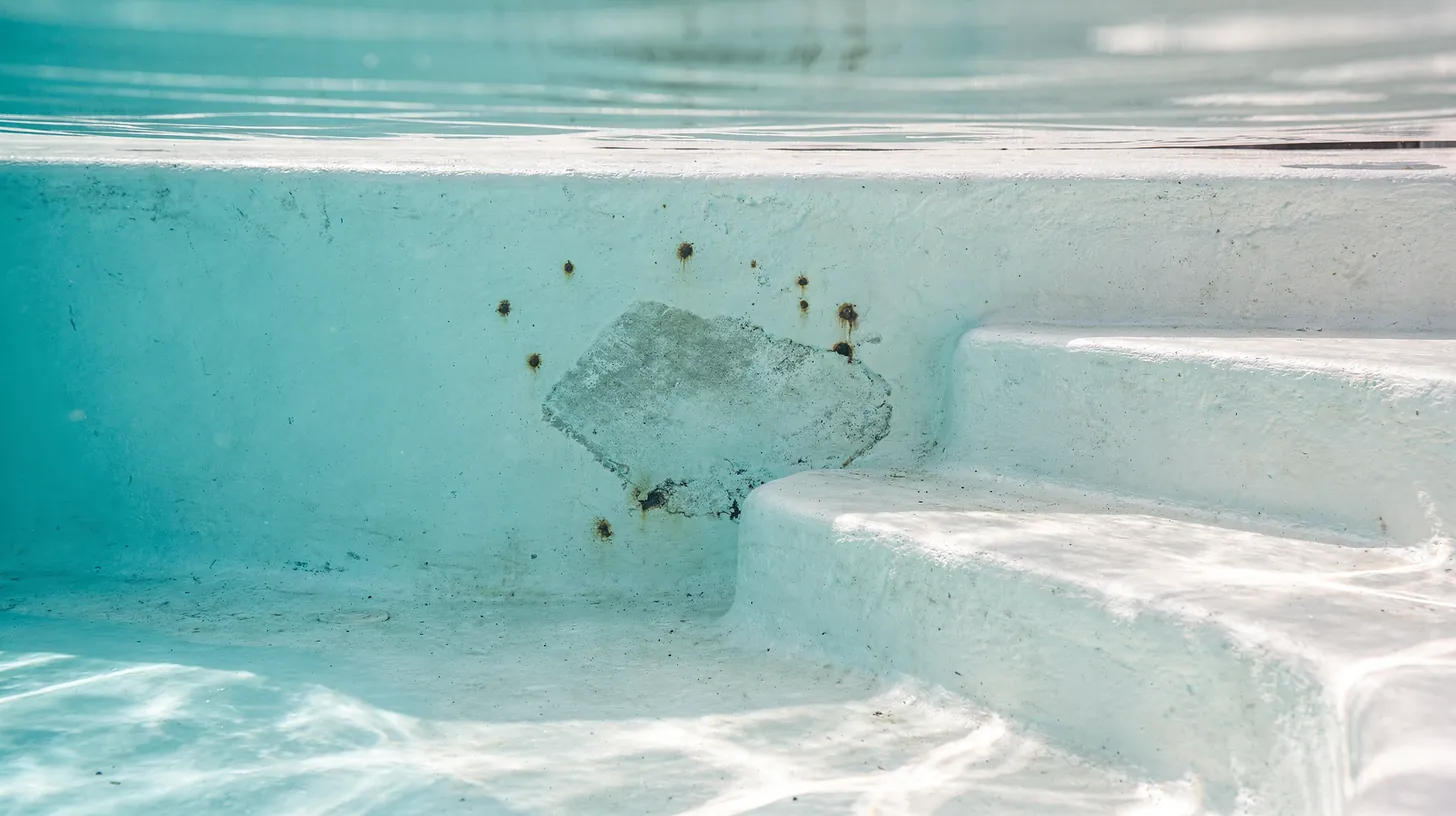
Etching is the low side. The Collier manual defines it as the corrosion of calcium from pool surfaces, which may produce pitting or wearing of the finish, and says values below minus 0.5 on the saturation index may result in etching (Florida Department of Health in Collier County, 2016)6. On a pigmented finish, the NPC says aggressive water left long enough can leach pigment up to 1/8 inch deep, and the loss is irreversible (National Plasterers Council, 2018)3.
Scale and stain are the high side. The manual says values above plus 0.5 may result in scaling (Florida Department of Health in Collier County, 2016)6, and the NPC card says a positive index will cause mineral scaling, metal staining or discoloration on the surface (National Plasterers Council, 2021)1. High pH, high calcium and warm water all push the index that way.
Metals are their own line. The NPC's fill water bulletin separates deterioration (low pH, calcium or alkalinity) and mineral scale (high pH, calcium or alkalinity) from metal staining, most commonly copper, iron and sometimes manganese (National Plasterers Council, 2019)4. A five-number test does not read metals; the bulletin calls for specialty kits (National Plasterers Council, 2019)4.
Clayton's note on this section is his list of causes, in his own words. The water is one candidate among several, and why pool staining in Southwest Florida is usually not your water sorts the chemistry causes from the rest.
What changes in a salt pool?
The swimmer side does not change either. The CDC's pH 7.0 to 7.8 and at least 1 ppm chlorine make no exception for how the chlorine got there (CDC, 2024)8.
Total dissolved solids reads differently. The card writes its TDS range of 300 to 1,800 ppm for non-salt pools (National Plasterers Council, 2021)1, and the Collier manual's index uses a TDS factor of 12.1 under 1,000 ppm and 12.2 at 1,000 and above (Florida Department of Health in Collier County, 2016)6. Dissolved salt is dissolved solids, so on a salt pool ask your service which TDS figure goes into the index.
Florida requires public pools that add sodium chloride to test for it (Florida Administrative Code, 2023)7. A home pool is not bound by that rule, but the logic carries.
Clayton's note on this section is his own practice with a salt cell on a new finish. Whether a new plaster finish belongs in a salt pool covers the longer question, and the first 30 days after a pool is resurfaced has the full start-up sequence.
What do the same numbers do to your skin and eyes?
Start with pH. The CDC's home pool page recommends pH 7.0 to 7.8 and says keeping it in that range best balances killing germs to prevent swimming-related illness, the lifespan of the pipes, and swimmers' comfort (CDC, 2024)8. Its guidelines add that pH too high or too low can also cause skin and eye irritation in swimmers (CDC, 2025)9.
Then chloramines. The CDC says chlorine can combine with sweat, dirt and pee to create chemical irritants called chloramines, and that swimmers can experience red and itchy eyes, skin irritation, and rashes (CDC, 2025)10. Note the word can. The CDC is describing what pool water can do, not explaining any one person's eyes or skin.
The smell is a clue. The CDC says that if you smell "chlorine" at the place you swim, you are probably smelling chloramines (CDC, 2025)10. It also says chloramines in the water can turn into gas in the surrounding air, and that this is more common in indoor pools, which often are not as well-ventilated as outdoor pools (CDC, 2025)10.
On the report, this is where combined chlorine earns its line: total chlorine minus free chlorine (CDC, 2025)11. The CDC's operator page notes that most city, county and state health departments limit combined chlorine to 0.4 ppm or less (CDC, 2025)11. That is a limit the CDC describes, not a CDC home pool rule, and the CDC pages read for this guide name no chlorine level that irritates.
The CDC's swimmer advice is to shower for at least 1 minute before getting in (CDC, 2025)9, because keeping sweat, dirt and pee out of the water helps prevent chloramines from forming (CDC, 2025)10. A test shows whether pH or combined chlorine is off; it cannot explain anyone's own eyes or skin. For that, the CDC's advice is plain: "Contact a healthcare provider if you get sick after swimming or going in water" (CDC, 2025)12.
How often should a Naples pool be tested?
The CDC puts the job on the owner. Its home pool page says that as a residential pool owner it is your responsibility to regularly check the chlorine concentration and pH of the water (CDC, 2024)8. Its guidelines page repeats at least twice per day and adds more often when the pool is in heavy use (CDC, 2025)9.
Naples sun is a reason to take that floor seriously. The CDC lists sunlight among the things that reduce chlorine levels, alongside pee, poop, sweat and dirt from swimmers' bodies (CDC, 2024)8. A morning reading is not an evening reading after a full day of sun.
A new finish is tested more, not less. The NPC card says the interior finish is especially susceptible to staining, scaling and discoloration within the first 28 days, and that start-up includes daily testing and adjusting of the water (National Plasterers Council, 2021)1. The first 30 days after resurfacing walks that month day by day.
None of the documents read for this guide sets a home pool frequency for alkalinity, calcium hardness or cyanuric acid. Ask your service how often they read them, and look for them, dated, on the report.
What should you ask your service company?
Do you test free and total chlorine, or only free? Combined chlorine is the difference between them (CDC, 2025)11, and a report without total chlorine cannot show it.
Which pH range do you hold, and do you adjust alkalinity first? The NPC card holds pH at 7.2 to 7.6 (National Plasterers Council, 2021)1, and the Collier manual adjusts alkalinity before pH (Florida Department of Health in Collier County, 2016)6. The NPC also says not to add any acid if pH is less than 7.2 (National Plasterers Council, retrieved 2026)2.
Where is my calcium hardness, and how often do you read it? With Collier tap water averaging 67 mg/L total hardness (Collier County Water-Sewer District, 2024)13 against an NPC range of 200 to 400 ppm (National Plasterers Council, 2021)1, this is the number a municipal fill starts short on.
What is my cyanuric acid? The NPC range is 30 to 50 ppm, and 100 ppm and above may cause permanent deterioration of the surface (National Plasterers Council, 2021)1. With it in the water, the CDC recommends at least 2 ppm chlorine (CDC, 2024)8.
Do you use a DPD kit or strips? The CDC says a DPD kit gives the most accurate results, and that strips are less accurate than the DPD kit (CDC, 2024)8. If the finish has already spent years in aggressive water, pool repair in Naples starts with what is left of the surface, and pool resurfacing follows once it is past repair.
Ask Clayton
Questions this article usually prompts
Tap a question. Clayton replies himself, here and on the phone.
Tap a question to ask
If this is the situation you are in
Pool resurfacing in Naples, including the part everyone skips →Pool repair in Naples, diagnosed before it is quoted →Pool remodeling in Naples, handled as one project →Spa remodels and new attached spas in Naples →References
- National Plasterers Council, NPC Pool Start-up Card: Start-Up Procedures and Water Chemistry and Maintenance, REV 03-2021
- National Plasterers Council, Pool Water Chemistry Effects & Prevention, retrieved 1 November 2026
- National Plasterers Council, Technical Bulletin #4: The Most Common Reasons for Loss of Color (April 2018)
- National Plasterers Council, Technical Bulletin #1: Testing Fill Water (revised January 2019)
- National Plasterers Council, Pool Interior Finish Disclosure (revised 16 December 2015)
- Florida Department of Health in Collier County, Swimming Pool Operators' Manual, 2016 Version
- Florida Administrative Code, Rule 64E-9.004 Operational Requirements, public swimming pools (amended 11 June 2023)
- Centers for Disease Control and Prevention, Home Pool and Hot Tub Water Treatment and Testing (May 10, 2024)
- Centers for Disease Control and Prevention, Guidelines for Keeping Your Pool Safe and Healthy (May 29, 2025)
- Centers for Disease Control and Prevention, Preventing Eye Irritation from Pool Chemicals (May 28, 2025)
- Centers for Disease Control and Prevention, Chloramines and Pool Operation (June 23, 2025)
- Centers for Disease Control and Prevention, Preventing Swimming-related Illnesses (June 6, 2025)
- Collier County Water-Sewer District, Annual Water Quality Report, 2024 data year, report dated 23 May 2025
- City of Naples Utilities Division, Consumer Confidence Report, 2024 data year
The article is general.
Your pool is specific.
Tell us what the pool is doing, a sentence or two is enough. The person who wrote this is the person who calls back.