
Insights · Working out what is wrong
Why is my pool losing water, and is it a leak or evaporation?
Almost every answer online gives you a single number for normal evaporation. The measured data says evaporation is not one number, which is exactly why the test that settles it compares your pool against itself rather than against an average.
 Clayton Waggoner, Owner and Managing Member · Published August 7, 2026 · 13 min read
Evaporation and a leak look identical at the waterline, and the difference is decided by a comparison rather than by a rate. The United States Geological Survey measured open water evaporation on Lake Okeechobee at a mean of about 1,825 millimeters per year across 2013 to 2016, among the highest rates observed in Florida by vetted methods (USGS, 2024)1. That is roughly a fifth of an inch a day averaged over a year, and no pool loses that evenly across twelve months.
The short version
How much water should a Naples pool lose to evaporation alone?
- 45inches a year, the high end of measured open-water evaporation in South Florida (USGS, 1958)
- 24hours the bucket test needs to separate a leak from evaporation
The United States Geological Survey measured open water evaporation from Lake Okeechobee at a mean of about 1,825 millimeters per year over 2013 to 2016, and describes those as among the highest rates observed in Florida using vetted methods such as evaporation pans, lysimeters, eddy covariance and Bowen ratio (USGS, 2024)1. Averaged across a year that is close to a fifth of an inch a day.
An older USGS water supply paper on southeastern Florida puts losses from permanent water areas at an average of roughly 40 to 45 inches a year (USGS, 1958)2, which works out nearer an eighth of an inch a day. Both numbers are real. They describe different water under different conditions.
The spread between them is the point. Evaporation is driven mostly by wind, humidity, sun and water temperature, and all four move constantly here. A pool inside a screened lanai is sheltered from wind in a way an open lake is not. The same pool loses noticeably more in May, before the rains, than it does in January.
The regional water authority reaches the same conclusion from the other direction. Reviewing data from nine pan evaporation sites across South Florida, the South Florida Water Management District concluded that pan evaporation measurements are prone to too many sources of error to be used for trend analysis, and reported differences in magnitude and direction between stations that sit close together (SFWMD, 2010)6. If the agency that manages the water cannot get a single reliable number out of nine instrument sites, a blog quoting one figure for every pool is not measuring anything.
So when a neighbor tells you a quarter inch a day is normal, they are repeating a rule of thumb that no Tier 1 source supports and that sits above every month's modeled rate (SFWMD, 2010). It is not a test. It cannot tell you whether your pool is leaking, because it was never measured on your pool. The sourced month-by-month band is set out here.
| Measurement | Figure | What it describes |
|---|---|---|
| Lake Okeechobee, 2013 to 2016 mean (USGS, 2024) | About 1,825 mm per year | Open water, exposed to wind, among the highest measured in Florida |
| Southeastern Florida permanent water areas (USGS, 1958) | About 40 to 45 in per year | A regional average across permanent water bodies |
| Your screened pool in May | Not published anywhere | Sheltered from wind, hot, before the rains, and specific to your lot |
| Your screened pool in January | Not published anywhere | Cooler water, lower demand, same pool, materially different loss |
How do I tell a leak from evaporation without any equipment?
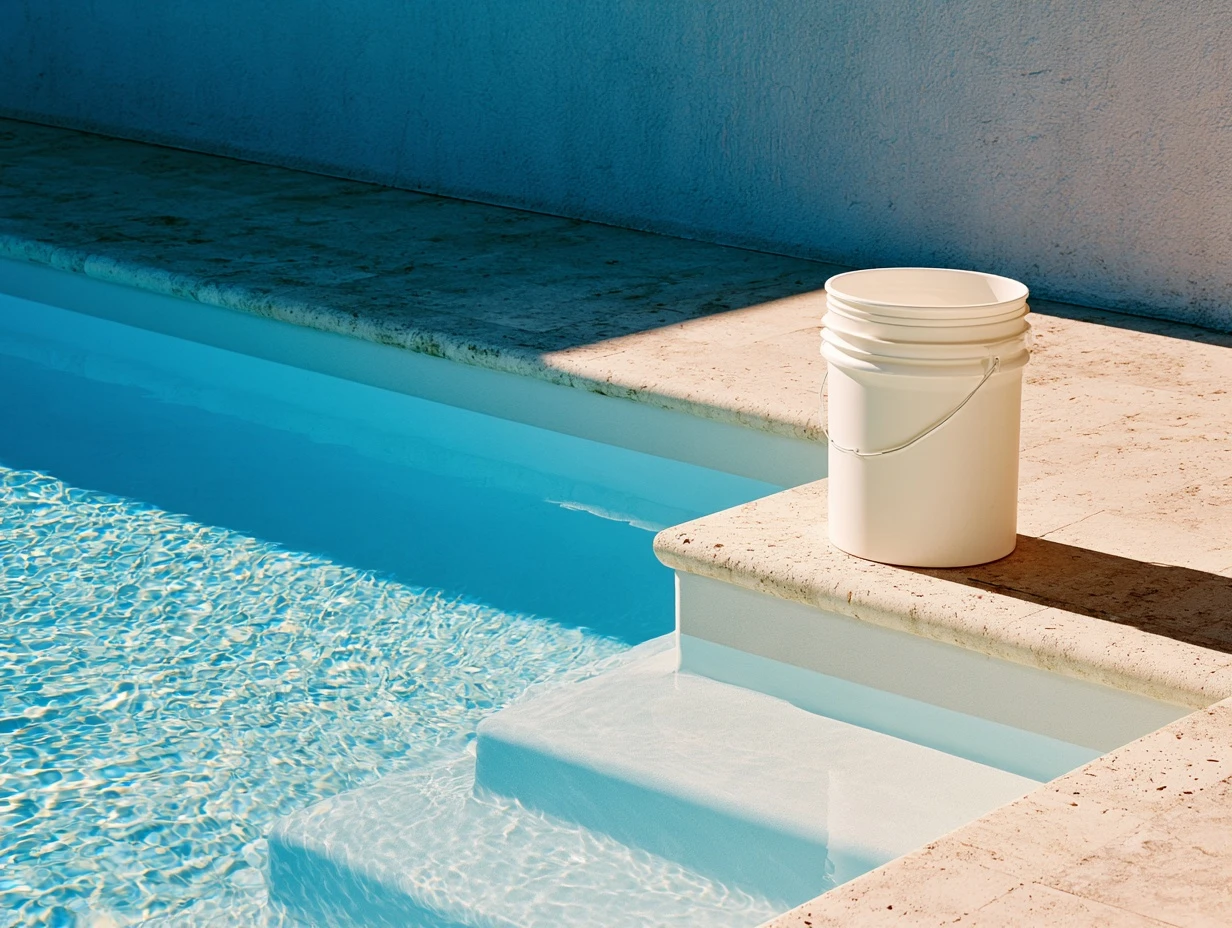
Fill a bucket with pool water and set it on the top step so it sits in the same air and the same sun as the pool. Mark the water level inside the bucket and the pool level outside it. Leave the pump running as normal. Compare both marks after twenty four hours.
If both levels have dropped by the same amount, you are watching evaporation and nothing else. If the pool has dropped further than the bucket, that difference is the leak, and it is a measurement rather than an opinion.
Run it a second time with the pump switched off for the twenty four hours. Comparing the two runs tells you something a single run cannot: a pool that loses more with the pump running is pointing at pressure side plumbing, while a pool that loses at the same rate either way is pointing at the shell or at a fitting.
That is the whole method, and it costs a bucket. It works because it removes the variable that makes published averages useless: it measures your water, on your lot, in the conditions of that particular day.
| What you see over 24 hours | What it indicates | What follows |
|---|---|---|
| Pool and bucket drop equally | Evaporation only | No leak investigation needed. Re-run in a different season if you are unsure. |
| Pool drops further, pump running and off alike | Loss independent of pressure | Points at the shell, the skimmer throat or a fitting rather than the lines. |
| Pool drops further only with the pump running | Loss under pressure | Points at the pressure side plumbing. Lines get pressure tested individually. |
| Loss changes sharply after heavy rain | Groundwater interacting with the pool | The water table is part of the picture and gets assessed before anything is dug. |
Why is a pool leak so hard to find on a canal or lake lot?
The United States Geological Survey describes the Floridan aquifer system as a sequence of carbonate rocks underlying approximately 100,000 square miles beneath all of Florida and parts of Georgia, Alabama and South Carolina, and notes that over roughly half of its extent it is an unconfined to thinly confined karst aquifer (USGS, 2024)3. Above it sits the surficial aquifer, and along the Naples coast that sits close to the surface.
On a canal lot in Royal Harbor or Aqualane Shores, or on a lake lot out east, the ground beside the pool can already be holding as much water as it will take. A pool leaking into it produces no surface sign at all. The water simply joins water.
That is why the honest method on these lots is to stop looking for evidence in the yard and start testing the system. Plumbing lines are isolated and pressure tested one at a time. The shell is dye tested at any suspect crack. Each test produces a yes or a no about a specific component, which is something a walk around the garden cannot produce.
It also explains a pattern owners find strange: a leak on a waterfront lot often shows up as nothing but a falling waterline for months, then as an unexpectedly large repair. Nothing was hiding. There was simply never a wet patch to see.
Where do pool leaks actually come from?
Plumbing leaks are the ones that respond to pressure. A suction side leak can pull air rather than push water, so the first sign is often bubbles at the returns or a pump losing prime rather than a falling level. A pressure side leak pushes water out whenever the pump runs, which is why running the bucket test both ways is informative.
The skimmer throat is a frequent and undramatic culprit. It is a joint between two materials that move at different rates, and a separation there loses water only when the level is high enough to reach it. A pool that stops dropping at a particular height is describing this exactly. Rebuilding that joint is skimmer and main drain repair, and it is usually a smaller job than the symptom suggests.
Shell leaks are the category owners fear and the least common of the group. A pool shell is a water-retaining structure, and the American Concrete Institute lists a tolerable crack width of 0.004 in for that exposure condition against 0.016 in for reinforced concrete in dry air (ACI 224R, 1990)4. A crack far narrower than looks alarming will pass water, which is why width is a poor guide and a dye test is a good one.
Equipment pad leaks are worth ruling out first because they are visible and cheap to confirm. A weeping union, a failing pump seal or a filter clamp can move a surprising amount of water over a week without ever looking dramatic. A clamp or seal that will not hold is filter repair work, and it is worth confirming before anybody opens the ground.
| Source | Behavior under the bucket test | Typical first sign |
|---|---|---|
| Pressure side plumbing | Loses faster with the pump running | Level falls quickly during filtration hours |
| Suction side plumbing | May lose little water at all | Air bubbles at the returns, pump losing prime |
| Skimmer throat | Loses until the level drops below the throat | Falling stops at one particular height |
| Shell or a structural crack | Loses at the same rate, pump on or off | Steady loss unrelated to the equipment schedule |
| Equipment pad | Loses only while running | Damp pad, weeping union, failing pump seal |
Behavior
Can a leaking pool be drained safely to find the leak?
The Florida Building Code requires a hydrostatic relief device, or an equivalent approved means of relieving hydrostatic pressure, in areas where a water table is anticipated (Florida Building Code, Residential, 2023)5. That requirement exists because the failure it prevents is real and expensive.
A pool full of water is holding itself down. Take the water out while the ground outside is saturated and the balance reverses. The shell becomes a boat, and the same buoyancy that floats a hull can lift a pool out of position. Repairing a pool that has moved is a different and much larger job than repairing the crack you set out to inspect.
None of this makes draining unusual or alarming. It makes it a planned step. The groundwater condition is assessed, the relief provision is confirmed to exist and to work, and the timing is chosen with the season in mind rather than with the calendar of whoever is quoting.
It is also why a great deal of leak work here is deliberately done without draining at all. Pressure testing the lines and dye testing the shell both happen with the pool full, which is safer, faster and considerably more informative than emptying a shell to look at it.
What should a real leak finding look like before anyone digs?
The sequence that produces a finding is short. Establish that there is a leak at all with a bucket test, because a pool losing water at the rate the weather explains does not need a leak investigation. Then isolate: lines individually pressure tested, shell dye tested, skimmer and fittings checked at their own levels.
The output of that is a sentence you can act on. The return line failed a pressure test at a stated pressure. Dye moved through the crack at the deep end. The skimmer throat has separated and the level stops falling exactly there. Each of those tells you what to fix and, just as importantly, what not to.
Ask what happens to the finding if it turns out to be the shell. A crack that leaks has passed through the structure by definition, and the question then becomes whether the movement that opened it has stopped. That is a different diagnosis, and it is covered in whether a pool crack is structural or cosmetic.
If the finding is the shell and the movement is still acting, the work belongs with shell and bond beam repair rather than a resurfacing product. If the finding is plumbing, it belongs with underground plumbing repair. Either way the finding comes first and the scope follows from it, which is the opposite of how most quotes on a leaking pool arrive.
One more question worth asking: what did the test rule OUT. A diagnosis that eliminates the lines is worth as much as one that finds the crack, because it stops you paying to dig a yard that was never the problem.
A confirmed leak also changes the order of everything else. It has to be resolved before a new interior finish goes on, which is the sequencing argument set out in resurface or remodel.
Interactive · READ YOUR BUCKET TEST
What is your pool actually telling you?
Run the bucket test first, once with the pump running and once with it off. These four questions read the result the way a diagnosis would, and point at which component to test rather than naming a repair1.
Ask Clayton
Questions this article usually prompts
Tap a question. Clayton replies himself, here and on the phone.
Clayton Waggoner Owner and Managing Member · Splash Pools Online Tap a question to ask
If this is the situation you are in
Pool leak detection in Naples, with a finding before a shovel →Underground pool plumbing repair, with the smallest possible hole →Structural crack repair, starting with what is causing it →Skimmer and main drain repair, the quiet leak →References
- United States Geological Survey, Evaporation From the Interior of Lake Okeechobee, a Large Freshwater Lake in Florida, 2013-16 (SIR 2024-5040)
- United States Geological Survey, Water Resources of Southeastern Florida (Water-Supply Paper 1255)
- United States Geological Survey, Floridan Aquifer System
- American Concrete Institute, ACI 224R, Table 4.1, tolerable crack widths by exposure condition
- South Florida Water Management District, Technical Paper 107, Pan Evaporation and Potential Evapotranspiration Trends in South Florida (Abtew, Obeysekera and Iricanin, 2010)
- Florida Building Code, Residential (2023), Chapter 45, Private Swimming Pools, published by the International Code Council

The article is general.
Your pool is specific.
Tell us what the pool is doing, a sentence or two is enough. The person who wrote this is the person who calls back.