
Insights · Naples and Collier County
Can reclaimed irrigation water fill or top off a Naples pool?
No. Florida's reuse rule says it in one sentence: reclaimed water "shall not be used to fill swimming pools, hot tubs, or wading pools" (Florida Administrative Code Rule 62-610.469, 2021) [1]. That matters to anyone whose irrigation runs on reclaimed water and whose pool drops a little every day, because a hose on the irrigation supply can look like the easy way to keep the level up. This article covers what the rule says, why it exists, how to tell whether your property has reclaimed irrigation, and what can go into the pool instead.
 Clayton Waggoner, Owner and Managing Member, Florida license CPC1461352 · Published November 17, 2026 · 15 min read
Reclaimed water is treated wastewater that a utility sends back out for uses such as lawn irrigation. Florida defines it as water that has received at least secondary treatment and basic disinfection and is reused after flowing out of a domestic wastewater treatment facility (Florida Administrative Code Rule 62-600.200, 2022)5. The state sets its treatment standard for irrigating places people use, such as lawns, parks and golf courses (Florida Administrative Code Rule 62-610.450, 2021)3, not for drinking or swimming.
The short version
Can you fill or top off a pool with reclaimed irrigation water in Florida?
Subsection (4) of Rule 62-610.469 is the pool sentence, and it names three things: swimming pools, hot tubs and wading pools (Florida Administrative Code Rule 62-610.469, 2021)1. A backyard pool and an attached spa both sit inside those words.
A top-off is still a fill. The rule does not set a volume, a frequency or an exception for emergencies, so an inch a day from the irrigation hose is the same use as a full refill under the plain text (Florida Administrative Code Rule 62-610.469, 2021)1. Even its tank-truck provision covers irrigating landscaped areas, nothing else (Florida Administrative Code Rule 62-610.469, 2021)1.
The City of Naples puts the same limit in its application for reclaimed service. Its irrigation meter application states that the reclaimed water "shall be used only for landscape irrigation purposes" (City of Naples Utilities, 2017)8. So a City customer meets the limit twice: in the state rule and in the City's application.
What is reclaimed water, and why is it kept out of swimming pools?
The definitions explain the starting point. Florida describes domestic wastewater as wastewater derived principally from dwellings, business buildings and institutions, "commonly referred to as sanitary wastewater or sewage" (Florida Administrative Code Rule 62-600.200, 2022)5. The U.S. Environmental Protection Agency's summary of Florida's rules describes what happens next: Florida approves the reuse of treated domestic wastewater for landscape irrigation in areas with public access (U.S. Environmental Protection Agency, 2026)16.
The treatment is serious. The rule requires filtration and high-level disinfection, and describes filtration as "the primary barrier for removal of protozoan pathogens (Cryptosporidium, Giardia, and others)" (Florida Administrative Code Rule 62-610.460, 2021)4. That is a standard for spraying turf in places people use. It is not a drinking water standard, and the state rule bars it from water people sit and swim in (Florida Administrative Code Rule 62-610.469, 2021)1.
Treatment also leaves things in on purpose. The City of Naples says nitrogen and phosphorus are reduced but remain, and that its reclaimed water provides 10% of the nitrogen needs of typical South Florida landscaping and 100% of the phosphorus requirements for typical turf grass (City of Naples Utilities, 2026)6. That is useful on a lawn, and the City's list of non-approved uses still names "Body-contact recreation" (City of Naples Utilities, 2026)6.
If fountains can use reclaimed water, why can't a pool?
The word "pool" appears on both sides of the rules, which is where the confusion starts. The reuse rule's examples of aesthetic uses begin with decorative pools (Florida Administrative Code Rule 62-610.480, 2021)2, and the Part III description names decorative ponds or fountains (Florida Administrative Code Rule 62-610.450, 2021)3.
What separates them is use. A decorative pool is water to look at. A swimming pool, a hot tub and a wading pool are water to get into, and Rule 62-610.469 names exactly those three (Florida Administrative Code Rule 62-610.469, 2021)1. The City's list makes the same cut in plain words: decorative fountains are approved, body-contact recreation is not (City of Naples Utilities, 2026)6.
In a community where the entrance fountain runs on reclaimed water, an owner can reasonably assume the backyard pool is no different. The rules say it is, and the table below sets out where each use falls.
| Use | Status | Where it says so |
|---|---|---|
| Irrigating residential lawns, golf courses, parks | Allowed, the purpose of the system | (Florida Administrative Code Rule 62-610.450, 2021)3 |
| Decorative pools, fountains, ponds, lagoons | Approved reuse | (Florida Administrative Code Rule 62-610.480, 2021)2 |
| Vehicle washing; cleaning roads, sidewalks | Approved reuse under the state rule | (Florida Administrative Code Rule 62-610.480, 2021)2 |
| Fire protection, including purple hydrants | Approved use in Naples | (City of Naples Utilities, 2026)6 |
| Swimming pools, hot tubs, wading pools | Prohibited | (Florida Administrative Code Rule 62-610.469, 2021)1 |
| Body-contact recreation; drinking or cooking | Not approved in Naples | (City of Naples Utilities, 2026)6 |
What is the reclaimed water in Naples, Collier County and Marco Island for?
The City frames reclaimed water as a way to save drinking water. By substituting it for potable or groundwater sources used for irrigation, the City says, it conserves fresh water and uses a treatment by-product that would otherwise be wasted (City of Naples Utilities, 2026)6. In a 2018 presentation to City Council, the City counted 1922 potential reclaimed connections and stated that all reclaimed water connections are voluntary, with 66% of them connected city-wide (City of Naples, 2018)10. A house can sit on a street with a reclaimed main and still water its lawn from another source.
Collier County calls its supply irrigation quality, or IQ, water, delivered over 135 miles of pipe (Collier County Public Utilities, 2026)11. On Marco Island, the City's plant filters through membrane trains, disinfects in chlorine contact chambers and stores the water before it enters the reuse distribution system (City of Marco Island, 2026)14.
The water also has its own schedule. The City of Naples currently limits reclaimed irrigation to before 10 AM or after 4 PM (City of Naples Utilities, 2026)7, and Collier County's ordinance limits irrigation of any source to three days a week with none between 10 a.m. and 4 p.m. (Collier County Public Utilities, 2026)11. Those are watering rules for landscaping, and none of them makes irrigation water into pool water.
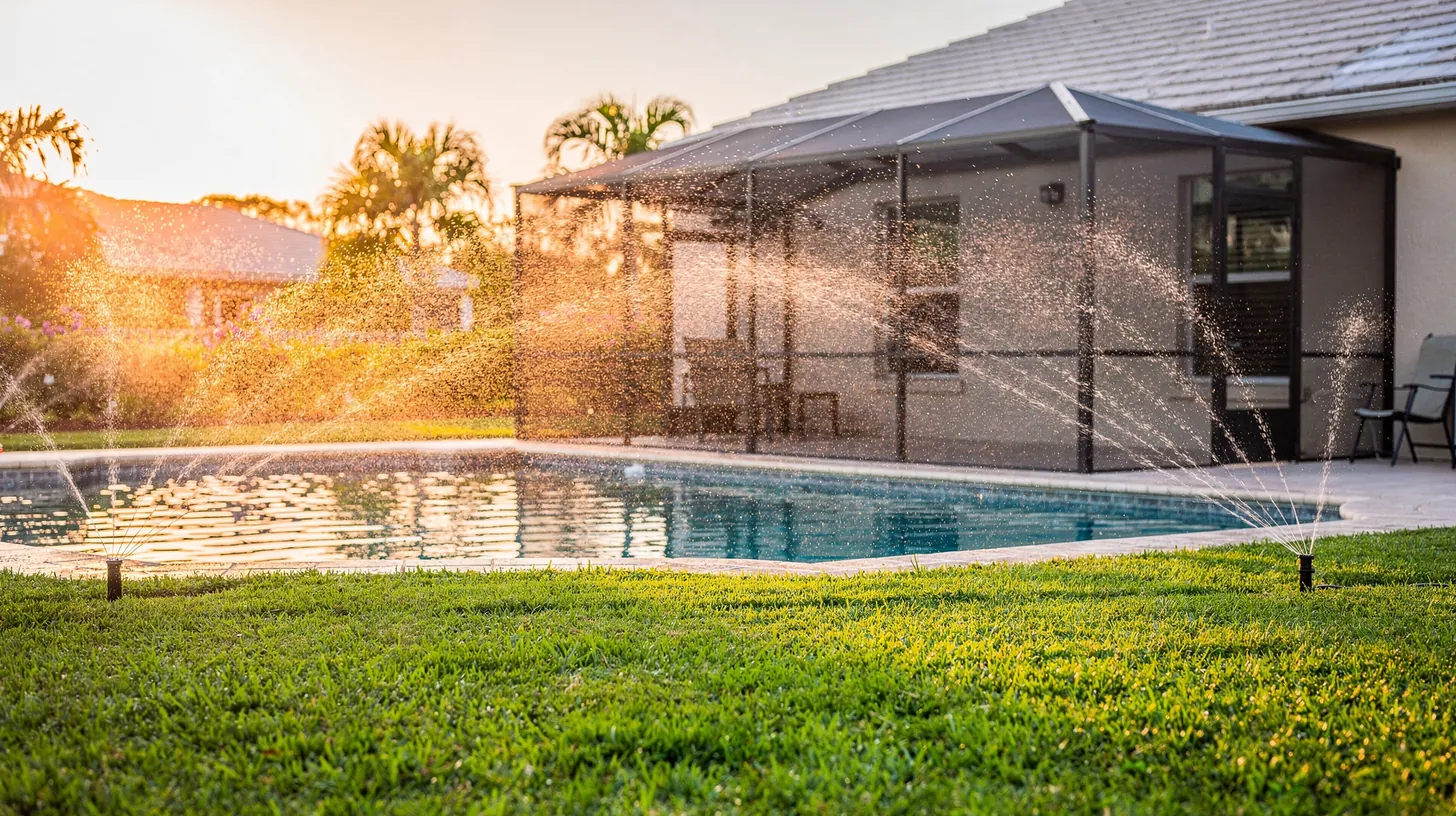
How can you tell if your property has reclaimed irrigation?
Start with the outlets. The rule says all reclaimed water valves and outlets "shall be appropriately tagged or labeled" with "Do not drink" in English and Spanish, and it keeps hose bibbs out of the open: they belong in locked vaults, service boxes or compartments, or in boxes that open only with a special tool (Florida Administrative Code Rule 62-610.469, 2021)1. A spigot in a labeled, lockable box near the irrigation valves is a strong sign that the irrigation is reclaimed.
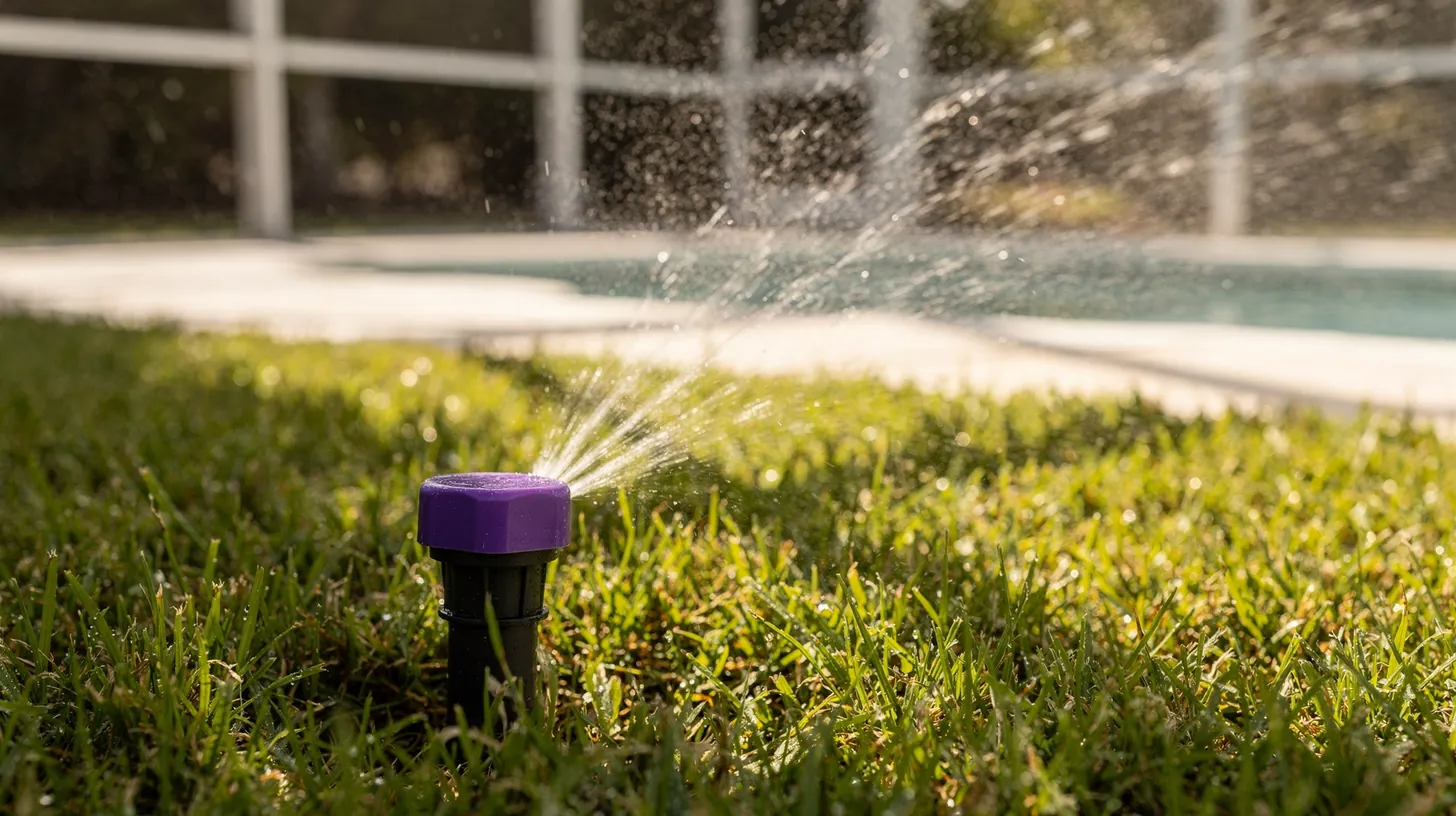
Then the color. Underground reclaimed piping on the distribution system that is not metal or concrete is color coded Pantone Purple 522C, and visible above-ground parts of that system must be clearly color coded or marked (Florida Administrative Code Rule 62-610.469, 2021)1. On private property, including homes, the same rule only recommends purple (Florida Administrative Code Rule 62-610.469, 2021)1. A white PVC irrigation line in a Naples yard can still carry reclaimed water.
In the City, reclaimed service comes through its own City-owned irrigation meter at the property line, and the City requires a backflow preventer on the drinking water meter before irrigation can be turned on (City of Naples Utilities, 2017)8. The City's reclaimed water page lists a Reclaimed Water Program contact for availability (City of Naples Utilities, 2026)6, and in a condominium or community, ask the association what the common irrigation carries.
What is the cross-connection risk of running a hose from an irrigation line?
The state rule is short: "No cross-connections to potable water systems shall be allowed" (Florida Administrative Code Rule 62-610.469, 2021)1. Collier County applies it directly to irrigation, stating that connecting an irrigation system to both irrigation quality (reclaimed) water and the drinking water system is "not only dangerous, but also illegal" (Collier County Water-Sewer District, 2024)13. A pool fill line or hose manifold that can draw from either supply makes the same link under the City code's definition, which covers any connection of the public supply with another water supply system (City of Naples Code of Ordinances, 2026)9.
The pool end is a risk too. Collier County says that without the proper vacuum breaker, a garden hose left submerged in a swimming pool is a cross-connection, because backflow can pull undesirable water into the drinking water supply (Collier County Public Utilities, 2026)12. The City of Naples code counts "swivel or changeable devices" and other temporary devices as cross connections when backflow could occur through them (City of Naples Code of Ordinances, 2026)9, wording broad enough to reach a hose on a quick-connect fitting.
The responsibility sits with the owner. The City code makes the customer responsible for eliminating or protecting every cross connection on the premises (City of Naples Code of Ordinances, 2026)9, and Collier County warns that a cross-connection could result in discontinuance of water service (Collier County Public Utilities, 2026)12. The County also says only a licensed plumber should change plumbing on a property where another source of water exists (Collier County Water-Sewer District, 2024)13.
My pool loses water every day. What should I do instead of using the irrigation line?
How much a Naples pool should lose to evaporation is its own question, and Naples pool evaporation month by month sets out what the measured South Florida data supports. How to tell a leak from evaporation walks through the bucket comparison, which needs no equipment and compares your pool against itself.
If the bucket says leak, the irrigation question goes away, because no top-off source fixes a hole. Every gallon added is a gallon the leak keeps taking, from whichever supply it came. That is the point to book pool leak detection in Naples before anything is drained or dug, and to plan the pool repair once the source is found.
Until then, refill from a drinking water spigot and stay with the hose. The City's watering table allows hoses for outdoor washing at any time when fitted with an automatic self-canceling or closing nozzle, and its restrictions are written for irrigation and cleaning; filling a pool is not one of the uses that table lists (City of Naples Code of Ordinances, 2026)9. Pull the hose out of the pool when the level is back.
What can legally refill a Naples pool, including after a new finish?
Tap water is the default. Collier County tap water and new pool plaster covers what the County and City supplies contain and what that means for a fresh finish. Where a property draws from its own well, well water and a new pool finish covers what to test before the water goes in.
A well and the City supply must stay apart. The City code makes it unlawful to connect any private water supply to the City water system in a way that permits intermingling (City of Naples Code of Ordinances, 2026)9, and the building code's backflow requirement applies to whichever supply fills the pool (Florida Building Code, Residential, 2023)15.
After a resurfacing the fill is part of the job, and the start-up month after a pool is resurfaced treats fill day as its own step. The fill source belongs in the planning for pool resurfacing in Naples, settled before the old finish comes out. Reclaimed irrigation water is not an option for it under the state rule (Florida Administrative Code Rule 62-610.469, 2021)1.
Ask Clayton
Questions this article usually prompts
Tap a question. Clayton replies himself, here and on the phone.
Tap a question to ask
If this is the situation you are in
Pool leak detection in Naples, with a finding before a shovel →References
- Florida Administrative Code Rule 62-610.469, Application/Distribution Systems and Cross-Connection Control (effective 1 April 2021), Florida Department of State
- Florida Administrative Code Rule 62-610.480, Other Reuse Applications (effective 1 April 2021), Florida Department of State
- Florida Administrative Code Rule 62-610.450, Description of System, Part III (effective 1 April 2021), Florida Department of State
- Florida Administrative Code Rule 62-610.460, Waste Treatment and Disinfection (effective 1 April 2021), Florida Department of State
- Florida Administrative Code Rule 62-600.200, Definitions (effective 16 January 2022), Florida Department of State
- City of Naples Utilities, Reclaimed Water, retrieved 15 November 2026
- City of Naples Utilities, Watering Restrictions, retrieved 15 November 2026
- City of Naples Utility Permits, Irrigation Meter Application (Reclaimed Water), form dated 26 May 2017
- City of Naples Code of Ordinances, Chapter 30 Utilities, Article II Water (Secs. 30-31, 30-68, 30-91, 30-96), Municode, retrieved 15 November 2026
- City of Naples, Overview of the Recently Completed Reclaimed Water System Expansion 2012-2017, City Council workshop presentation, 19 March 2018
- Collier County, Irrigation Water (Water Services), retrieved 15 November 2026
- Collier County, Meters and Backflows (Drinking Water), retrieved 15 November 2026
- Collier County Water-Sewer District, 2024 Drinking Water Quality Report (Cross-Connection Program)
- City of Marco Island, Wastewater Treatment (Reclaimed Water Production Facility), retrieved 15 November 2026
- 2023 Florida Building Code, Residential, 8th edition, Chapter 45: Private Swimming Pools (section R4501.9, Water Supply)
- U.S. Environmental Protection Agency, Summary of Florida's Water Reuse Guideline or Regulation for Landscaping, last updated 31 August 2026
The article is general.
Your pool is specific.
Tell us what the pool is doing, a sentence or two is enough. The person who wrote this is the person who calls back.