
Insights · Pumps, heaters and automation
Does Florida's energy code apply to your pool pump and heater?
Yes, in more ways than most replacement quotes mention. Florida law tells the state energy code to set the minimums for residential pool pumps and pool heaters (Florida Legislature, 2025) [5], and the 2023 code's pool section asks for an on-off switch at each heater, a time switch on heaters and pump motors, and a cover on outdoor heated pools, the last two with stated exceptions (Florida Building Commission, 2023) [1]. Federal rules cover the pump and motor by manufacture date. This guide reads each rule as written and ends with the questions to ask before a pump or heater is replaced.
 Clayton Waggoner, Owner and Managing Member, Florida license CPC1461352 · Published November 2, 2026 · 15 min read
The Florida energy code for pools is section R403.10 of the 2023 Florida Building Code, Energy Conservation, 8th Edition: a mandatory section, in an edition that adopts the 2021 International Energy Conservation Code with amendments, that sets heater switch, time switch, cover and heater efficiency rules for pools and permanent spas in five subsections (Florida Building Commission, 2023)1.
The short version
Does Florida's energy code apply to your pool pump and heater?
The chain starts in the statutes. Section 553.909 says the state energy code "shall set the minimum requirements for commercial or residential swimming pool pumps, swimming pool water heaters, and water heaters used to heat potable water," and that pool heaters, residential filtration pumps and pump motors manufactured and sold on or after December 31, 2011 for installation in Florida must comply with it (Florida Legislature, 2025)5.
That code is the 2023 Florida Building Code, Energy Conservation, 8th Edition, and its pool section, R403.10, is marked mandatory (Florida Building Commission, 2023)1. The City of Naples applies the 8th Edition to permit applications submitted on or after December 31, 2023 (City of Naples Building Department, retrieved 2026)12. A separate section, R403.12, says pools at detached one- and two-family homes and townhouses "shall be in accordance with PHTA-15," listed as ANSI/PHTA/ICC 15-2021 (Florida Building Commission, 2023)13. We did not read PHTA-15; your installer and the building official apply it beside R403.10.
Most owners meet the code at replacement. R501.7 says products replaced in existing buildings "for which a permit must be obtained" meet the code's minimum efficiencies, and its list names "Service water or pool heating systems" but not pumps, while R503.1 applies new construction provisions to the altered part only (Florida Building Commission, 2023)2. Whether a pump-only swap brings in the time switch rule is the building official's question.
The table puts each rule in this guide on one line, with what it applies to and the condition that changes it.
| Rule | Applies to | Exception or condition | Source |
|---|---|---|---|
| Heater on-off switch | The electric power to pool heaters: a readily accessible switch on the heater exterior or within 3 feet of it, in addition to the circuit breaker, that does not change the thermostat setting (Florida Building Commission, 2023)1 | No exception is printed in the subsection | FBC-EC 2023, R403.10.1 (Florida Building Commission, 2023)1 |
| No standing pilot | Gas-fired pool heaters, including heaters fired by natural or LP gas (Florida Building Commission, 2023)1 | No exception is printed | R403.10.1 and R403.10.4 (Florida Building Commission, 2023)1 |
| Gas and oil heater efficiency | Gas- and oil-fired pool and spa heaters manufactured on or after April 16, 2013: minimum thermal efficiency of 82 percent, tested to ANSI Z 21.56 (Florida Building Commission, 2023)1 | Federal law also sets 82 percent for gas-fired pool heaters manufactured before May 30, 2028 (U.S. Department of Energy, eCFR 2026)10 | R403.10.4 (Florida Building Commission, 2023)1; 10 CFR 430.32(k) (U.S. Department of Energy, eCFR 2026)10 |
| Heat pump heater efficiency | Heat pump pool heaters: minimum COP of 4.0 under AHRI 1160, Table 2, Standard Rating Conditions, Low Air Temperature, with an independent laboratory test report (Florida Building Commission, 2023)1 | Geothermal swimming pool heat pumps are not required to meet it (Florida Building Commission, 2023)1 | R403.10.5 (Florida Building Commission, 2023)1 |
| Time switch | Heaters and pump motors: a time switch or other control that can automatically turn off and on by a preset schedule; built-in time switches comply (Florida Building Commission, 2023)1 | Not required where public health standards require 24-hour pumping, for pumps that run solar and waste-heat-recovery pool heating, or for pumps powered only by onsite renewable generation (Florida Building Commission, 2023)1 | R403.10.2 (Florida Building Commission, 2023)1 |
| Cover | Outdoor heated pools and outdoor permanent spas: a vapor-retardant cover, a liquid cover or other means proven to reduce heat loss (Florida Building Commission, 2023)1 | Not required where more than 70 percent of the heating energy over an operation season is site-recovered, such as from a heat pump or solar (Florida Building Commission, 2023)1 | R403.10.3 (Florida Building Commission, 2023)1 |
| Replacement heater efficiency | Pool heating systems installed or replaced in existing buildings where a permit must be obtained meet the code minimums (Florida Building Commission, 2023)2 | Pool pumps are not named in the list (Florida Building Commission, 2023)2 | R501.7 (Florida Building Commission, 2023)2 |
| PHTA-15 for single-family pools | Pools and permanent spas at detached one- and two-family homes and townhouses three stories or less, for the household and its guests (Florida Building Commission, 2023)1 | Listed as ANSI/PHTA/ICC 15-2021; not read for this guide (Florida Building Commission, 2023)3 | R403.12 (Florida Building Commission, 2023)1 |
| Federal pool pump standard | Dedicated-purpose pool pumps, other than submersibles, manufactured starting July 19, 2021: a minimum weighted energy factor (U.S. Department of Energy, eCFR 2026)6 | Applies by manufacture date; nothing read requires removing an installed pump (U.S. Department of Energy, eCFR 2026)6 | 10 CFR 431.465(f) (U.S. Department of Energy, eCFR 2026)6 |
| Federal replacement motor standard | Pool pump motors of 0.5 THP and up: variable speed control, for motors manufactured from September 29, 2025 at 1.15 to 5 THP and from September 28, 2027 at 0.5 to under 1.15 THP (U.S. Department of Energy, eCFR 2026)7 | Motors under 0.5 THP manufactured from September 29, 2025 need a full-load efficiency of at least 69 percent instead (U.S. Department of Energy, eCFR 2026)7 | 10 CFR 431.485 (U.S. Department of Energy, eCFR 2026)7 |
What does the code require on every pool heater?
R403.10.1 asks for "a readily accessible on-off switch that is an integral part of the heater mounted on the exterior of the heater, or external to and within 3 feet (914 mm) of the heater" (Florida Building Commission, 2023)1. Operating it "shall not change the setting of the heater thermostat," and it is in addition to the heater's circuit breaker, so the breaker does not count as the switch (Florida Building Commission, 2023)1.
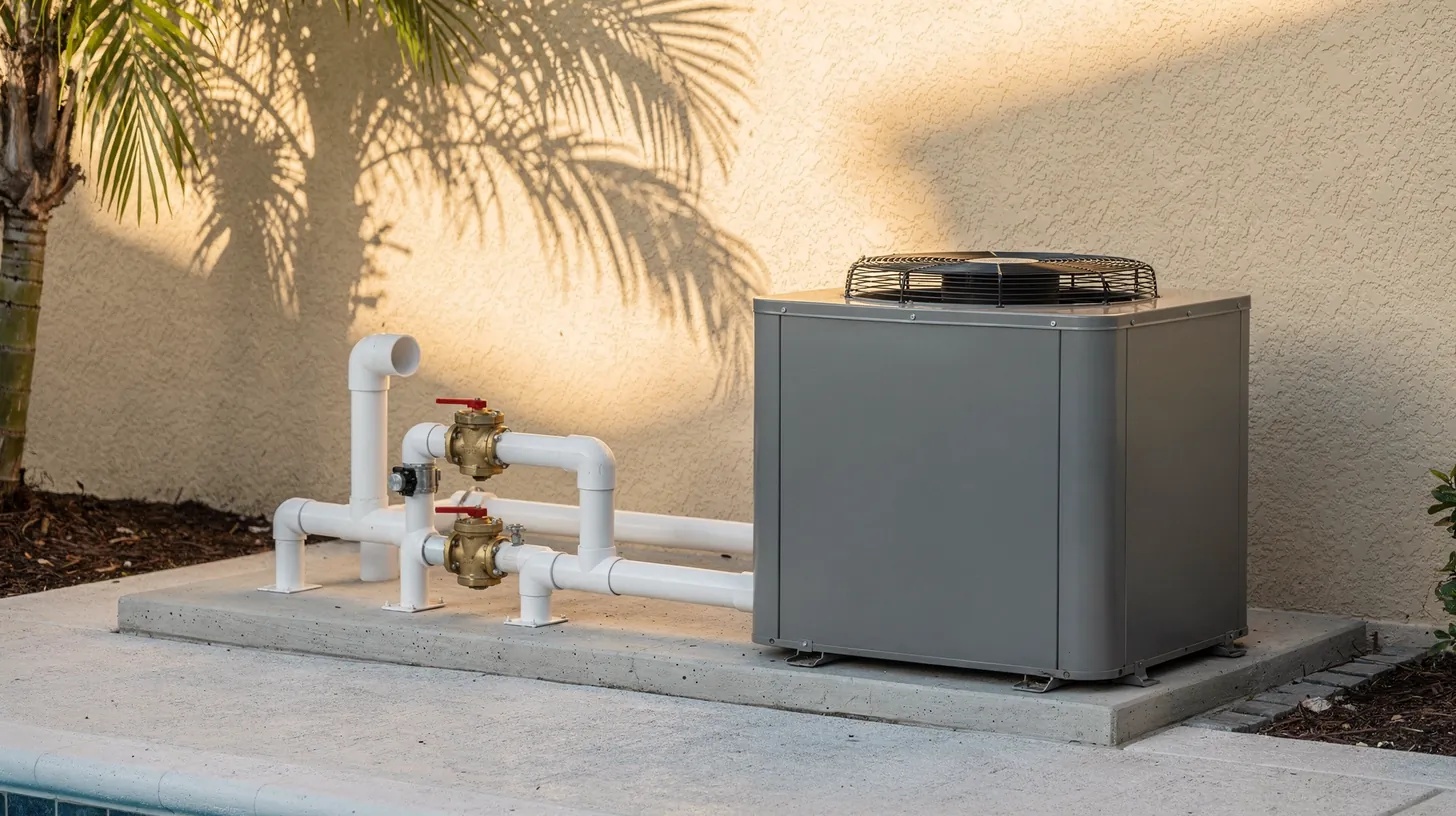
The pilot rule appears twice: R403.10.1 bars continuously burning ignition pilots on gas-fired heaters, and R403.10.4 repeats it for pool heaters fired by natural or LP gas (Florida Building Commission, 2023)1. The plain test for an owner is whether a flame burns while the heater is not heating.
The switch is the item an owner can check by eye on installation day. Gas pool heater installation and heat pump pool heaters cover how each type is fitted, and the switch question belongs on both quotes.
How efficient does a replacement pool heater have to be?
R403.10.4 applies the 82 percent figure "when tested in accordance with ANSI Z 21.56," and 10 CFR 430.32(k)(1) sets the same floor federally for gas-fired pool heaters manufactured on and after April 16, 2013 and before May 30, 2028 (Florida Building Commission, 2023; U.S. Department of Energy, eCFR 2026)110.
R403.10.5 sets the heat pump COP of 4.0 under AHRI 1160, Table 2, Standard Rating Conditions, Low Air Temperature, requires a test report from an independent laboratory, and exempts geothermal swimming pool heat pumps (Florida Building Commission, 2023)1. The COP is a rating at a stated test condition, which is why the code asks for the report.
Federal pool heater standards have applied to manufacturers since 1990, and amended standards are required from May 30, 2028 (U.S. Department of Energy, 2025)9, when the federal measure becomes integrated thermal efficiency (U.S. Department of Energy, eCFR 2026)10. The 2028 values are not quoted here; that table did not come through in the text we read.
R501.7 is what ties these numbers to a permitted replacement in an existing home (Florida Building Commission, 2023)2. Why a pool heater is not keeping up covers the question that comes first: whether the old heater needs replacing at all.
Are time switches required on pumps and heaters?
R403.10.2 is two sentences long. The first is the requirement; the second says heaters and pump motors that have built-in time switches "shall be in compliance with this section" (Florida Building Commission, 2023)1. A pump whose own control can run it on a schedule is the case that second sentence describes.
The exceptions are narrower than they sound: "Where public health standards require 24-hour pump operation," "Pumps that operate solar- and waste-heat-recovery pool heating systems," and pumps "powered exclusively from onsite renewable generation" (Florida Building Commission, 2023)1. A home pump on grid power with no solar heating loop matches neither of the last two, and the rule does not carve out booster, cleaner or water feature pumps (Florida Building Commission, 2023)1.
A federal timer rule exists too, for a narrow group: integral cartridge filter and integral sand filter pool pumps manufactured starting July 19, 2021 must ship with a pool pump timer, a control that turns the pump off after a run-time of no longer than 10 hours (U.S. Department of Energy, eCFR 2026)6. The Florida rule is the broader one.
Does automation count as the time switch?
The code never names automation; its test is capability (Florida Building Commission, 2023)1. The question is whether every heater and pump motor on the pad runs through a control that can schedule it. A panel that schedules the filter pump but leaves a booster pump or the heater on a plain switch covers only part of the equipment. Ask for a list of what is on the schedule.
Freeze protection is the other setting worth knowing. A federally covered pool pump sold with freeze protection controls must ship with them disabled, or with user-adjustable defaults of no more than 40 F air temperature, no more than 1 hour of run time before the temperature is rechecked, and no more than half the maximum motor speed (U.S. Department of Energy, eCFR 2026)6.
Pool automation installation covers how we set schedules for houses that sit empty part of the year, and whether a variable speed pump is worth it covers running hours and the efficiency rating.
Do heated pools need a cover?
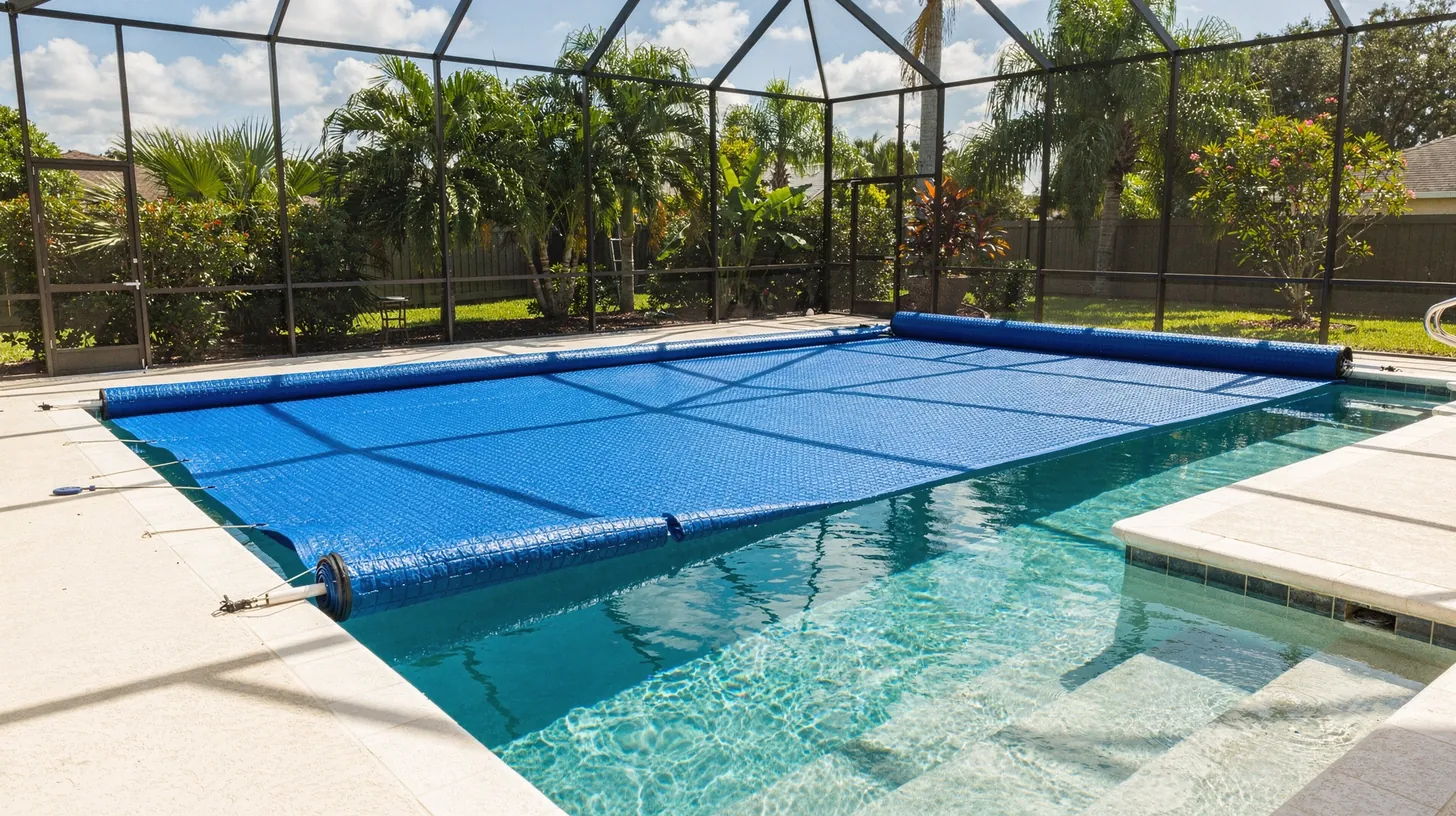
The cover rule, R403.10.3, is wider than a solid sheet on the water: a liquid cover is named as an equal option, and so is any other means proven to reduce heat loss (Florida Building Commission, 2023)1. An unheated pool is outside the rule. The text read for this guide does not say how a pool under a screen enclosure is classed, so if yours is caged, ask the building official.
The exception is where heat pumps come in, and it carries a condition. The heat pump is the code's example of a site-recovered source, not an automatic pass: the test is whether more than 70 percent of the season's heating energy is site-recovered, and someone has to compute it (Florida Building Commission, 2023)1. A heat pump with gas backup depends on how the season's heat splits between the two.
Whether a cover is worth using in a Naples winter, rule aside, is covered in how cold a Naples pool gets in winter.
Can a single-speed pump still be installed?
A dedicated-purpose pool pump includes pool filter pumps, waterfall pumps, pressure cleaner booster pumps, integral filter pool pumps and electric spa pumps, and each non-submersible one manufactured starting July 19, 2021 must meet a minimum weighted energy factor, or WEF (U.S. Department of Energy, eCFR 2026)6. That is an efficiency floor, not a motor type.
DOE's own reading, in its 2023 motor rule, is that the pump standard "would likely require" variable speed motors in standard-size self-priming pool pumps, a line at roughly 1.15 total horsepower, about 0.711 hydraulic horsepower (U.S. Department of Energy, 2023)8. The word "likely" is DOE's. The same rule notes that motor-only replacements are common and that the pump standard does not cover motors sold alone (U.S. Department of Energy, 2023)8.
So motors got their own rule. Under 10 CFR 431.485, pool pump motors of 1.15 to 5 THP made from September 29, 2025, and of 0.5 to under 1.15 THP made from September 28, 2027, must be variable speed control motors; motors under 0.5 THP made from September 29, 2025 need a full-load efficiency of at least 69 percent (U.S. Department of Energy, eCFR 2026)7.
None of that orders an installed pump out; it governs what is manufactured from those dates (U.S. Department of Energy, eCFR 2026)67. No Florida pump speed rule appears in the energy code's residential chapter or the pool chapter of the 2023 residential code (Florida Building Commission, 2023)14; PHTA-15, unread, is the one place one could sit. Pool pump replacement and whether a failing pump is repairable cover the practical side.
Who checks any of this?
The city's building FAQ says it "does require a permit and inspection of replacement pool heaters," and that this includes gas heaters, heat pumps and solar systems (City of Naples Building Department, retrieved 2026)11. That answer covers heaters, not pumps, so put a pump-only job to the building department directly.
The permit is what carries the efficiency rules to a replacement, through R501.7 (Florida Building Commission, 2023)2, and the inspection puts someone other than the installer in front of the equipment pad. If your address is outside the city, the city's FAQ is not your answer, and we did not read any other office's position for this guide. Pool permits in the City of Naples and on Marco Island explains how to tell which office covers you.
What should you ask an installer?
On the heater: confirm the switch is on the exterior or within 3 feet and separate from the breaker, that a gas heater has no continuously burning pilot, and ask for the rated thermal efficiency, or for a heat pump the COP and the laboratory report (Florida Building Commission, 2023)1.
On controls: ask what turns each heater and pump motor off and on by a preset schedule, what on the pad is not on it, and which exception applies to anything left off (Florida Building Commission, 2023)1.
On the cover: for an outdoor heated pool, ask which accepted means is planned, or, if the installer relies on the exception of more than 70 percent site-recovered energy, how that share was computed (Florida Building Commission, 2023)1.
On the pump and the paperwork: ask for the WEF and motor total horsepower the federal rule puts on the nameplate (U.S. Department of Energy, eCFR 2026)6, the manufacture date, and whether a permit is being pulled. A quote that names these items is not padding. A quote that leaves them out has not answered them.
Placement and sound are a separate, local question, covered in pool heat pump noise rules in Naples.
Ask Clayton
Questions this article usually prompts
Tap a question. Clayton replies himself, here and on the phone.
Tap a question to ask
If this is the situation you are in
Pool pump replacement in Naples, programmed not just installed →Pool heat pumps, which genuinely work in this climate →Gas pool heater installation, sized to the whole run →Pool automation, for a house that sits empty half the year →References
- Florida Building Commission, 2023 Florida Building Code, Energy Conservation, 8th Edition, Chapter 4 Residential Energy Efficiency, R403.10 Pools and Permanent Spa Energy Consumption and R403.12 (text via UpCodes)
- Florida Building Commission, 2023 Florida Building Code, Energy Conservation, 8th Edition, Chapter 5 Existing Buildings, R501.7 and R503.1 (text via UpCodes)
- Florida Building Commission, 2023 Florida Building Code, Energy Conservation, 8th Edition, Chapter 6 Referenced Standards, PHTA entry (text via UpCodes)
- Florida Building Commission, 2023 Florida Building Code, Residential, Chapter 45 Private Swimming Pools (text via UpCodes)
- Florida Legislature, The 2025 Florida Statutes, Section 553.909, Setting requirements for appliances; exceptions
- U.S. Department of Energy, 10 CFR Part 431 Subpart Y, Dedicated-Purpose Pool Pumps: 431.462 definitions, 431.465 standards, 431.466 labeling (eCFR, up to date as of October 29, 2026)
- U.S. Department of Energy, 10 CFR 431.485, Energy conservation standards for dedicated-purpose pool pump motors, Subpart Z (eCFR, up to date as of October 29, 2026; source 88 FR 67041, September 28, 2023)
- U.S. Department of Energy, Energy Conservation Standards for Dedicated Purpose Pool Pump Motors, final rule, EERE-2017-BT-STD-0048, RIN 1904-AF27 (pre-publication copy signed July 27, 2023)
- U.S. Department of Energy, Consumer Pool Heaters, Appliance and Equipment Standards (page modified January 16, 2025)
- U.S. Department of Energy, 10 CFR 430.32(k), Pool heaters (eCFR, up to date as of October 29, 2026)
- City of Naples Building Department, Frequently Asked Questions, Building, retrieved November 1, 2026
- City of Naples Building Department, Building, retrieved November 1, 2026

The article is general.
Your pool is specific.
Tell us what the pool is doing, a sentence or two is enough. The person who wrote this is the person who calls back.