
Insights · Naples and Collier County
Is Marco Island tap water different for a new pool finish?
Marco Island does not drink the same water as Naples. The City runs its own utility, with its own two plants, its own mix of mainland surface water and island groundwater, and its own way of putting the two together. For a new plaster or pebble finish, that mix is the first water the surface ever touches. This post reads what the City publishes about it, sets it beside the Collier County and City of Naples figures, and says plainly where the published record stops.
 Clayton Waggoner, Owner and Managing Member, Florida license CPC1461352 · Published November 18, 2026 · 18 min read
Fill water is the water that goes into a pool after a new interior finish is installed, usually from a hose on the house supply. On Marco Island that supply is a blend of lime-softened surface water and reverse osmosis groundwater (City of Marco Island, retrieved 2026)2. For a cement-based finish it matters because the National Plasterers Council recommends fill water above 200 ppm calcium hardness (National Plasterers Council, 2025)9.
The short version
Is Marco Island tap water different for a new pool finish?
This post was built from the City's own documents: its 2025 Water Quality Report (City of Marco Island, 2025)1, the 2024 report before it (City of Marco Island, 2024)3, its Drinking Water Treatment page (City of Marco Island, retrieved 2026)2, and the last Marco Shores report it published (City of Marco Island, 2020)4.
EPA's drinking water registry lists the utility as Marco Island Utilities (City of), a community water system serving 31,830 people through 10,301 service connections (U.S. EPA, 2026)6. Collier County (Collier County Water-Sewer District, 2024)7 and the City of Naples (City of Naples Utilities Division, 2024)8 each publish their own, separate reports.
The general chemistry, why water short on calcium works on a young cement surface, is set out in why Collier County tap water is hard on a new plaster finish, and the Lee County version is in the Bonita Springs, Estero and Fort Myers fill water guide. This one stays on what is particular to the island: two plants, two very different source waters, and a blend whose hardness the City describes but does not print.
Where does Marco Island's water come from, and how is it blended?
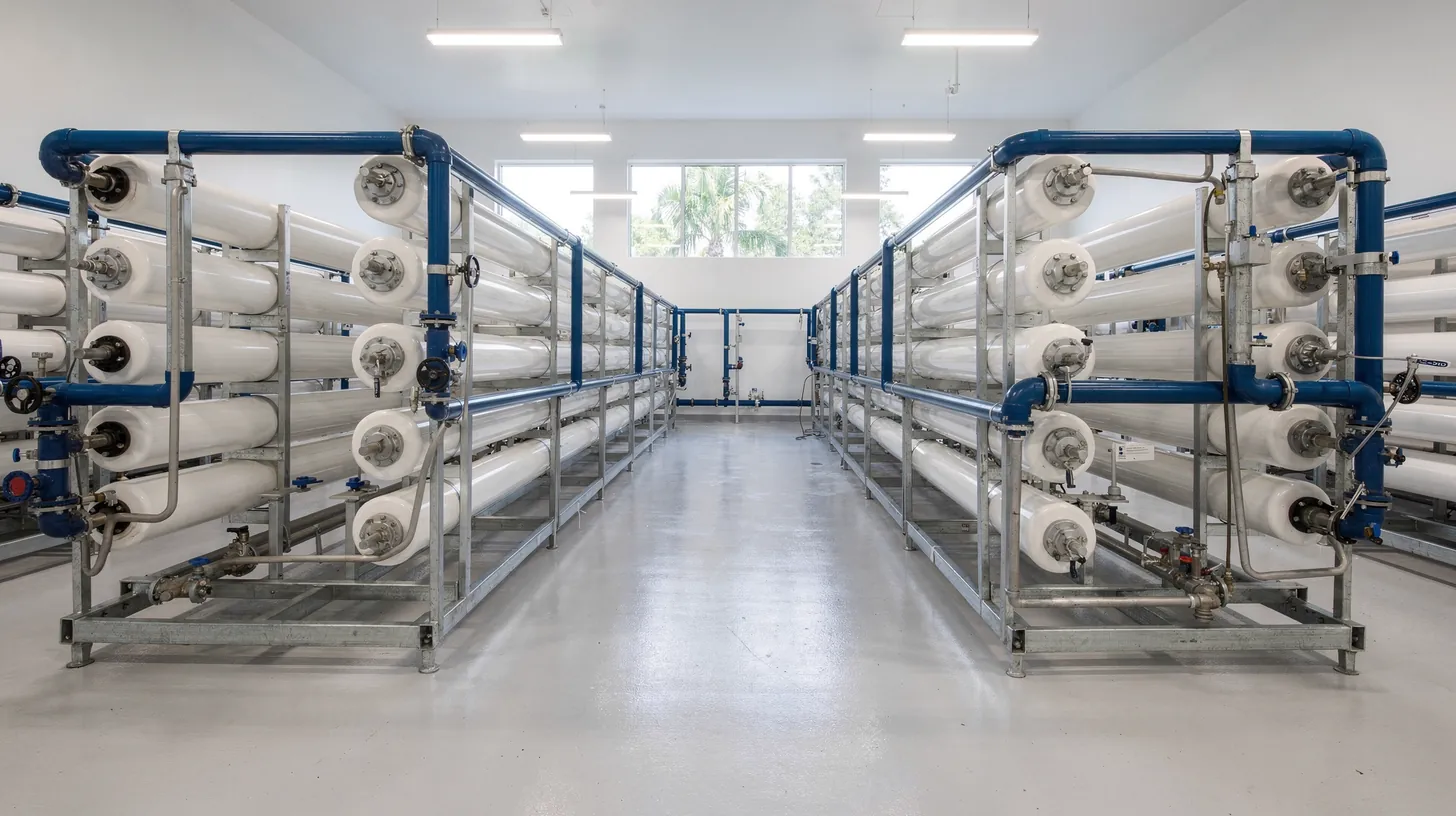
The North Water Treatment Plant has a permitted capacity of 6.67 million gallons a day and treats raw surface water pumped from the Source Water Facility (City of Marco Island, retrieved 2026)2. The water is mixed with hydrated lime and alum in a lime reactor, which makes bicarbonate precipitate and settle out, and the effluent then passes through a low-pressure hollow-fiber membrane system for polishing (City of Marco Island, retrieved 2026)2.
The South Water Treatment Plant has a permitted capacity of 6.0 million gallons a day, and to produce that it needs 8 to 8.2 million gallons a day of raw water from the 18 brackish wells on the island (City of Marco Island, retrieved 2026)2. That water is filtered, dosed with a scale inhibitor and sulfuric acid, pushed through six dual-stage reverse osmosis trains, and degassed to remove hydrogen sulfide (City of Marco Island, retrieved 2026)2.
The blend is described in one passage. The North plant treats approximately 75% of the City's potable water, but only 33% enters the distribution system from the North plant, because typically 3 to 3.5 million gallons a day of lime-softened water is pumped to the South plant and blended there with its reverse osmosis water (City of Marco Island, retrieved 2026)2.
There is a seasonal piece as well. The City stores water underground in Aquifer Storage and Recovery wells during the rainy months and recovers it during the dry winter months (City of Marco Island, 2025)1. The treatment page carries no date, so its percentages describe the plants as the City presents them today, not a measured year.
What do the City's own reports say about hardness?
The City defines the term on the same page: water hardness means calcium and magnesium ions, and the raw surface water is lime-softened to reduce it (City of Marco Island, retrieved 2026)2. That definition matters for a pool, because the start-up card works in calcium hardness (National Plasterers Council, 2021)12, and on the City's own definition calcium is only part of the total it quotes.
The 120 to 140 mg/L figure is the City's number for water leaving the North plant. The City says only 33% of its water enters the distribution system from that plant, and the rest goes out from the South plant after blending with reverse osmosis water (City of Marco Island, retrieved 2026)2. It does not publish what the mixture measures or what any one address receives. This post does not estimate it. The City gives its flows as typical, and a typical ratio is not a number for one street on one day.
The annual reports confirm the gap. The 2025 report has no hardness, pH, alkalinity or calcium row (City of Marco Island, 2025)1, and neither do the 2024 report (City of Marco Island, 2024)3 or the 2023, 2019 and 2017 reports in the City's library (City of Marco Island, retrieved 2026)14.
One comparison can fairly be drawn from the City's own figure. The City's report treats ppm and mg/L as the same unit (City of Marco Island, 2025)1, so even the lime-softened stream, at 120 to 140 mg/L total hardness (City of Marco Island, retrieved 2026)2, sits below the 200 ppm calcium hardness the National Plasterers Council recommends for fill water (National Plasterers Council, 2025)9. What the blend does to that figure is the question a test at the hose answers.
How does Marco Island water compare with Collier County and City of Naples water?
The table sets out what each report prints, with the year it covers. The first thing it shows is that the comparison cannot be made on delivered hardness, because only two of the three utilities print it. On the scale Collier and Naples both publish, 61 to 120 mg/L is moderately hard and 121 to 180 mg/L is hard (Collier County Water-Sewer District, 2024)7, so Marco's lime-softened stream at 120 to 140 mg/L straddles that line before blending (City of Marco Island, retrieved 2026)2. Nothing printed says where the blend lands.
The second is the disinfectant. Marco listed chloramines at a level of 3.07 ppm in 2025 (City of Marco Island, 2025)1, Collier 3.4 ppm in 2024 (Collier County Water-Sewer District, 2024)7, and Naples 2.97 ppm in 2024 (City of Naples Utilities Division, 2024)8. A fill from any of the three arrives carrying chlorine already combined with ammonia, not the free chlorine a pool runs on.
Sodium is printed by all three: 56.0 ppm on Marco in the 2025 report (City of Marco Island, 2025)1, 57.8 ppm in Collier's 2024 report (Collier County Water-Sewer District, 2024)7 and 32.9 ppm in Naples' 2024 report (City of Naples Utilities Division, 2024)8. None of the reports says anything about pools, and this post draws no conclusion about a finish from a sodium figure.
| Utility and report year | Source water | Treatment | Hardness as printed | Disinfectant as printed | Sodium as printed |
|---|---|---|---|---|---|
| City of Marco Island (Marco Island Utilities), 2025 report (City of Marco Island, 2025)1 | Surface water from a source water facility on the mainland and brackish Floridan Aquifer groundwater (City of Marco Island, 2025)1; 18 brackish wells on the island (City of Marco Island, retrieved 2026)2 | Lime softening and membrane polishing at the North plant, reverse osmosis at the South plant, blended at the South plant (City of Marco Island, retrieved 2026)2 | No delivered figure (City of Marco Island, 2025)1. Treatment page: raw surface water 400 mg/L, North plant output 120 to 140 mg/L before blending (City of Marco Island, retrieved 2026)2 | Chloramines, level detected 3.07 ppm, results 0.80 to 5.0 ppm (City of Marco Island, 2025)1 | 56.0 ppm (City of Marco Island, 2025)1 |
| Collier County Water-Sewer District, 2024 report (Collier County Water-Sewer District, 2024)7 | Hawthorn and Golden Gate Tamiami wellfields (Collier County Water-Sewer District, 2024)7 | Nanofiltration and reverse osmosis at the North Plant, lime softening and reverse osmosis at the South Plant (Collier County Water-Sewer District, 2024)7 | 67 mg/L average, 42 to 94 mg/L range (Collier County Water-Sewer District, 2024)7 | Chloramines, 3.4 ppm, results 1.6 to 4.1 ppm (Collier County Water-Sewer District, 2024)7 | 57.8 ppm (Collier County Water-Sewer District, 2024)7 |
| City of Naples Utilities Division, 2024 report (City of Naples Utilities Division, 2024)8 | Lower Tamiami Aquifer through 51 wells (City of Naples Utilities Division, 2024)8 | Lime softening and filtration (City of Naples Utilities Division, 2024)8 | 67 mg/L average, 58 to 102 mg/L range (City of Naples Utilities Division, 2024)8 | Chloramines, 2.97 ppm, results 0.40 to 4.70 ppm (City of Naples Utilities Division, 2024)8 | 32.9 ppm (City of Naples Utilities Division, 2024)8 |
What disinfectant is in Marco Island tap water, and does it ever change?
The 2024 report listed chloramines at a level of 3.19 ppm, with results from 1.0 to 4.8 ppm (City of Marco Island, 2024)3. The City reports no violation for chloramines in either year (City of Marco Island, 2025)1 (City of Marco Island, 2024)3.
For a new finish, the practical point is what a test reads on fill day. The start-up card says DO NOT add chlorine for 48 hours, then on Day 3 bring chlorine to 1.5 to 3.0 ppm (National Plasterers Council, 2021)12. A total chlorine reading before then is the utility's residual, not chlorine anyone added. This post makes no claim that chloramine harms a finish, because none of the documents read for it says so.
The disinfectant does not always stay the same. In September 2024 WGCU reported the City's annual temporary modification of the disinfection process for Marco Island and Marco Shores, with the water disinfected by free chlorine rather than chloramines and the distribution system flushed at the same time (WGCU, 2024)13. That news report is the only record read for this post, because the City's own notice is no longer online.
So this post gives no dates for the next switch. Before a fill date is set, call the City at (239) 394-3880, the number its water report gives for questions about the utility, and ask whether a disinfection change or flush is scheduled (City of Marco Island, 2025)1. The National Plasterers Council says the finish is especially susceptible to staining, scaling and discoloration within the first 28 days (National Plasterers Council, 2025)10, which is the wrong window to discover that the fill water changed.
Does Marco Shores get the same water as Marco Island?
Marco Shores used to be its own water system. The City's report library holds separate Marco Shores reports through 2020 (City of Marco Island, retrieved 2026)14, under system number 5110182 (City of Marco Island, 2020)4. EPA's registry lists that system as inactive, with a deactivation date of January 17, 2020 and a last recorded population of 1,647 people through 533 service connections (U.S. EPA, 2026)5.
The City's current reports cover both communities. The 2025 report says the City operates the treatment and distribution system serving Marco Island and Marco Shores (City of Marco Island, 2025)1, and the 2024 report says the same (City of Marco Island, 2024)3. The City's report library holds no Marco Shores report after 2020 (City of Marco Island, retrieved 2026)14, so a Marco Shores owner reads the island report.
One detail survives from the old arrangement. The 2020 report says the ability to connect to the Collier County system remains if needed in the case of an emergency (City of Marco Island, 2020)4. That is a contingency rather than normal supply, but it is one more reason the number that matters is the one measured at the hose on fill day.
Communities near the island are a separate question. None of the documents read for this post says which utility serves an address off the island outside Marco Shores, so the water bill is the place to check before assuming the island's water is the water in the hose.
What does low-hardness or reverse osmosis water do to new plaster?
The Council's white paper explains the mechanism. Water that is deficient in calcium, in contact with a material source of calcium, can dissolve or leach calcium from it (National Plasterers Council, 2025)9. A new cement finish releases an excess of calcium hydroxide as it cures, and that release is normal and not deleterious, but soft or low-calcium water in contact with the finish early on can leach calcium hydroxide from the upper surface beyond that excess and weaken the cement binder there (National Plasterers Council, 2025)9.
The Council says the resulting damage can range from severe discoloration to a weakened cement binder and a reduced service life (National Plasterers Council, 2025)9. Its fill water bulletin names low pH, low calcium hardness and low alkalinity as the cause of deterioration, the first of three common problems, ahead of scale and metal staining (National Plasterers Council, 2019)11.
The City's supply is not straight reverse osmosis water. It is a blend that includes reverse osmosis water and lime-softened water (City of Marco Island, retrieved 2026)2, while the Council's warning is about soft and reverse osmosis water as such (National Plasterers Council, 2025)10. The unanswered part is what the blend measures, and the Council's bulletin says testing fill water should no longer be an option (National Plasterers Council, 2019)11.
When a test comes back low, the white paper's options include another water source such as a hydrant or trucked water, dosing calcium chloride as the pool fills, or sealing the surface and raising calcium hardness as soon as the pool is full (National Plasterers Council, 2025)9. The start-up card says a negative saturation index will cause leaching, etching or discoloration (National Plasterers Council, 2021)12; how that index is built is in what a Naples pool water test should check.
What should you ask the contractor about fill and start-up on Marco Island?
The first question has a yes or no answer. The Council says to test fill water for pH, total alkalinity, calcium hardness and metals and to record the results (National Plasterers Council, 2025)10, prior to usage or immediately after the pool is full (National Plasterers Council, 2019)11. On Marco, where the City prints no hardness for the blend (City of Marco Island, 2025)1, that test is the only hardness number the job will have.
The second has a known shape. The start-up card raises low calcium hardness to 80 to 100 ppm on Day 1 and 100 to 150 ppm on Day 2, then to a minimum of 200 ppm from Day 4, dissolved and added in 10 lb increments separated by several hours and never together with alkalinity increaser (National Plasterers Council, 2021)12. A contractor who works that way will describe the sequence without being asked.
The third is about ownership. The Council says the water is typically started by the plastering company and that the party performing the initial start-up should be determined in advance (National Plasterers Council, 2025)10. The window that matters is the first 28 days, when the finish is especially susceptible to staining, scaling and discoloration (National Plasterers Council, 2025)10. The month is set out day by day in what happens after a pool is resurfaced.
The fourth is particular to the island. Ask whether anyone has called the City at (239) 394-3880 about the fill date (City of Marco Island, 2025)1, because the 2024 switch to free chlorine came with a flush of the distribution system (WGCU, 2024)13. Salt pools add one more step: the card says not to add salt within the first 30 days (National Plasterers Council, 2021)12, and whether a new plaster finish belongs in a salt pool covers the rest.
A Marco resurfacing follows the same sequence as any pool resurfacing in Naples, with the fill tested for the island's own water. The rest of what changes for a pool on the island is on the Marco Island pool contractor page.
Ask Clayton
Questions this article usually prompts
Tap a question. Clayton replies himself, here and on the phone.
Tap a question to ask
If this is the situation you are in
Pool resurfacing in Naples, including the part everyone skips →Pool remodeling in Naples, handled as one project →Pool repair in Naples, diagnosed before it is quoted →Spa remodels and new attached spas in Naples →References
- City of Marco Island, 2025 Water Quality Report, Marco Island Service Area, PWS ID 5110183
- City of Marco Island, Drinking Water Treatment (North and South Water Treatment Plants), undated, retrieved 15 November 2026
- City of Marco Island, 2024 Water Quality Report, Marco Island Service Area, PWS ID 5110183
- City of Marco Island, Marco Shores Water Service Area 2020 Water Quality Report, PWS ID 5110182
- U.S. Environmental Protection Agency, Envirofacts SDWIS, water system record for Marco Shores Utilities (FL5110182), as served 15 November 2026
- U.S. Environmental Protection Agency, Envirofacts SDWIS, water system record for Marco Island Utilities (City of) (FL5110183), as served 15 November 2026
- Collier County Water-Sewer District, Annual Water Quality Report, 2024 data year, report dated 23 May 2025
- City of Naples Utilities Division, Annual Water Quality Report (Consumer Confidence Report), 2024 data year, PWSID 5110198
- National Plasterers Council, White Paper 7: Avoiding Soft Water or Water with a Low Calcium Hardness (file dated 8.8.25)
- National Plasterers Council, White Paper 6: Tips on Filling the Pool and Initial Start Up (file dated 2.27.25)
- National Plasterers Council, Technical Bulletin #1: Testing Fill Water, revised January 2019
- National Plasterers Council, NPC Pool Start-up Card, REV 03-2021
- WGCU, Annual modification to water disinfection now underway in Marco Island, Marco Shores area, 5 September 2024 (news report, cited for what happened)
- City of Marco Island, document library, Water and Sewer, Consumer Confidence Report folder (reports 2017 to 2025), retrieved 15 November 2026

The article is general.
Your pool is specific.
Tell us what the pool is doing, a sentence or two is enough. The person who wrote this is the person who calls back.